

How Do You Maintain Water Quality in Bait Tanks?
Last Updated: November 13, 2026
Quick Summary
Maintaining bait tank water comes down to four things: oxygen, temperature, waste, and crowding. Keep dissolved oxygen above roughly 5 mg/L, replace a quarter to a third of the volume every few hours on the water, and match replacement water temperature before adding it. Treat municipal tap water to remove chlorine and chloramine, and cut your bait load in half in warm weather.
- Low dissolved oxygen is the number one killer in home bait tanks.
- Below 3 mg/L dissolved oxygen is an emergency; above roughly 5 mg/L is a reasonable target.
- Keep pH roughly 6.5-8.5 and ammonia as close to zero as possible.
- Dechlorinate municipal tap water in the bucket, not in the tank.
- A 30-gallon tank at a one-third change means about 10 gallons swapped.
Table of Contents
- Why Bait Tank Water Quality Decides Whether Your Baitfish Survive
- Bait Tank Aeration: Keeping Dissolved Oxygen Above the Danger Line
- Baitfish Stocking Density: How Many Baitfish Can Your Tank Hold?
- Bait Tank Water Changes: How Often and How Much to Swap
- Bait Tank Water Treatment: Safe Water, Salt, and What to Avoid
- Tank Cleaning and Waste Removal: Scrubbing Out Grime and Solid Waste
- Troubleshooting Cloudy Water, Gasping Baitfish, and Temperature Shock
- Stocking Blue River Carp Bait for Your Next Catfish Trip
- Frequently Asked Questions
Why Bait Tank Water Quality Decides Whether Your Baitfish Survive
Baitfish die in dirty water faster than they die from almost anything else. Maintaining water quality in bait tanks comes down to four things: oxygen, temperature, waste, and crowding. Get those right, and your minnows or shiners stay lively from the bait shop to the hook.
Here is the part most anglers learn the hard way. A bait tank is a closed system. Nothing refreshes itself. Every fish you add eats, breathes, and produces waste in the same small volume of water. Skip the maintenance and that water turns against them.
Live bait deserves careful handling. Below, we break down each piece of the puzzle, from aeration to water changes, so your bait load survives the day.
Bait Tank Aeration: Keeping Dissolved Oxygen Above the Danger Line
Dissolved oxygen is the amount of oxygen available in your tank water. Baitfish need it constantly, and low oxygen is the number one killer in home bait tanks. The difference between a tank that works and one that fails is usually measurable, not mysterious.
Know Your Target
Warm water holds less oxygen than cool water, so a hot truck bed and a weak aerator is a bad combination.
Size the Equipment to the Tank and the Load
There is no universal pump rating, but the principle is consistent: more water volume and more bait mean more air. A basic air pump with a stone works for a small bucket; a recirculation pump that sprays water back into the tank works better for larger tanks because it moves more water and breaks the surface. When you add bait, add aeration before you add fish, not after. If you are unsure, oversize the pump slightly and use a valve to dial it back.
Watch out: an airstone that has clogged or a pump running on a weak battery can look like it is working while output has quietly dropped. Check for steady bubbling, not just the sound of the pump.
Plan for Failure
Pumps fail, batteries die, and a dead pump in August can wipe out a tank in under an hour. Keep a spare pump and stone on hand, plus a battery-powered backup air pump for transport. Test the backup before each trip. For a practical build, see our DIY bait bucket aeration system guide.
Species and Load Matter
Tolerances differ. Hardy baitfish such as fathead minnows handle lower oxygen better than delicate shiners or shad, which stress quickly and die in crowded, warm water. Match your bait load to your tank capacity in gallons, then cut that number in half for warm weather. Overcrowding is the mistake we see most. Anglers buy a scoop too many and pay for it by noon.
Baitfish Stocking Density: How Many Baitfish Can Your Tank Hold?
There is no single number, but there is a simple rule. Give each baitfish room to swim without touching its neighbors. A crowded tank burns through oxygen and fouls the water fast.
A common approach is to match your bait load to your tank capacity in gallons, then cut that number in half for warm weather.
Signs you have too many fish:
- Fish gulping at the surface
- Bait clustering in corners
- Water clouding within hours
If you plan to hold and haul bait, our guide on how to transport live bait safely covers container and water choices.
Bait Tank Water Changes: How Often and How Much to Swap
Water changes are the simplest tool you have, but the details decide whether they help or shock your bait. Plan on replacing part of the tank water every few hours on the water. A partial swap of a quarter to a third of the volume keeps waste diluted without stressing the fish.
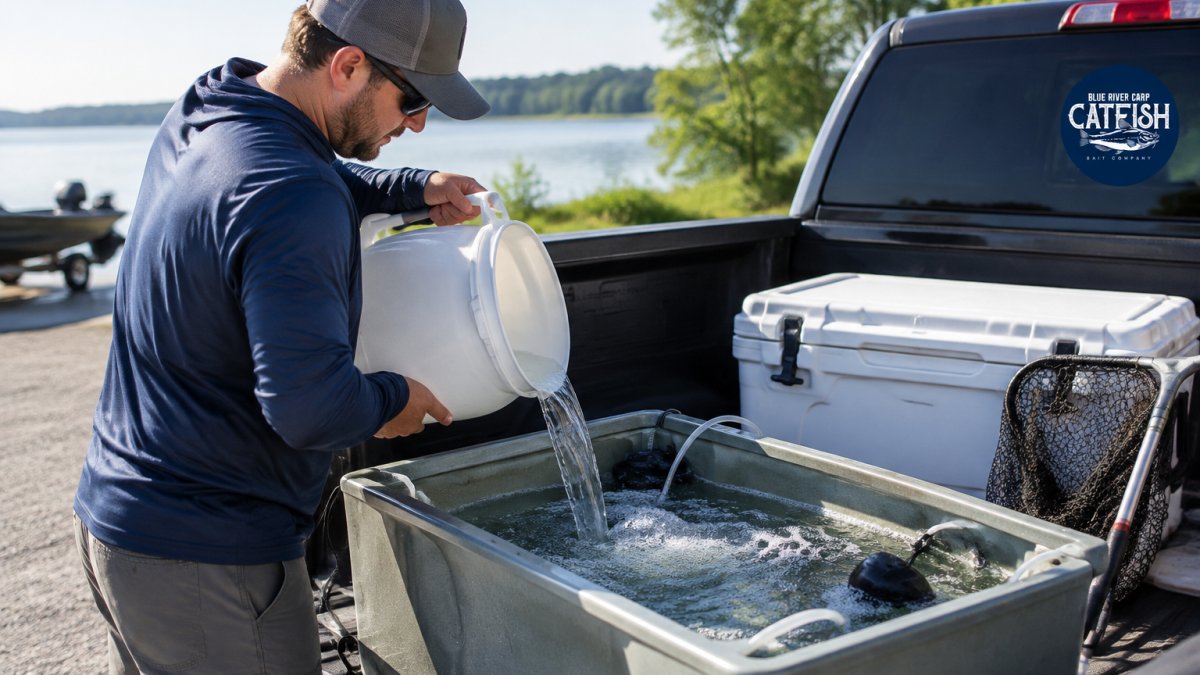
A Stepwise Partial Water Change
- Match the temperature first. Fill your replacement container and check it with a thermometer. Keep the new water as close to the tank temperature as you can.
- Treat the new water before it goes in. If you are using municipal tap water, dechlorinate it in the bucket, not in the tank. Chlorine and chloramine can harm baitfish, so treat municipal water before use.
- Turn off the pump, keep the aerator running. Siphon or dip out the old water from the bottom, where solid waste collects. Removing a portion of the volume at each change keeps waste diluted.
- Add the new water slowly. Pour it against the side of the tank or use a cup to spread the flow. Rapid addition mixes temperatures unevenly and can stir up settled waste.
- Restart circulation and watch the bait. Normal swimming and feeding behavior within a few minutes is a good sign. Gasping, clustering, or pale color means something in the change went wrong.
How Much Water to Replace
A simple calculation keeps you honest: tank volume in gallons times the fraction you plan to swap. A 30-gallon tank at a one-third change means about 10 gallons out and 10 gallons back in. Write the number on the tank or keep it in your phone so you are not guessing at the ramp.
Watch out: a full 100% change on a hot day with cool well water can drop the tank temperature several degrees at once. If you must do a full change, match temperatures in the bucket first and add the water in stages.
Water Quality Targets to Check Before and After
You do not need a lab, but a few inexpensive test strips or a handheld meter turn guesswork into decisions. The following ranges are commonly used as general guidance:
- Temperature: keep it stable and cool; sudden swings matter more than the exact number.
- Dissolved oxygen: above roughly 5 mg/L is a reasonable target; below 3 mg/L is an emergency.
- pH: roughly 6.5-8.5; a sudden shift after a water change is a warning sign.
- Ammonia: keep it as close to zero as possible; any readable level means waste is outpacing your changes.
- Salinity: only relevant if you are holding saltwater bait; match the source water and do not guess.
Record the readings after each change for a few trips. Patterns, such as ammonia creeping up by afternoon, tell you whether to change more water or cut the bait load.
Water Changes During Transport
On the road, you rarely have room for a full change. Carry a separate jug of treated, temperature-matched water and swap a quarter of the tank volume at each long stop. Keep the aerator running during the swap, and never pour untreated water straight from a hose into a tank full of bait.
Here are the water quality targets the article suggests checking before and after a water change.
| Parameter | Target | Note |
|---|---|---|
| Temperature | Stable and cool | Sudden swings matter more than the exact number |
| Dissolved oxygen | Above roughly 5 mg/L | Below 3 mg/L is an emergency |
| pH | Roughly 6.5-8.5 | A sudden shift after a water change is a warning sign |
| Ammonia | As close to zero as possible | Any readable level means waste is outpacing your changes |
| Salinity | Match the source water | Only relevant if holding saltwater bait |
Bait Tank Water Treatment: Safe Water, Salt, and What to Avoid
Untreated city water is a real risk. Municipal water treatment leaves chlorine and chloramines behind, and both harm baitfish. Use a water conditioner made for aquariums, or let water sit out and aerate before use. Because chlorine and chloramines can linger even after water has been left to stand, check that the water is safe for fish before adding it to the tank, using PatriotPetz's tips on aquarium water safety.
A little non-iodized salt can help baitfish handle stress. Keep it light. Salt does not fix dirty water, and too much does more harm than good.
What to avoid:
- Soap residue on anything that touches the tank
- Chlorinated tap water straight from the hose
- Overdosing any treatment product
When in doubt, treat less and change water more.
Tank Cleaning and Waste Removal: Scrubbing Out Grime and Solid Waste
Solid waste and grime build up on the bottom and sides of every bait tank. Remove it before it breaks down. A quick net pass for dead bait and debris after each trip goes a long way.
For a deeper clean, scrub the tank with a dedicated cleaning brush and plain water. Distilled white vinegar cuts mineral film. Baking soda handles odors. Rinse everything thoroughly, because leftover cleaner is toxic to bait.
Between trips, keep bait healthy with proper storage tips from our guide on how to keep nightcrawlers alive for days.
Troubleshooting Cloudy Water, Gasping Baitfish, and Temperature Shock
Cloudy water usually means waste is outpacing your water changes. Do a partial swap and cut back on feeding or crowding.
Gasping at the surface is an oxygen emergency. Add aeration now, then change part of the water.
Temperature shock shows up as fish going pale, listing, or dying after a water change. Match temperatures and add new water slowly. For the full picture on keeping bait fresh between trips, read our complete bait storage guide.
Stocking Blue River Carp Bait for Your Next Catfish Trip
Cut bait and live bait solve different problems. Blue River Carp, Inc. bait is scent-infused cut bait crafted from invasive carp, made in Indiana, and veteran-owned.
That means one less thing to manage on the water. If you are wondering whether carp bait works for catfish, read Is Carp Bait Good For Catfish. Keep your live bait tank in shape, and keep Blue River Carp, Inc. bait on hand for when the bite turns to catfish.
Your bait tank only works as well as the water in it. Oxygen, temperature, waste, and crowding decide whether your baitfish make it to the hook.
Frequently Asked Questions
How often should you change the water in a bait tank?
For a small tank holding a modest bait load, replace roughly a quarter to a third of the bait tank water every few hours during active use, and do a full change daily on multi-day trips. If the water turns cloudy, smells foul, or baitfish start gasping at the surface, change more of it immediately. Larger tanks with strong recirculation can stretch intervals, but never let waste and grime build up between changes.
What is the best water treatment for a bait tank?
Start with dechlorinated water: fill from the tap, then treat with a dechlorinator or let it sit before adding baitfish. Untreated city water can kill bait quickly. A small amount of non-iodized salt (about 1 to 3 parts per thousand) can ease fish stress, but avoid soaps, bleach, or dish detergents when cleaning. Rinse the tank with fresh water and a dedicated brush instead.
How do you increase oxygen in a bait tank?
Run a quality aerator with an air stone rated for your tank volume, and keep the pump on whenever bait is in the tank. Add a second aerator or battery backup for long trips. Avoid overcrowding, since more baitfish consume oxygen faster. If fish gasp at the surface, do a partial water change with cooler, well-aerated water and reduce the bait load right away.
How many baitfish can you keep in a tank?
A common working guideline is roughly 1 pound of baitfish per 3 to 5 gallons of water in a well-aerated tank, less in hot weather or a closed system without filtration. Watch behavior: if baitfish crowd the surface or die off overnight, you are overstocked. Match baitfish stocking density to your tank capacity and plan on shorter trips with smaller loads to keep bait healthy.


