
DIY Bait Bucket Aeration System: Keep Bait Alive
Last Updated: November 5, 2026
Quick Summary
A DIY bait bucket aeration system adds oxygen to your bucket by pumping air through an air stone, which creates bubbles that dissolve oxygen into the water as they rise. Build one from a 5-gallon bucket with a lid, a small battery-powered air pump, clear airline tubing, and a fine-pore air stone, then run the tubing through a drilled lid hole to the weighted stone near the bottom.
- Match the pump to the bucket; a pump rated for 10 gallons is plenty for a 5-gallon setup.
- Fill the bucket no more than two-thirds full and keep the lid cracked, not sealed.
- Swap out about one-third of the water every two to three hours on hot days.
- Use roughly one gallon of water per dozen small minnows to avoid overcrowding.
- Manual aeration means scooping water and pouring it back from about a foot above every 20 to 30 minutes.
Table of Contents
- Why Bait Bucket Aeration Matters More Than Ice
- Portable Bait Bucket Aerator DIY: Parts and Setup
- How to Keep Minnows Alive in a Bucket Step by Step
- No-Electricity Backup Methods for Remote Trips
- Water Care: Temperature, Changes, and Warning Signs
- Common Aeration Mistakes That Kill Bait
- Pairing Live Bait with Shelf-Stable Cut Bait
- Building Your Aerated Bucket Before Your Next Trip
- Frequently Asked Questions
Why Bait Bucket Aeration Matters More Than Ice
A bait bucket aeration system is the difference between lively minnows and dead bait by lunch.
Cold slows baitfish down, but it doesn't give them oxygen. A sealed, chilled bucket is still a sealed bucket. Fish pull dissolved oxygen out fast, and once it runs low, they gasp, roll over, and die.
Aeration addresses the oxygen problem directly. Ice mainly slows things down.
What Aeration Actually Does for Baitfish
Aeration is the process of adding oxygen to water by pumping air through an air stone, which creates bubbles that dissolve oxygen into the water as they rise. That exchange keeps dissolved oxygen livable for minnows, shad, and other baitfish.
- Oxygen levels stay steady instead of dropping through the trip
- Water circulates, so cold and warm layers mix
- Waste gases escape instead of building up
Skip aeration and you're relying on surface area alone. A five-gallon bucket has very little of it.
Portable Bait Bucket Aerator DIY: Parts and Setup
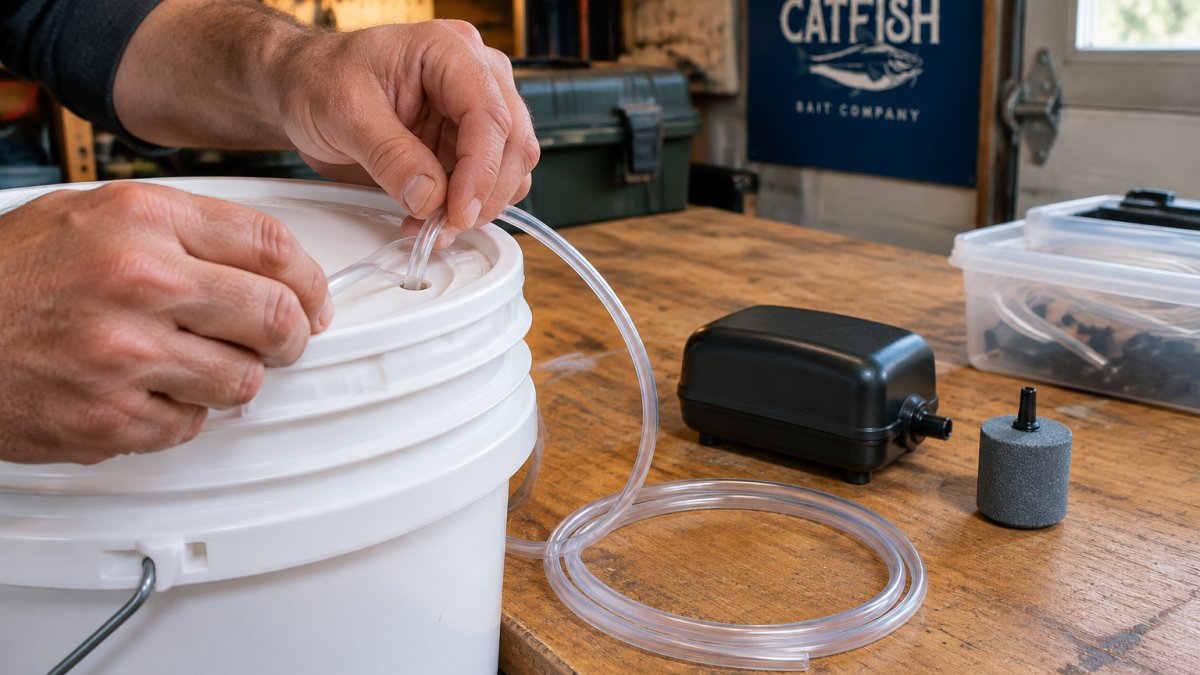
A portable bait bucket aerator DIY build can be done with a few common parts and no kit.
- A 5-gallon bucket with a lid. Food-grade plastic is best.
- A small battery-powered air pump. Look for one rated for a few gallons, not a pond pump.
- Clear airline tubing. Silicone tubing stays flexible in the cold.
Assembly is simple. Drill a small hole in the lid for the tubing, run the tubing from the pump to the stone, and weight the stone near the bottom. Clip the pump to the bucket or set it on the lid.
Choosing a Pump, Air Stone, and Power Source
Match the pump to the bucket. A pump rated for 10 gallons is plenty for a 5-gallon setup.
Pick a fine-pore air stone over a coarse one, smaller bubbles mean more oxygen transfer per pump stroke, which matters on batteries.
For power, batteries are simplest; a small power bank with a USB pump works for longer days.
How to Keep Minnows Alive in a Bucket Step by Step
Learning how to keep minnows alive in a bucket comes down to water, oxygen, and temperature, in that order.
- Start with good water. Use water from the lake or river you're fishing where possible, rather than chlorinated tap water.
- Fill the bucket no more than two-thirds full. Leave room for air and splash.
- Hook up the aerator before you add fish. Run it for a few minutes first.
- Add bait gently. Net them in; don't dump them from a height.
- Keep the lid cracked, not sealed. Air exchange matters.
- Set the bucket in shade. Sunlight heats water fast.
- Check the stone every few hours. If bubbles slow down, the stone may be clogged.
For a deeper walkthrough on moving baitfish without losses, our guide on how to transport live bait safely covers containers, water, and aeration from the bait shop to the water.
Here is the full sequence for keeping minnows alive in a bucket, from water choice to hourly checks.
| Step | What to do |
|---|---|
| 1 | Start with lake or river water, not chlorinated tap water |
| 2 | Fill the bucket no more than two-thirds full |
| 3 | Hook up the aerator and run it a few minutes first |
| 4 | Add bait gently by netting them in |
| 5 | Keep the lid cracked, not sealed |
| 6 | Set the bucket in shade |
| 7 | Check the stone every few hours for slowing bubbles |
No-Electricity Backup Methods for Remote Trips
Batteries die and remote trips don't have outlets. You need a plan that works with no power, and ideally one that keeps bait usable if the live bucket fails entirely. That's the angle most aeration guides skip: pairing a no-power aeration backup with a no-ice preservation backup.
Battery-Free and Manual Aeration
A no-power option is a battery-free bubbler, a small unit that runs on a built-in rechargeable cell.
Manual aeration is the fallback: every 20 to 30 minutes, scoop water and pour it back in from about a foot above the surface.
A third lever is water volume.
Watch out: sealing the lid to stop splashing also stops air exchange. That's the fastest way to kill bait on a hot day.
No-Ice Field Preservation: Salt and Salt-Borax Basics
When live bait is at risk and you have no ice, the practical backup is preservation, not aeration. The two workhorse methods are salting and a salt-borax mix. These are working ratios anglers use; adjust to bait size and conditions.
Salt-only method (toughening and short-term preservation):
- Pat baitfish dry, surface moisture dilutes the salt and invites spoilage.
- Use about 1 part non-iodized salt to 4 parts bait by volume as a starting point; a common field measure is roughly 1/4 cup of salt per quart of small baitfish.
- Layer bait and salt in a sealed bag or container, working the salt into the body cavity of larger bait.
- Keep the container out of direct sun. Expect the bait to firm up over several hours and hold for roughly 1-3 days in mild conditions, less in heat.
Salt-borax method (drying and longer storage):
- Pat bait dry and, for larger baitfish, split or score the body so the mix penetrates.
- Use a 50/50 mix of non-iodized salt and borax by volume. A common batch is 1 cup salt to 1 cup borax, enough for roughly 2-3 quarts of small baitfish.
- Coat the bait thoroughly, layer it in a sealed container, and keep it shaded.
- Drying time depends on bait size and humidity, often 3-7 days for small baitfish in dry conditions, longer in humid weather. The bait is ready when it feels leathery and firm, not wet or tacky.
Brining (toughening before storage):
- Dissolve about 1 cup of non-iodized salt per gallon of water.
- Soak baitfish for 30-60 minutes, then pat dry before packing.
- Brined bait firms up and holds better on the hook; it still needs cool, shaded storage and should be used within a few days unless further preserved.
Expected Storage Life Without Ice
Realistic ranges for preserved bait kept shaded and out of direct sun:
- Salt-only, mild conditions (under 75°F): roughly 1-3 days.
- Salt-borax, fully dried: several weeks to a few months in a sealed container; humidity is the main enemy.
- Brined and patted dry: a few days; treat as short-term.
Spoilage Signs and When to Discard
Discard preserved bait if it smells of rot rather than salt, feels slimy or tacky instead of firm, shows mold, or has been exposed to heat or moisture beyond the ranges above. Preserved bait is not necessarily safe for human consumption, keep it away from food and wash hands after handling.
How Preservation Affects Bait Performance
Salting and brining firm the bait and help it stay on the hook cast after cast, which suits bottom fishing and set lines. Borax-dried bait is tougher and more shelf-stable but can lose scent punch; rehydrating briefly before use can help. Neither matches live bait for triggering active fish, but both keep you fishing when the aerator quits or the ice runs out.
Water Care: Temperature, Changes, and Warning Signs
Water quality decides how long bait lasts, and the two things that wreck it fastest are heat and waste buildup.
Temperature Targets and Why They Matter
Baitfish metabolism and dissolved oxygen move in opposite directions as water warms: warmer water holds less oxygen and makes fish burn through it faster. Hold bucket water within about 5°F of the water you're fishing; swings of 10°F or more shock baitfish and trigger the pale, listing behavior anglers mistake for disease.
Practical moves:
- A light-colored bucket reflects more heat than a dark one.
- Set the bucket in shade and rotate it as the sun moves. A folded towel over the lid (with the aerator line free) helps.
- On hot days, float a sealed freezer pack in the bucket rather than dumping ice in. Meltwater dilutes and shifts chemistry; a sealed pack cools without changing the water.
Partial Water Changes: How Much and How Often
Swap out about one-third of the water every two to three hours on hot days, and every four to six hours in mild weather. Replace it with water from the same source so temperature and chemistry stay close.
Watch out: changing more than half the water at once, or mixing in water from a different body of water, can trigger a swing that kills bait faster than the old water would have.
Warning Signs: Stressed vs. Dying vs. Dead
Learn to read the bucket in layers:
- Stressed but recoverable: fish gasping at the surface, crowding the aerator stone, or swimming erratically. Act now: increase aeration, move to shade, and do a partial water change.
- Deteriorating: cloudy or foul-smelling water, foam that doesn't clear, baitfish turning pale or listing sideways. Change water, add aeration, and isolate any dead fish immediately.
- Dead: floating baitfish that don't respond to movement, or water that smells of rot. Remove dead fish at once; a single decomposing baitfish fouls a five-gallon bucket quickly and takes the rest with it.
Expected Storage Life by Condition
Realistic ranges, assuming a five-gallon bucket, a working aerator, and baitfish not overcrowded:
- Cool water (under 65°F), aerated, shaded: most minnows and shad hold 12-24 hours; some hardy minnows go longer.
- Warm water (75-85°F), aerated, shaded: expect 4-8 hours before stress signs appear; plan to fish or refresh sooner.
- Warm water, no aeration: often 1-3 hours. This is the failure mode most anglers hit.
These are working ranges, not guarantees. Baitfish species, size, and handling before you bought them all shift the clock.
Food-Safety and Spoilage Notes
Preserved or aerated bait is not automatically safe for human consumption, and spoilage bacteria harmless to a catfish can still make a person sick. Keep bait separate from food and drink, wash hands after handling, and discard bait showing deterioration rather than trying to "save" it. For a full breakdown on keeping bait fresh across methods, see our complete bait storage guide.
Common Aeration Mistakes That Kill Bait
- Overcrowding. Too many baitfish in too little water burns oxygen fast. Use roughly one gallon of water per dozen small minnows as a starting point.
- Chlorinated tap water. Chlorine harms baitfish. Use source water.
- Running the pump dry. Air pumps overheat without a load. Keep the stone submerged.
A common mistake is treating aeration as set-and-forget. Check the bubbles every hour, it takes five seconds and saves the trip.
Pairing Live Bait with Shelf-Stable Cut Bait
Live bait has a hard limit: it dies. That's why smart catfish anglers carry a backup that never needs a bucket.
Shelf-stable cut bait made from invasive carp needs no cooler, no freezer, and no aerator. Blue River Carp, Inc. makes bait with a 12+ month shelf life, so it's ready when live bait isn't.
Pair the two like this:
- Use live bait when fish are active and shallow. A lively minnow or shad triggers strikes.
- Switch to cut bait when the bite slows or fish go deep. Scent does the work.
- Keep both on the boat. If the aerator fails, you're still fishing.
Our Big-Cat Chunk Kit gives you bigger pieces for blues, flatheads, and set lines, with four scent varieties in one box. For a tougher strip that stays on the hook cast after cast, our Fish Attack Strips are built for it. If you're weighing live against preserved, our breakdown of cut bait vs live bait for catfish lays out the trade-offs.

Building Your Aerated Bucket Before Your Next Trip
Build the bucket this week, not at the ramp. Gather the parts, drill the lid, and test the pump in a sink.
Aeration keeps bait alive. Shelf-stable cut bait keeps you fishing when it doesn't.
Blue River Carp, Inc. makes veteran-owned, Indiana-made cut bait that stays fresh 12+ months without a cooler, so you're always ready to fish.
Frequently Asked Questions
How long can minnows survive in a bucket with an aerator?
With steady aeration and cool water, minnows typically survive 24 to 48 hours in a bucket, and longer if you change part of the water daily. Heat is the main limit: water above roughly 75°F holds less oxygen and speeds waste buildup. Keep the bucket shaded, avoid overcrowding (about one gallon per dozen minnows), and remove dead fish promptly so they don't foul the water.
What is the best way to aerate a bait bucket without electricity?
Use a battery-powered portable bait bucket aerator DIY setup: a small air pump running on D-cell batteries or a USB power bank, connected by tubing to an air stone. For backup, a manual hand pump or simply swapping half the water every few hours works. Keep the bucket in shade and skip tight lids, since surface agitation is what transfers oxygen into the water.
How often should I change the water in my bait bucket?
Change about a third to half the water every 4 to 6 hours in warm weather, and once or twice a day in cool conditions. Use water from the same lake or river when possible, since sudden temperature or chemistry shifts stress baitfish. If the water turns cloudy or smells strongly, replace more of it and remove any dead minnows right away.
Do I still need aeration if I use shelf-stable cut bait?
No. Shelf-stable cut bait such as Blue River Carp's scent-infused carp bait needs no cooler, aerator, or ice, and stays fresh for 12+ months in the bag. Many anglers run an aerated bucket for live minnows and pack cut bait as a backup, so a pump failure or hot spell never ends the trip early.


