
Cut Bait vs Live Bait for Catfish: Which Wins?
Table of Contents
- Cut Bait vs Live Bait for Catfish: The Quick Comparison
- Why Live Bait Triggers Catfish Predatory Instinct
- Scent-Infused Cut Bait Benefits: The Olfactory Advantage
- How to Rig Cut Bait for Catfish (and Live Bait Too)
- Species Preferences: Flathead vs Blue vs Channel Catfish
- Water Temperature, Depth, and Clarity: When Each Bait Wins
- Best Bait for River Fishing: Current, Cover, and Bait Presentation
- Ethical and Legal Sourcing: What Anglers Need to Know
- Frequently Asked Questions
Last Updated: September 17, 2026
Cut Bait vs Live Bait for Catfish: The Quick Comparison
Choosing between cut bait vs live bait for catfish comes down to one question: are you hunting actively or waiting patiently? Live bait wins when flatheads feed on the move in warm water; cut bait wins when blue and channel catfish scavenge by scent in current or deep holes. This guide from Blue River Carp, Inc. breaks down when each bait produces fish.
| Factor | Live Bait | Cut Bait |
|---|---|---|
| Best For | Flathead, active predators | Blue, channel, scavengers |
| Water Temp | 65°F and above | Any, best below 65°F |
| Water Clarity | Clear to stained | Stained to muddy |
| Scent Trail | Minimal | Strong |
| Movement | Active swimming | None |
| Hook-Up Rate | Lower, harder to set | Higher, easier to set |
| Storage | Needs aeration | Shelf-stable options exist |
Why Live Bait Triggers Catfish Predatory Instinct
Live bait works because catfish are predators first and scavengers second. A struggling bluegill or gizzard shad sends out vibration that a catfish's lateral line, a sensory organ that detects pressure changes, picks up from several feet away.
Vibration, Active Swimming, and the Lateral Line
A live bluegill pumps its tail and displaces water; a catfish resting under a log senses that displacement and moves toward it. Hook a baitfish through the back so it stays lively, a dead bait stops producing vibration.
Best Live Bait Options: Bluegill, Gizzard Shad, and Carp
The best live bait options depend on your water:
- Bluegill - Hardy, easy to catch, survives well on a hook
- Gizzard shad - Oily and bloody, but fragile and dies quickly
- Carp - Large profile, ideal for trophy flatheads
- Green sunfish - Tough and long-lasting in warm water
Match bait size to your target. A 3-inch bluegill catches eating-size channels. A 6-inch carp is trophy flathead territory.
Scent-Infused Cut Bait Benefits: The Olfactory Advantage
Cut bait wins on scent. A catfish's olfactory senses far outstrip its eyesight, and a fresh chunk of bloody, oily fish releases a scent trail that travels downstream, pulling fish toward your hook from a distance no live bait can match.
Scent Trail, Freshness, and Bloody Oily Profiles
Freshness matters: cut bait loses its scent load within hours in warm water. A bloody, oily profile like gizzard shad or skipjack herring releases the strongest trail. For that scent advantage without the mess, Blue River Carp, Inc. makes preserved cut bait from invasive carp that stays fresh for 12+ months in the bag with no refrigeration.
How to Rig Cut Bait for Catfish (and Live Bait Too)
Rigging differs sharply: cut bait needs a rig that holds a soft chunk in current; live bait needs a rig that lets a baitfish swim freely without tangling.
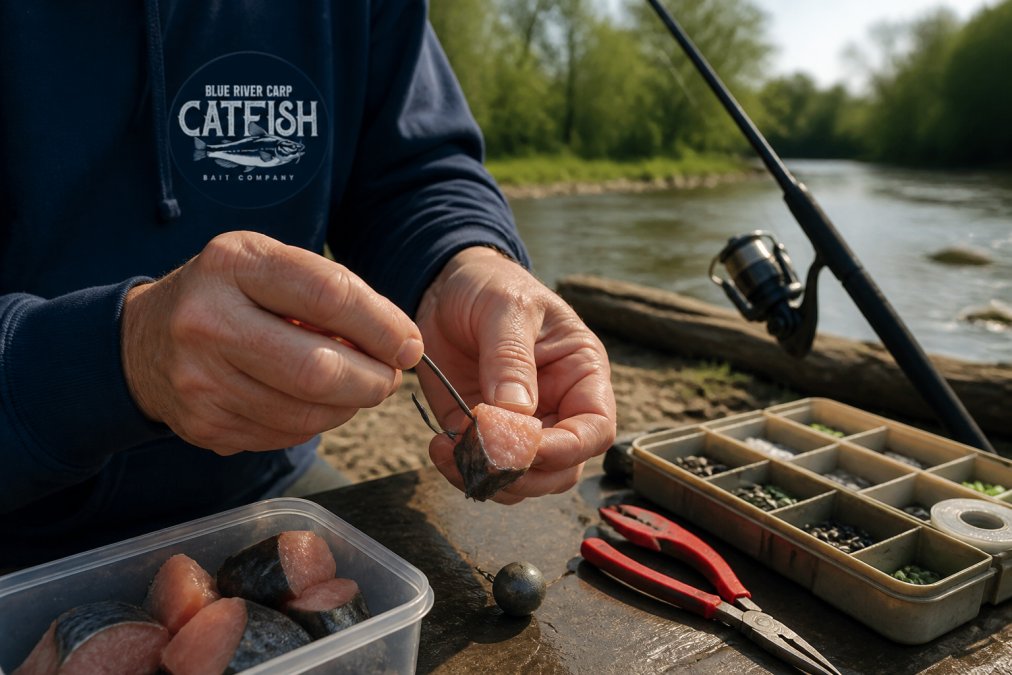
Cut Bait Rig: Carolina and Fish-Finder Setups
For cut bait, use a Carolina or fish-finder rig, threading the chunk onto a circle hook so the point and gap stay fully exposed. A standard setup for blues and channels:
- Hook: 5/0 to 8/0 circle hook for chunks; 3/0 to 5/0 for nuggets and strips
- Leader: 18 to 24 inches of 30 to 50 lb monofilament or fluorocarbon
- Sinker: 1 to 3 oz egg sinker on the main line above a bead and swivel; go heavier in current
- Main line: 20 to 30 lb braid for bite detection and abrasion resistance
Live Bait Rig: Free-Swimming Setups
Live bait needs the opposite treatment. A baitfish that can't swim naturally stops producing the vibration that triggers a flathead strike. Two setups cover most situations:
- Fish-finder rig with a larger hook: 7/0 to 10/0 circle hook through the back behind the dorsal fin, 2 to 4 oz sinker, 24 to 36 inch leader. The longer leader gives the baitfish room to circle without wrapping the main line.
- Three-way rig for current: a 3-way swivel with a short dropper to the sinker and a 24 to 30 inch leader to the hook. This holds bottom in current while letting the baitfish swim above the snag line.
Circle Hooks, Hook Gap, and Hook Placement
Circle hooks are standard for both bait types: they set in the corner of the mouth, meaning fewer gut-hooked fish and easier releases. The hook gap must clear your bait, if a chunk covers the point, you'll miss strikes.
- Cut bait: Hook through the tough end of the chunk, point fully exposed
- Live bait: Hook behind the dorsal fin for free swimming, or through the lips for trolling
- Hook size: Match gap to bait size, not fish size
Matching Sinker Weight to Bait Movement
The biggest rigging mistake is using the same sinker for both baits. Cut bait is dead weight and needs enough lead to stay put; live bait is a swimmer, and too much lead kills its movement. Fish cut bait with 2 to 3 oz in moderate current, live bait with 1 to 2 oz.
Species Preferences: Flathead vs Blue vs Channel Catfish
Species preference is the biggest factor in the cut bait vs live bait for catfish decision. Flatheads want live; blues and channels will eat either but lean toward cut.
| Species | Preferred Bait | Why |
|---|---|---|
| Flathead | Live | Ambush predator, hunts by vibration |
| Blue | Cut | Scavenger, follows scent trails |
| Channel | Cut or live | Opportunistic, eats both |
Water Temperature, Depth, and Clarity: When Each Bait Wins
Water temperature and clarity decide which bait outperforms the other on any given day. Cold water slows catfish metabolism and makes them reluctant to chase: below roughly 65°F, cut bait's scent trail beats live bait's movement; above that, live bait's vibration becomes the stronger trigger.
Temperature Bands by Species
A single 65°F line is a starting point, not the whole story. The three main species respond on different schedules:
- Channel catfish: Active from the mid-50s into the 80s. Below about 50°F they feed less, and cut bait on the bottom is the better bet. In summer, channels will chase live bait in shallow water at night.
- Blue catfish: Most consistent from the upper 50s through the 80s. Big blues are scent-driven year-round, so cut bait holds up across a wider temperature range than live bait does.
- Flathead catfish: The warmest-water specialist. Flatheads turn on when water climbs into the upper 60s and stay aggressive through the low 80s. Below about 60°F, live bait's advantage shrinks fast because flatheads stop chasing.
Water Clarity and Turbidity: When Scent Beats Sight
Water clarity decides which sense the catfish can use. In clear water, catfish can see a struggling baitfish and strike it; in stained or muddy water, sight means little and scent dominates, cut bait territory.
A rough guide to how anglers read clarity:
- Clear (visibility 3+ feet): Live bait has the edge. Catfish can see movement from a distance and ambush it.
- Stained (visibility 1 to 3 feet): Both work. Cut bait's scent trail and live bait's vibration are both detectable.
- Muddy (visibility under 1 foot): Cut bait wins. Scent is the only reliable channel, and a bloody, oily chunk broadcasts farther than a baitfish can.
Depth, Thermoclines, and Scent Dispersal
Depth plays a role too: in deep holes and along thermoclines, scent disperses slowly, so strong-smelling cut bait holds fish in place; in shallow current, live bait's vibration carries farther.
A few depth-specific patterns:
- Shallow flats (under 10 feet): Live bait for flatheads and channels working cover at night; cut bait still produces when fish are scattered.
- Mid-depth structure (10 to 25 feet): Cut bait on the bottom near rock piles, bridge pilings, and timber. Blues patrol these zones by scent.
- Deep holes and river bends (25+ feet): Cut bait, anchored. Scent lingers in the slower water and pulls fish up the gradient.
- Below a thermocline in summer: Cut bait. Live baitfish struggle in low-oxygen water below the thermocline, so they die and lose their movement advantage.
Putting It Together: A Quick Decision Framework
- Warm and clear: Live bait
- Cold or muddy: Cut bait
- Deep holes: Cut bait on the bottom
- Shallow current: Live bait
- Post-rain muddy water: Cut bait for the first day or two
- Summer thermocline: Cut bait below the break, live bait above it
Best Bait for River Fishing: Current, Cover, and Bait Presentation
For anglers who want a shelf-stable option that won't turn to mush in a river current, Blue River Carp, Inc. offers pre-cut chunks and nuggets in resealable bags. The 10oz chunks run $10.00, and the 7oz nuggets also run $10.00. Both stay on the hook in moving water.

Ethical and Legal Sourcing: What Anglers Need to Know
Sourcing bait legally protects both your fishing access and the water you fish. Baitfish regulations vary by state, and moving live fish between waters can spread disease or introduce invasive species. Always check your state wildlife agency's rules before transporting live bait.
For cut bait prep, keep it simple:
- Confirm your state allows the baitfish species you plan to use
- Never move live bait between separate bodies of water
- Keep bait iced or use shelf-stable preserved bait
- Dispose of unused bait properly, never dump it back
- Check for baitfish size and possession limits
Frequently Asked Questions
Do catfish prefer cut bait or live bait?
It depends on the species and conditions. Flathead catfish are ambush predators that strongly prefer live bait, especially bluegill and gizzard shad, because the active swimming triggers their predatory instinct. Blue and channel catfish are more opportunistic and feed heavily on cut bait, relying on their olfactory senses to locate scent trails in current. Water temperature and clarity also shift the advantage: muddy, cold water favors cut bait, while clear water with active forage fish favors live bait.
What is the best type of bait for catfish?
There is no single best bait for every situation, but a few options consistently produce. Live bluegill and gizzard shad excel for flatheads. Cut bait from oily fish like shad or carp works well for blues and channels. Pre-cut, scent-infused options such as Blue River Carp's 10oz chunks or 7oz nuggets stay on the hook without refrigeration and are ready to fish straight from the bag. Match your bait to the species and water conditions you are targeting.
How do I rig cut bait for catfish?
For bottom fishing, use a slip sinker rig with a 5/0 to 8/0 circle hook. Thread the cut bait through the meaty section, leaving the hook gap exposed. For river current, a three-way rig or fish finder rig keeps bait stationary. When using a bobber, suspend cut bait 1 to 3 feet off the bottom. Blue River Carp's pre-cut nuggets and chunks are sized to fit standard catfish hooks without trimming, which saves time and keeps bait presentation consistent.
Does scent-infused cut bait perform as well as fresh cut bait?
Scent-infused cut bait offers advantages in convenience and durability. Fresh cut bait releases a strong scent trail but breaks down quickly, especially in warm water, and requires refrigeration. Scent-infused options like Blue River Carp's preserved chunks and nuggets maintain their scent profile for 12+ months without freezing, stay securely on the hook, and do not get mushy. In practice, the longer soak time and consistent hook placement often make shelf-stable cut bait more effective for anglers who fish spontaneously or in warm conditions.
Which catfish species are most attracted to live bait?
Flathead catfish are the most live-bait-oriented species. They hunt by vibration and movement, using their lateral line to detect active swimming prey. Blue catfish also take live bait, particularly large gizzard shad, when targeting trophy fish. Channel catfish are the least dependent on live bait and feed readily on cut bait, prepared baits, and natural forage. If you are specifically targeting flatheads, rig a live bluegill or shad on a circle hook near heavy cover.