
Is Carp Bait Good for Catfish? What Anglers Need to Know
Table of Contents
- Why Carp Bait Works for Catfish
- How to Cut Carp for Bait
- Scent-Infused Cut Bait Benefits
- Best Bait for Channel Catfish and Other Species
- Carp vs. Shad, Bluegill, and Sucker: How They Compare
- Rigging and Presentation Tips for Cut Carp
- Storage, Freshness, and Legal Considerations
- Frequently Asked Questions
Last Updated: September 14, 2026
Why Carp Bait Works for Catfish
Is carp bait good for catfish? Yes. Carp is an oily, soft-fleshed baitfish that bleeds scent and stays on a hook through repeated casts, and catfish are scent-driven predators and scavengers. This guide from Blue River Carp, Inc. covers why carp works, how to cut it, and how to rig it.
Carp checks every box a catfish bait needs: oil dispersion, hook-holding texture, and a profile that appeals to trophy fish. Those same properties make it a legal gray area in some waters.
Scent Trail and Oil Dispersion in the Water
Cut carp releases oil and blood continuously, creating a scent trail that pulls catfish in from a distance. Warmer water disperses oil faster, so cut bait outperforms in warm months.
A common mistake is cutting bait too fine, slivers bleed out in 10 minutes (pubmed.ncbi.nlm.nih.gov). Chunks in the 1 to 2 inch range keep working for 20 to 30 minutes per cast.
Natural Texture and Hook Penetration
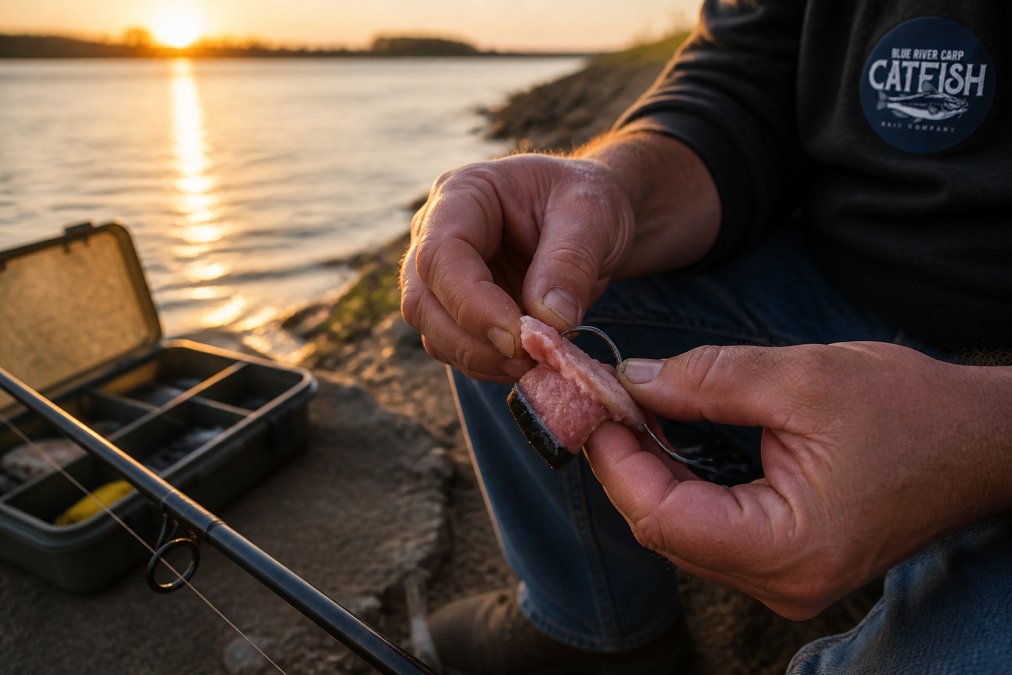
Fresh carp has a firm, fibrous texture that stays on a circle hook through current and structure, the difference between surviving a cast into a brush pile and sliding off before it hits bottom.
A chunk that's too thick blocks the point from rotating into the jaw, so match chunk size to hook size. For a 5/0 circle hook, a 1-inch cube is the sweet spot.
How to Cut Carp for Bait
Cutting carp for bait takes about five minutes per fish once you've done it a few times. The goal is uniform chunks with skin left on one side to hold the meat on the hook.
Here's the process:
- Lay the carp on a fillet board and make a cut behind the gills down to the backbone.
- Run your knife along the spine to remove the fillet, skin side down.
- Cut the fillet into 1 to 2 inch chunks, leaving a strip of skin on each piece.
- Bag the chunks by size so you can match bait to hook quickly on the water.
- Save the head and guts for chum if your local rules allow it.
Best Cuts and Sizes for Catfish
Match the cut to the species: smaller cubes for channel catfish, larger steaks for blues and flatheads.
| Target Species | Best Cut | Chunk Size | Hook Size |
|---|---|---|---|
| Channel catfish | Cube with skin | 1 inch | 3/0 to 5/0 circle |
| Blue catfish | Steak or thick chunk | 1.5 to 2 inches | 5/0 to 7/0 circle |
| Flathead catfish | Whole head or large steak | 2 to 3 inches | 7/0 to 9/0 circle |
Scent-Infused Cut Bait Benefits
Scent-infused cut bait is carp treated or packed with attractants before it hits the water, producing a longer, stronger scent trail than plain cut carp, which matters most in murky water or heavy current.
Many anglers soak chunks in garlic, anise, or commercial attractant oil overnight. Shelf-stable options skip that step: Blue River Carp, Inc. makes a preserved ground fish bait from invasive Asian carp that stays ready in the bag with no refrigeration, solving the mushy-bait problem that ruins homemade cut bait in a hot tackle box.

Best Bait for Channel Catfish and Other Species
The best bait for channel catfish is a 1-inch chunk of cut carp or a prepared scent-infused bait on a 3/0 to 5/0 circle hook near the bottom. Channels are the most adaptable feeders, taking cut bait, prepared bait, and even stinkbait readily.
Blue catfish lean toward fresh cut bait. They roam open water following shad, so oily carp drifting in current mimics their natural forage.
Flatheads are the outlier, live-bait specialists. They'll take cut carp, but a live bluegill or sucker usually outproduces it. Save big carp steaks for blues and channels.
Carp vs. Shad, Bluegill, and Sucker: How They Compare
Carp holds up better than most baitfish because it's tougher. Shad is the gold standard for scent but falls apart after a cast or two. Bluegill is a solid live-bait option but harder to keep alive. Sucker is a close second for durability.
| Baitfish | Scent Strength | Durability on Hook | Best Use |
|---|---|---|---|
| Carp | High | High | Cut bait, chum, shelf-stable prep |
| Shad | Very high | Low | Fresh cut bait, immediate use |
| Bluegill | Medium | Medium | Live bait for flatheads |
| Sucker | Medium-high | High | Cut bait, cold water |
The trade-off is availability. Shad is seasonal and hard to keep fresh without a freezer. Carp is widely available, and because it's invasive in many waters, harvesting it is often encouraged.
Rigging and Presentation Tips for Cut Carp
Rigging cut carp is less about the rig and more about how the oily, skin-on chunk behaves in the water. Carp chunks are denser than shad or bluegill, so they sink faster, cast flatter, and resist current better, but they spin more and can wrap a leader if hooked wrong.
Carolina Rig (The Default for Bank and Boat)
A Carolina rig with a 1 to 2 ounce egg sinker, a bead, a barrel swivel, and a 12 to 18 inch leader of 30 to 50 pound mono or fluorocarbon covers most situations. The sliding sinker lets a catfish pick up the bait without feeling weight. Use a 3/0 to 5/0 circle hook for 1-inch channel-cat chunks and 5/0 to 9/0 for blue and flathead steaks.
Santee Rig (Better for Current and Drift)
The Santee rig, also called the Santee Cooper rig, adds a peg float or foam cigar between sinker and hook, lifting the cut carp 2 to 6 inches off the bottom so the scent trail stays in the strike zone instead of buried in silt. Use it in current or when blues suspend off a channel ledge, with a 1 to 3 ounce no-roll sinker so the rig stays put.
Three-Way Rig (For Deep Holes and Ledges)
A three-way swivel with a dropper weight on one eye and a 12 to 24 inch leader on the other lets you fish cut carp straight down in deep water without the bait helicoptering on the drop. It's common for flatheads on deep timber, though flatheads still prefer live bait most of the time.
Circle Hooks vs. Treble Hooks for Cut Carp
Circle hooks are standard for cut carp because the skin-on chunk stays put and the hook rotates into the corner of the jaw on a steady pull. Trebles hold a soft chunk better on the cast but gut-hook fish and are illegal for catfish in some waters. If you use trebles, go one size smaller, a 2/0 treble matches a 4/0 circle for a 1-inch chunk.
Hook Placement on the Chunk
The goal is a chunk that hangs straight and exposes the hook point. Two placements work:
- Skin-side first: Push the hook through the skin side once, then back through the meat so the skin acts as a hinge. This is the most durable option and the one to use when casting into brush or rocks.
- Meat-side first: Push through the meat, then out through the skin. This exposes more scent but tears out faster on a hard cast. Use it for short pitches or vertical presentations.
Avoid hooking through the middle of a thick steak, the point buries in meat and never rotates into the jaw. Match hook gap to chunk thickness: the gap should be at least as wide as the chunk is thick.
Leader and Line Considerations
Cut carp is abrasive on the cast because the skin is tough and the chunk heavy. A 30 to 50 pound mono leader handles most situations; step up to 60 or 80 pound fluorocarbon around timber or rocks. Braid main line in the 30 to 65 pound range cuts current and transmits the tap of a picky channel cat.
Presentation Adjustments by Situation
- Heavy current: Add a second hook or a bait clip so the chunk doesn't spin and twist the leader. Bump sinker weight until the rig holds.
- Murky water: Fish the chunk higher in the water column with a Santee rig so the scent trail spreads through more of the strike zone.
- Jug lining and trotlines: Cut chunks smaller, 3/4 to 1 inch, and hook once through the skin only. This keeps the bait on through the set and makes release cleaner.
- Bank fishing with a rod holder: A fish-finder rig with a 2 to 3 ounce flat sinker and a tight line is the simplest setup. Let the chunk sit, cut carp keeps working for 20 to 30 minutes per cast.
Storage, Freshness, and Legal Considerations
Storage and legality are the two places cut carp trips up otherwise dialed-in anglers. A chunk that sat in a hot tackle box all afternoon smells like rot, not bait, and a carp legal to keep in one state can be a citation in the next.
Freshness Timeline for Cut Carp
Cut carp is soft-fleshed and degrades faster than most anglers expect:
- On ice, in a cooler: 1 to 2 days. After that, the meat turns mushy and slides off the hook on the cast.
- Refrigerated at 35 to 40°F: (the FDA) 2 to 3 days in a sealed container. Blood and oil separate, so drain and re-bag before use.
- Frozen in a ziplock with water: 3 to 6 months before freezer burn sets in. The ice glaze protects the meat and slows the thaw.
- Vacuum-sealed and frozen: 6 to 12 months. This is the method most serious cut-bait anglers use for bulk batches.
- Shelf-stable preserved bait: 1 year or more in the bag, no refrigeration, the fastest-growing category because it solves the cooler problem entirely.
Preservation Methods That Actually Work
Brining. A brine of 1 cup non-iodized salt to 1 gallon of water, soaked 12 to 24 hours, firms the meat and pulls out blood, but also some of the oil that makes carp effective. Brine only chunks you'll use within a week.
Vacuum sealing. Portion chunks into meal-sized bags, add a splash of water or attractant oil, and vacuum seal. It's the best method for scent integrity over months, and flat bags thaw faster and stack better in a cooler than round containers.
Freezing in water. Cover chunks with water in a ziplock, squeeze out air, and freeze flat. The ice glaze prevents freezer burn and keeps meat firm through a slow thaw, cheaper than vacuum sealing and nearly as effective for 3 to 6 months.
Salting and drying. A heavy salt cure plus air drying produces a tough, shelf-stable bait that stays on the hook through anything. It loses most of its oil, though, so it's better for chum or tough current than a scent-driven bite.
Legal Considerations: Invasive vs. Native Carp
This is the part most guides skip, and it can cost you a citation. Carp in the U.S. fall into two very different legal buckets:
Invasive carp, bighead, silver, black, and grass carp, are classified as injurious or invasive in many states. Harvest is often encouraged, bag limits frequently unlimited, and in some waters you must kill rather than release them. Using them as cut bait is usually straightforward, but check whether your state bans transporting them live away from the water where they were caught.
Common carp, the species most anglers actually catch, is native to Eurasia but naturalized across most of the country, managed as a game fish in some states and a rough fish in others. In a handful of states it has protected status or seasonal restrictions, and using it as bait may require counting it against a daily limit.
Native suckers, redhorse, and other baitfish are a separate category. Many states restrict or ban using game fish or their parts as bait, and some require any fish used as bait to be caught in the same water body where it will be used.
What to Check Before You Cut
Before you fillet a carp at the ramp, confirm four things with your state wildlife agency:
- Whether carp are classified as invasive, rough fish, or game fish in your state.
- Whether there is a daily limit or possession limit on the species you caught.
- Whether transporting live carp away from the water is legal.
- Whether using cut fish, of any species, as bait is allowed on the water you're fishing, and whether the bait fish must be caught from that same water.
state fishing regulations and bait rules and your state's department of natural resources site are the two places to confirm what's legal in your water. When in doubt, keep receipts or photos showing the carp was legally taken.
Frequently Asked Questions
Is carp a good bait for catching trophy catfish?
Yes. Big blue and flathead catfish are predatory and scavenging, and a large chunk of fresh cut carp appeals to both instincts. Trophy-class blues over 30 pounds key in on oily, sizable baits, so a 2 to 4 inch chunk of carp presented on a circle hook near deep structure gives you a real shot at a fish of a lifetime. Flatheads in particular favor live or freshly cut baitfish over prepared stink baits.
How long does cut carp bait stay effective on the hook?
Fresh cut carp holds scent for roughly 20 to 45 minutes in warm water before the oils wash out and the flesh turns pale. In colder water it lasts longer. Check your bait every 30 minutes and swap it when the color fades or the texture goes soft. Shelf-stable preserved options like Blue River Carp's ground fish keep their scent longer between trips, so you are not re-baiting as often.
Does the scent of carp attract catfish more than other baits?
Carp is an oily baitfish, and that oil disperses a strong scent trail that channel, blue, and flathead catfish can follow from a distance. Compared with leaner baits, carp releases more attractant into the water column. That said, shad and bluegill are also proven. The deciding factor is usually freshness and how well the bait stays on the hook, not the species alone.
Is it legal to use invasive carp as bait in all waters?
No. Rules vary by state, and some waters ban moving live baitfish between bodies of water to stop the spread of invasive species. Using cut or preserved carp is often allowed where live transport is not, but you should check your state wildlife agency's regulations before you fish. Buying commercially preserved bait, like the shelf-stable products from Blue River Carp, avoids many of these live-transport restrictions.
Cutting bait on the bank, guessing at freshness, and losing chunks to mushy meat is the part of catfishing nobody enjoys. Blue River Carp, Inc. solves that with preserved ground fish bait made from invasive Asian carp, harvested from the Ohio River and packed to stay ready without a cooler or freezer. It's veteran-owned, made in Indiana, and built for anglers who want bait that's ready when the fish are. Get started with Blue River Carp, Inc. and keep a bag in your tackle box for every trip.