
Best Catfish Bait for Summer Heat: Top Picks
Table of Contents
- Why Summer Heat Changes Everything for Catfish Bait
- Top Bait Options for Summer Catfish: From Live to Cut
- How to Keep Cut Bait Fresh in Extreme Heat
- Scent-Infused Bait Benefits for Hot Weather Fishing
- Catfish Fishing Tips for Summer: Depth, Structure, and Timing
- Matching the Hatch and Ethical Sourcing of Bait
- Conclusion
- Frequently Asked Questions
Last Updated: September 13, 2026
Why Summer Heat Changes Everything for Catfish Bait
Water temperature dictates where and when catfish feed and how bait performs once it hits the water. This guide from Blue River Carp, Inc. covers what changes once surface temps climb into the 80s, and how to pick the best catfish bait for summer heat instead of guessing.
Warm water doesn't just make catfish more active, it accelerates bait decomposition, disperses scent faster, and pushes fish toward deeper, cooler structure during daylight. Get the bait wrong and you're feeding the river, not catching fish.
U.S. Geological Survey water temperature data confirms that surface water temperatures routinely exceed 85°F across southern reservoirs by midsummer, which is well above the comfort range for channel catfish.
Water Temperature Thresholds That Trigger Feeding
Channel catfish feed most aggressively between 70°F and 85°F (PubMed). Past 90°F in shallow flats, daylight feeding slows and shifts toward dawn, dusk, and overnight windows.
Blue catfish tolerate warmer water but still follow baitfish into deeper, oxygenated zones. Flathead catfish stay shallow but become almost entirely nocturnal once temperatures peak.
That threshold matters because it changes your bait choice. Live bait and fresh cut bait outperform stale offerings when fish are feeding in short, aggressive windows.

How Heat Affects Bait Breakdown and Scent Dispersion
Warm water speeds scent dispersion, but that also means bait loses its punch faster. A chunk of cut bait that holds scent 45 minutes in spring water may go bland in 20 minutes at 88°F.
Heat also breaks down tissue faster. Traditional frozen bait turns mushy within an hour on the hook, which is why so many anglers lose fish to bait that simply won't stay put.
Top Bait Options for Summer Catfish: From Live to Cut
The best catfish bait for summer heat balances scent strength, hook durability, and shelf stability. Live bait wins on freshness, cut bait on scent volume, prepared baits on convenience.

Live Bait: Gizzard Shad, Skipjack, and Sunfish
Gizzard shad and skipjack herring are the gold standard for blue catfish, oily, fast-bleeding scent in warm water, and what big blues already eat. Sunfish and bullheads work for channel catfish, especially in river eddies.
The catch: live bait requires aeration, a bait tank, and constant attention in summer heat. It's the highest-maintenance option on this list.
Cut Bait and Punch Bait: When to Use Each
Cut bait is the summer workhorse. Chunks of shad, skipjack, or mullet release a strong scent trail that pulls fish from deep structure, ideal in current, deep holes, or anywhere you want scent working over time.
Punch bait and prepared dough baits shine for channel catfish in ponds and slow-moving water. They stay on the hook better than cut bait and don't require a cooler, but they lack the scent volume of fresh fish.
| Bait Type | Best Species | Holds on Hook | Scent Strength | Storage |
|---|---|---|---|---|
| Live shad/skipjack | Blue, flathead | High | Moderate | Bait tank |
| Fresh cut bait | Blue, channel | Medium | Very high | Cooler + ice |
| Punch/prepared bait | Channel | High | Moderate | Shelf-stable |
| Preserved cut bait | All catfish | High | High (infused) | Shelf-stable |
How to Keep Cut Bait Fresh in Extreme Heat
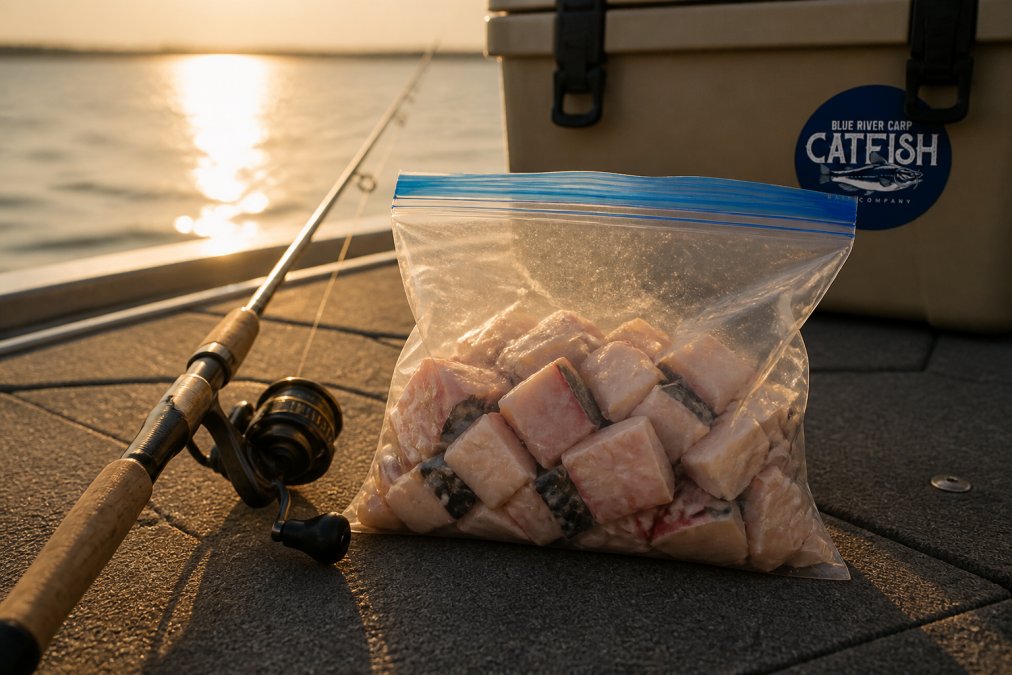
Keeping cut bait fresh in extreme heat means controlling temperature, air exposure, and time. Most anglers fixate on ice and ignore the other two, which is why bait that left the dock perfect is mush by 1 PM. The goal is keeping bait below the temperature where tissue breakdown accelerates, and sealed so scent stays in the flesh.
Rule of thumb: every 10°F above 80°F roughly doubles how fast cut bait softens on the hook. A chunk that holds 45 minutes in May water may hold only 20 in an 88°F reservoir. Plan bait rotation around that math, not how the bait looks when you cut it.
Cooler Strategy: Temperature, Ice, and Air
- Use a hard-sided cooler, not a soft bag. Soft bags sweat, collapse around bait, and offer almost no radiant-heat resistance in direct sun.
- Pre-chill the cooler. A cooler starting at 95°F burns ice just to reach bait-safe temps. Add a frozen water bottle the night before, or pre-cool with ice you drain before loading bait.
- Layer ice below and above. Ice only on the bottom chills the lowest inch of bait. Sandwiching bait between two ice layers keeps the whole mass near 32-40°F.
- Drain the meltwater. Cut bait sitting in meltwater turns to paste. Use a cooler with a drain plug and crack it every hour or two, or elevate bait on a wire rack above the water line.
- Block the sun. Radiant heat on a cooler lid can push internal temps 10-15°F above ambient. A wet towel or a reflective cover over the lid buys you hours.
Bait Tank and Aerator Setup for Live Bait
Live shad and skipjack are the most heat-sensitive option in the boat, above 80°F, dissolved oxygen drops and baitfish stress fast. A basic summer setup:
- A round or oval tank (corners stress baitfish) sized at least 20-30 gallons for a half-day trip.
- A dual-port aerator or a recirculating pump rated for the tank volume, running continuously, not on a timer.
- A handful of non-iodized salt or a commercial bait saver to reduce stress and ammonia.
- A mesh dip net, never bare hands, to move bait without stripping slime coat.
- Partial water changes every couple of hours using lake water, not tap.
When Refrigeration Isn't an Option
The practical fix for long summer sessions is to stop treating refrigeration as the only option. Preserved, scent-infused cut bait solves storage entirely, exactly what Blue River Carp, Inc. built its product line around. It doesn't need ice, doesn't sweat, and doesn't turn to mush at 2 PM.

For anglers who want to run both, a workable split is fresh cut bait for the first two hours of a dawn bite and preserved bait for the rest of the day, once the sun is high and the fresh stuff starts breaking down.
Scent-Infused Bait Benefits for Hot Weather Fishing
Scent-infused bait addresses summer's core problem: scent dissipates faster in warm water. Concentrated oils and attractants extend how long a single piece keeps pulling fish to your hook.
Blue River Carp, Inc. infuses its cut bait with blood, garlic, and shad scents, so the bait keeps releasing a scent trail long after a plain chunk of fish would have gone bland. The 12+ month shelf life and no-refrigeration design mean you can leave a bag in your tackle box all season without it turning to mush.
That's the difference between bait that works on a cool morning and bait that still works at 2 PM in July.
Catfish Fishing Tips for Summer: Depth, Structure, and Timing
Summer catfish move to deep structure during daylight, then push shallow at night to feed. Depth and timing matter as much as bait choice.
Channel catfish hold along river eddies, outside bends, and submerged timber in 8-20 feet. Blue catfish stack on ledges, humps, and channel drops, often below the thermocline where water stays cooler and oxygenated. Flatheads hold tight to rock piles, brush, and undercut banks.
Timing is everything. Dawn and dusk produce the most consistent action. Overnight trips in midsummer often outproduce midday trips by a wide margin.
Night vs. Day Bait Selection
Night fishing favors cut and live bait because catfish feed aggressively and rely on smell over sight. A strong scent trail spreads through cooler nighttime water and pulls fish from farther away.
Daytime fishing calls for bait that stays put and keeps working through heat. Preserved, scent-infused cut bait holds up better than fresh bait that's been sweating in a cooler since sunrise.
Matching the Hatch and Ethical Sourcing of Bait
Matching the hatch means using bait that mirrors what catfish already eat. On shad reservoirs, shad-based cut bait outperforms everything. On skipjack rivers, skipjack cut bait wins. In stocked ponds, punch bait and dough baits often beat fresh fish because that's what the fish associate with food.
The fastest way to match the hatch is to look at what's already in the water. Shad flickering at dawn, skipjack busting bait in current, or sunfish hugging shallow cover all tell you what to cut.
Catching Your Own Bait vs. Buying It
Catching your own bait is cheaper and lets you match the hatch exactly, but it comes with real trade-offs in summer heat:
- Cast netting shad works best at first light when schools are shallow. A 3/8-inch mesh net is standard for gizzard and threadfin shad. Shad die fast once netted, so have a tank or ice-water cooler ready before you throw.
- Sabiki rigs and small jigs work for skipjack in tailrace current. They're hardier than shad but still need aeration.
- Sunfish and bullheads can be caught on a worm and a small hook near shallow cover. They're the most durable live bait in summer and the easiest to keep alive in a simple bucket with an aerator.
- Buying bait saves time and eliminates the tank-and-aerator problem, but you're limited to what the shop stocks and you pay per dozen or per bag.
A practical pattern: catch bait the evening before, keep it on ice or in a tank overnight, and buy preserved bait as backup for when fresh runs out or the bite shifts.
Legal and Ethical Sourcing Considerations
Baitfish rules vary by state and by waterbody, and summer is when enforcement is heaviest. Before you net bait, check three things:
- Whether the waterbody allows baitfish harvest at all (some trophy and designated waters don't).
- Whether the species you're netting is legal to use as bait in that water, moving live bait between drainages is restricted or banned in many states to prevent the spread of invasive species and disease.
- Whether you need a separate baitfish license or a commercial permit if you're selling.
Using invasive Asian carp, bighead and silver carp, as cut bait turns an ecological problem into a fishing advantage. These fish damage native fisheries across the Midwest and Mississippi River system, and using them means you're not stripping native baitfish populations to fill your cooler. Blue River Carp, Inc. builds its bait from invasive carp, which keeps the product line sustainable and gives anglers a bait source that doesn't depend on wild-caught native species.
U.S. Fish and Wildlife Service guidance on invasive carp outlines how Asian carp populations continue to spread through major river systems, which is exactly why using them as bait makes practical sense.
Match the hatch first, source legally second, and let ethics guide the third decision. Bait that mirrors local forage, comes from a legal source, and doesn't strip native populations is bait you can feel good about running all summer.
Conclusion
Summer heat punishes anglers who show up with the wrong bait. Fresh cut bait that turns to mush, live bait that dies in a hot bucket, and punch bait that can't compete with a strong scent trail all cost you fish. Blue River Carp, Inc. solves that with preserved, scent-infused cut bait that stays fresh 12+ months without refrigeration, holds tight on the hook, and keeps releasing scent in water that would ruin traditional bait. Get started with Blue River Carp, Inc. and stop losing fish to bait that can't handle the heat.
Frequently Asked Questions
Does catfish bait need to be refrigerated in the summer?
Not all catfish bait requires refrigeration. Traditional cut bait and chicken liver spoil quickly in summer heat and need ice or a cooler. Shelf-stable options like preserved cut bait from Blue River Carp last 12+ months without refrigeration, so you can leave them in your tackle box. If you use fresh bait, keep it on ice and use it within a few hours.
What is the best time of day to catch catfish in hot weather?
Catfish feed most aggressively from dusk through early morning during summer heat. Water temperatures often exceed 85°F in shallow areas by midday, pushing fish into deeper, cooler water. Focus your efforts between 8 PM and 8 AM. Night fishing with cut bait or scent-infused bait produces the best results when daytime temperatures peak.
How do you keep bait from getting mushy on the hook in high heat?
Mushy bait falls off the hook because heat breaks down proteins and connective tissue. Use preserved or shelf-stable bait that holds its shape, or firm up cut bait by salting it before your trip. Blue River Carp's pre-cut chunks and nuggets stay firm on the hook for extended use, even in direct sun, because they are preserved and do not rely on refrigeration.
Why does cut bait work better than live bait in summer?
Cut bait releases scent trails that spread through warm water quickly, drawing catfish from a distance. Live bait moves less in hot, low-oxygen water, reducing its appeal. Scent dispersion matters more in summer because catfish rely on olfactory senses to locate food. Cut bait also stays on the hook better than live bait when fish are aggressive and feeding fast.