
Effective Cut Bait for Catfish: A 2026 Guide
Table of Contents
- Why Effective Cut Bait Matters for Catfish
- Best Bait for River Fishing: Fish Species That Work
- How to Hook Cut Bait for Catfish: Rigging and Placement
- Scent-Infused Cut Bait Benefits: Why Aroma Matters
- Fresh vs. Frozen Cut Bait: Storage and Preservation
- Targeting Specific Catfish Species with Cut Bait
- Ethical and Legal Sourcing of Baitfish
- Troubleshooting Bait Failure and Common Mistakes
Last Updated: August 26, 2026
Why Effective Cut Bait Matters for Catfish
Catfish hunt by smell first, sight second. The right cut bait creates a scent trail that pulls fish from dozens of yards away. Most anglers fail because they grab whatever baitfish is cheapest rather than considering three critical factors: baitfish species, preparation method, and freshness on the hook.
Blue River Carp, Inc. produces scent-infused cut bait from invasive carp species with a 12-month shelf life, eliminating refrigeration needs. Effective cut bait must be firm enough to last on the hook yet soft enough to release scent continuously.
Best Bait for River Fishing: Fish Species That Work
Not all baitfish are equal for catfish. The species you choose determines scent release and how quickly catfish detect your bait. River environments demand bait that handles current while maintaining its scent trail.
Gizzard Shad and Bluegill
Gizzard shad is the gold standard for catfish across freshwater systems. These oily fish release strong, persistent scent that travels through current and attracts catfish from distance. When cut into chunks, the bloodline and flesh release a scent profile catfish instinctively recognize as a feeding trigger.
Bluegill works well as a secondary option, particularly for channel catfish in smaller rivers. Bluegill has less oil than shad, so the scent trail is milder but still effective. For river fishing where current is a factor, shad's oil content works in your favor because scent disperses faster and travels farther downstream.
Oily Fish and Natural Scent Trails
Oily fish are the backbone of effective cut bait. Higher fat content means more potent scent release. Shad, herring, and mackerel consistently outperform leaner fish because oils create a visible scent plume catfish can track.
Oily fish release scent gradually, giving you a longer window of effectiveness per cast. Catfish have evolved to recognize the specific chemical signature of certain prey species (peer-reviewed research). When you use gizzard shad, you trigger a hardwired feeding response that artificial scents cannot fully replicate.
How to Hook Cut Bait for Catfish: Rigging and Placement
How you rig cut bait matters as much as what you choose. Poor rigging means your bait falls off during the cast, spins in the water, or doesn't present the bloodline where catfish detect it.
Hook Size and Circle Hook Selection
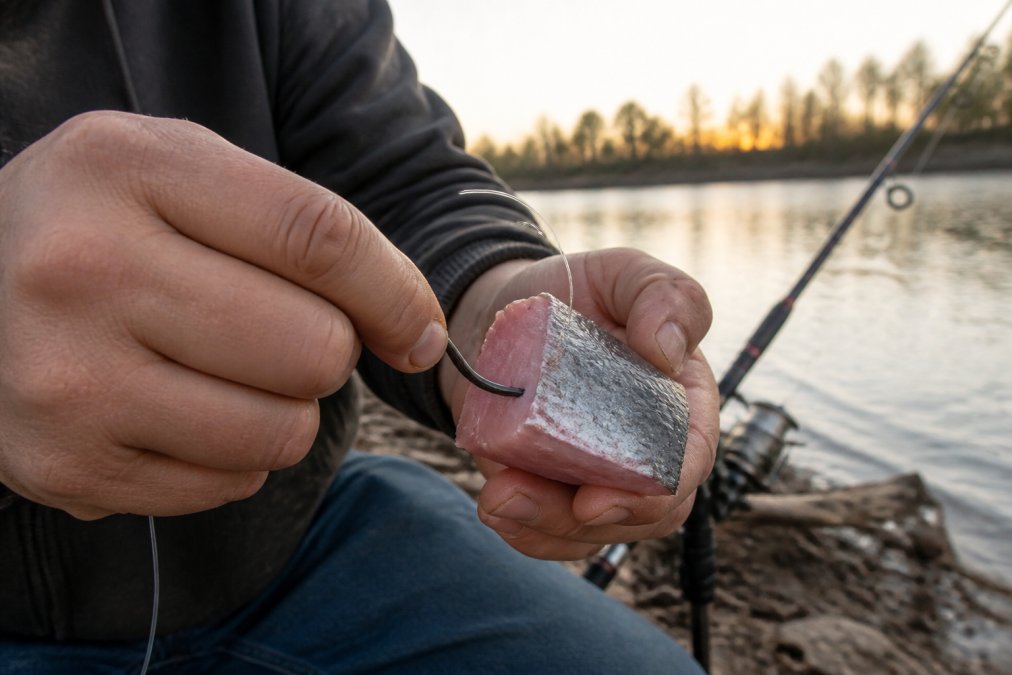
Circle hooks are standard for cut bait fishing. They hook fish in the corner of the mouth, reducing deep hooking and improving catch-and-release survival. For catfish, circle hook sizes range from 2/0 to 8/0 depending on species and bait size.
Channel catfish respond well to 2/0 to 4/0 circle hooks with medium chunks. Blue catfish prefer 5/0 to 8/0 hooks. Flathead catfish often require 6/0 to 8/0 hooks because they bite hard and need quick penetration. Match hook size to your bait chunk: a 2/0 hook should pass through a 1-inch by 2-inch nugget without oversizing it.
Bloodline Positioning for Maximum Scent Release
The bloodline is the dark red vein running through the bait center, where most scent originates. Position the hook so the bloodline is exposed and facing into the current or toward open water to maximize scent dispersal.
The most effective technique is the "through-the-bloodline" rig: pierce the hook through the bloodline lengthwise, entering one side and exiting the other. This keeps the bloodline intact and exposed, allowing continuous scent release. The bait hangs naturally and the bloodline faces downward or into the current.
Scent-Infused Cut Bait Benefits: Why Aroma Matters
Scent-infused cut bait amplifies effectiveness beyond natural baitfish scent. This is especially valuable in murky water, high-current conditions, or when catfish are less active. Infused bait creates a stronger, more persistent scent trail that reaches catfish faster.
Catfish detect chemical compounds dissolved in water. More compounds mean faster detection from greater distance. Infused bait enhances natural scent rather than replacing it, creating a multi-layered profile more potent than either alone.
Garlic Spray and Flavor Profiles
Garlic is one of the most effective scent additives for catfish. Its pungent compounds are detectable at very low concentrations, and the effect lasts longer than many other additives. Blood scent triggers aggressive feeding responses, signaling injured or dead prey. Shad oil enhances natural oily scent and adds complexity.
Match scent profile to conditions: in murky water with heavy current, strong scents like blood and garlic cut through and reach catfish effectively. In clear water with light current, milder scents like anise work better. choosing a knife.
Blue River Carp, Inc. offers scent-infused options in blood, garlic, and shad profiles baked into the bait during preservation, ensuring consistent, long-lasting scent without reapplication.
Scent Dispersion in Freshwater and Current
Scent dispersal works differently in moving water than still water. In rivers with strong current, scent travels downstream quickly, you need bait that releases scent fast enough to reach catfish before current carries it away. In slower rivers, scent lingers longer, allowing slower release.
Water temperature affects scent dispersion. In warmer water (above 70°F), catfish are more active and scent travels faster (usgs.gov). In cooler water (below 50°F), catfish are less active and scent travels slowly. You need stronger scent profiles to trigger feeding responses.
| Condition | Best Bait Type | Scent Profile | Duration |
|---|---|---|---|
| High current, warm water | Gizzard shad | Strong (garlic, blood) | 15-20 minutes |
| Moderate current, warm water | Shad or bluegill | Medium (shad oil) | 20-30 minutes |
| Low current, warm water | Bluegill or shad | Medium (anise, shad oil) | 25-35 minutes |
| High current, cool water | Gizzard shad | Very strong (blood, garlic) | 20-25 minutes |
| Low current, cool water | Shad or bluegill | Strong (blood, garlic) | 30-45 minutes |
Fresh vs. Frozen Cut Bait: Storage and Preservation
Fresh bait offers maximum scent release and natural presentation but requires refrigeration with a shelf life measured in days. Frozen bait stays viable for 2-3 months but loses some scent potency during freezing. Preserved bait offers a third option: shelf-stable effectiveness without refrigeration.
Fresh cut bait is ideal within a day or two of preparation, at peak scent potency with optimal texture. The downside is rapid spoilage in warm weather, requiring coolers with ice.
Frozen cut bait maintains viability for 2-3 months but loses scent potency when thawed and can become mushy, making rigging difficult (peer-reviewed research).
Preserved cut bait eliminates these problems. Blue River Carp, Inc.'s products maintain scent and texture for 12+ months without refrigeration or freezing.
Targeting Specific Catfish Species with Cut Bait
Different catfish species have different hunting styles and scent preferences. Channel catfish are active hunters responding quickly to scent. Blue catfish are more aggressive and prefer larger bait. Flathead catfish hunt live prey primarily but will take cut bait under certain conditions.
Channel Catfish and Blue Catfish Preferences
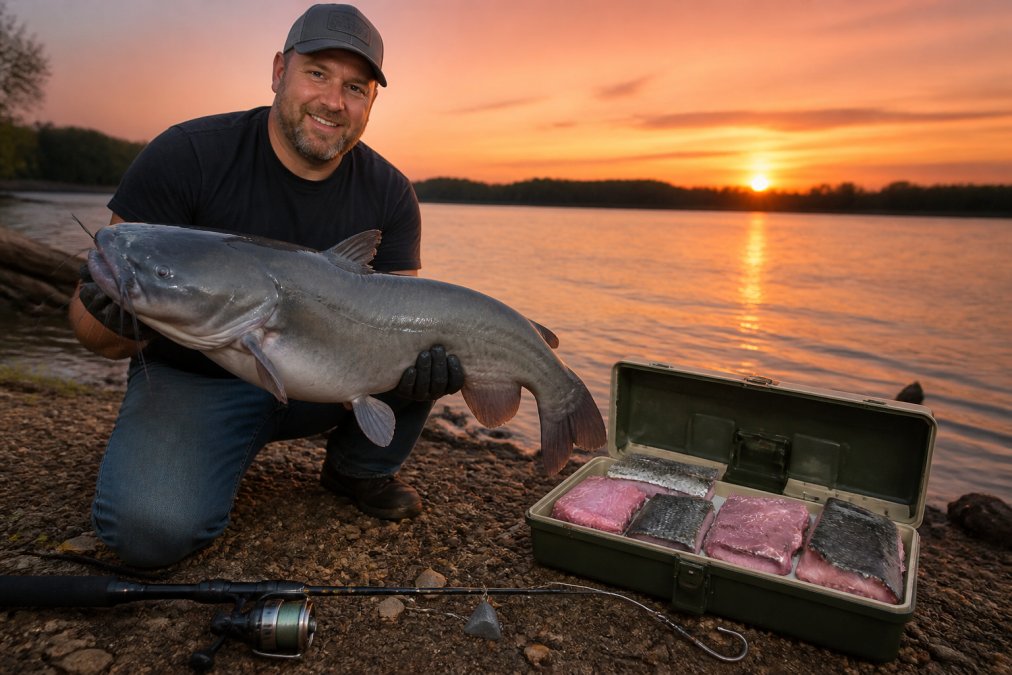
Channel catfish are the most forgiving species for cut bait fishing. They're active scavengers responding to many bait types. Gizzard shad works exceptionally well. They prefer medium-sized chunks (1 to 2 inches) engulfed quickly. Use 2/0 to 4/0 circle hooks for typical 2-15 pound channel catfish.
Blue catfish are larger and more aggressive, preferring bigger chunks (2 to 3 inches) of oily species like shad. They often weigh 10-40 pounds or more, requiring 5/0 to 8/0 hooks and stronger rigging. Both species respond well to scent-infused bait, though blue catfish are more attracted to stronger scent profiles.
Channel catfish remain active at lower temperatures than blue catfish. In early spring or late fall, channel catfish are more reliable targets. In summer, blue catfish become more active and aggressive.
Flathead Catfish and Aggressive Feeders
Flathead catfish prefer live bait but will take fresh cut bait, especially if large and oily. They're ambush predators hunting by sight more than smell, so presentation matters more than scent alone.
For flathead catfish, use larger chunks (3 to 4 inches) rigged on bigger hooks (7/0 to 10/0). Flathead catfish are most active at night. Fish after dark when they're most aggressive.
Ethical and Legal Sourcing of Baitfish
Where your bait comes from matters ethically and legally. Many states regulate which species can be harvested for bait and in what quantities. Some baitfish are protected; harvesting them is illegal. Other species are invasive, and harvesting them is encouraged as environmental management.
Blue River Carp, Inc. uses invasive Asian carp species harvested from the Ohio River. These fish threaten native ecosystems, so harvesting them is both legal and environmentally responsible.
Before harvesting or purchasing bait, check your state's regulations. Gizzard shad and bluegill are legal baitfish in most states, but regulations vary by region and season.
Troubleshooting Bait Failure and Common Mistakes
The most common issue is using bait that's too old or too soft. If your bait falls apart during the cast or within minutes in the water, you're wasting time. This happens with thawed frozen bait left too long, fresh bait in warm tackle boxes, or low-quality preserved bait.
Another common mistake is incorrect rigging. If your bait spins or the bloodline faces the wrong direction, catfish won't detect scent effectively. Practice the through-the-bloodline rig until it becomes automatic.
Water conditions sometimes reduce effectiveness temporarily. In extremely murky water with heavy current, try stronger scent profiles or move to slower current locations. In extremely cold water (below 40°F), catfish are less active and may not respond to bait at all.
Poor hook placement or dull hooks cause missed bites. If you're getting bites but not hooking fish, sharpen or replace hooks.
| Problem | Likely Cause | Solution |
|---|---|---|
| No bites after 30 minutes | Bait too old, wrong location, or no catfish present | Change location, use fresher bait, or try different water |
| Bait falls apart during cast | Bait too soft or thawed too long | Use preserved bait or fresher frozen bait |
| Bites but no hookups | Dull hooks or poor rigging | Sharpen or replace hooks, check bloodline positioning |
| Bait spins in water | Rigging through wrong part of bait | Use through-the-bloodline rig |
| Slow bite rate in cold water | Catfish less active, need stronger scent | Try blood or garlic scent, slow presentation, fish deeper |
Effective cut bait for catfish requires attention to detail. The right species, proper rigging, and appropriate scent profile make the difference between productive days and frustrating ones. Blue River Carp, Inc.'s preserved cut bait eliminates refrigeration hassles and delivers consistent results with a 12-month shelf life. Their 7oz nuggets and 10oz chunks are ready to use straight from the tackle box, with scent-infused options in blood, garlic, and shad profiles matching any water condition. For anglers wanting to simplify their setup and focus on catching fish, the Best 3 Bundle packages offer a complete solution. Start with what works, refine based on local conditions, and you'll catch more catfish consistently.


Frequently Asked Questions
What is the best cut bait to use for catfish?
Gizzard shad and bluegill are top choices for effective cut bait for catfish because of their natural oils and strong scent trails that attract catfish in freshwater environments. Oily fish create longer-lasting scent dispersal, which is critical for bottom-feeding scavengers. Pre-cut bait chunks (approximately 2" x 3") work best for larger species like blue and channel catfish, while smaller nuggets (1" x 2") suit rod and reel fishing. Scent-infused options with garlic or blood additives can increase bite rates.
Why is invasive carp considered a top-tier catfish bait?
Invasive Asian carp species offer multiple advantages: they're high in omega-3 fatty acids and natural oils that create powerful scent trails in current, they're sustainably harvested from waterways where they damage ecosystems, and they stay fresh without refrigeration for 12+ months when properly preserved. The high-fat content can trigger feeding responses in channel, blue, and flathead catfish. This makes carp-based bait both environmentally responsible and highly effective for river fishing applications.
How long does shelf-stable cut bait last?
Quality preserved cut bait can last 12+ months in a resealable bag without refrigeration or freezing, making it ideal for spontaneous fishing trips. The preservation process maintains scent potency and texture throughout storage. This shelf stability prevents the mushy bait problem common with frozen options that thaw on the hook. Proper storage in a cool, dry tackle box keeps bait ready whenever you need it, eliminating the need for coolers or freezer space on your fishing trip.
How do I hook cut bait for catfish to maximize scent release?
Position the hook through the bloodline of the cut bait chunk to maximize scent dispersion into the water column. Use circle hooks (size 2/0 to 8/0 depending on catfish species and bait size) which hook fish naturally in the mouth corner. Thread the hook once through the thickest part of the bait, keeping the chunk intact so it releases scent gradually rather than falling apart. For channel catfish, 1" x 2" nuggets work well; for larger blue and flathead catfish, use 2" x 3" chunks that stay securely on the hook during casting and bottom fishing.
What makes scent-infused cut bait more effective than plain bait?
Scent-infused cut bait benefits come from enhanced flavor profiles and concentrated odor that travels farther in water current than plain bait alone. Garlic spray, blood oil, and shad oil additives trigger multiple sensory responses in catfish, which are scavengers that rely heavily on smell and taste. The combination of natural baitfish scent plus infused attractants creates a stronger scent trail that reaches feeding catfish from greater distances. This increased sensory stimulation can lead to more bites and higher catch rates, especially in deeper water or low-visibility conditions.
This article was written using GrandRanker


