
Why Bait Falls Off Hook: 7 Proven Fixes
Table of Contents
- Why Bait Falls Off Your Hook
- Choosing the Right Hook Size and Type
- How to Thread Bait on a Hook Correctly
- How to Keep Cut Bait on Your Hook
- Using Bait Elastic for Fishing Success
- Casting Techniques That Prevent Bait Loss
- Troubleshooting Bait Slippage Problems
- Conclusion
Why Bait Falls Off Your Hook
Bait falls off your hook because of poor hook selection, incorrect threading technique, weak bait integrity, inadequate securing methods, or casting force that exceeds what your setup can handle. Most anglers assume the problem is their bait quality when it's actually their approach. The good news: fixing bait slippage is straightforward once you understand what's happening.
At Blue River Carp, Inc., we've spent years analyzing why catfish anglers lose bait mid-cast or during the fight. The issue rarely stems from a single factor, it's a combination of hook size mismatches, bait preparation mistakes, and casting mechanics that work against you.
Choosing the Right Hook Size and Type
The foundation of bait retention starts with hook selection. Your hook size, bend, and shank length determine whether bait stays secure or slides off during casting or fighting a fish.
Hook size is measured by the gap, the distance between the hook point and the shank. For catfish, sizes typically range from 2/0 to 8/0. A 4/0 hook works well for medium cut bait chunks (roughly 2 inches by 3 inches), while larger 6/0 or 8/0 hooks handle bigger pieces. The key is matching the hook gap to your bait width.

Hook bend matters more than many anglers realize. Circle hooks have a subtle inward curve near the point, which helps secure bait by creating friction along the shank. J-hooks have a sharper bend, giving you more control over where the bait sits but requiring more precision in threading. For cut bait retention, circle hooks generally outperform J-hooks.
Shank length is the distance from the eye to the bend. A medium to long shank (roughly 2-3 inches) gives you better bait-holding capability by providing more surface area for threading and distributing weight more evenly.
Treble hooks, three-pronged hooks, offer a different advantage. The multiple points distribute the bait across three sections, creating redundancy if one point doesn't hold. Many anglers use treble hooks specifically for soft baits because the extra contact points reduce slippage.
How to Thread Bait on a Hook Correctly
Threading technique determines whether your bait stays put or slides off. The most effective method for cut bait is nose hooking, which uses the bait's firmest section.
Nose hooking means pushing the hook point through the bait's head or thickest end first, then threading the point through the body so it exits near the tail. This approach works because the nose section is denser and grips the hook better, threading lengthwise distributes the bait's weight along the shank, and the hook point anchors deep inside the bait.
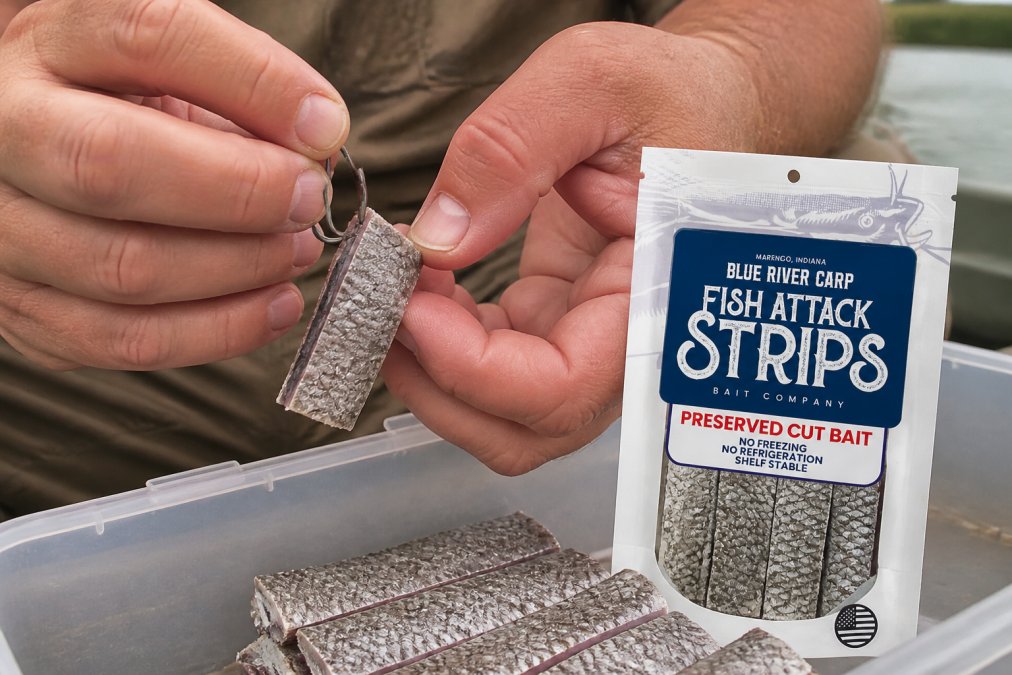
Start by holding the bait firmly between your thumb and forefinger. Position the hook point at the bait's nose and push straight through, angling slightly downward so the point travels through the center rather than along the edge. Continue until the point exits near the tail. The bait should sit snug against the hook shank with no gaps.
Avoid these threading mistakes:
- Threading too shallow (just piercing the skin), the bait will slide off under casting force
- Threading at an angle, this creates leverage that helps the bait slip off the bend
- Threading multiple times, each additional hole weakens the bait's grip on the hook
- Using a dull hook point, dull points require extra pressure, tearing the bait
For smaller bait nuggets (roughly 1 inch by 2 inches), a single nose-to-tail thread is usually sufficient. For larger chunks, some anglers use a second thread perpendicular to the first, creating a cross-pattern. This works but creates more damage to the bait, so reserve this technique for extra-large baits or rough casting conditions.

The hook point should be barely visible after threading, not buried deep and not protruding. A visible point improves hook penetration when a catfish takes the bait.
How to Keep Cut Bait on Your Hook
Cut bait, pieces of fresh or preserved fish, requires specific handling to maintain bait integrity and retention. The bait's firmness directly impacts how well it grips the hook.
Bait consistency matters enormously. Mushy, overly soft bait won't hold the hook shank securely. Premium preserved bait like Blue River Carp, Inc.'s cut bait maintains firmness for months. Standard frozen bait often thaws unevenly, creating soft spots that tear easily during threading or casting.
Temperature affects bait integrity. Cold bait is firmer and grips better. Warm bait becomes mushy and slides off more readily. If you're fishing in summer heat, keep your bait in a cooler or shaded tackle box. Bait that's been sitting in direct sunlight for an hour will be noticeably softer than bait stored in shade.
Bait size consistency helps too. Uniform chunk sizes are easier to thread securely than a mix of large and small pieces. Uniform pieces also seat more predictably on the hook, reducing variables that cause slippage.
For cut bait, avoid handling the piece more than necessary. Each time you handle it, you're damaging the surface and reducing friction with the hook.
Using Bait Elastic for Fishing Success
Bait elastic, specialized thread designed to secure bait, provides a mechanical backup to hook retention. It's not a replacement for proper threading, but rather an additional layer of security.
Bait elastic is a thin, stretchy thread (usually made from rubber or synthetic material) that wraps around the bait and hook to create a spring lock effect. The elastic holds the bait snug against the hook shank, preventing sideways movement that can lead to slippage. maintain fishing gear.
To apply bait elastic:
- Thread your bait onto the hook using the nose-hooking method
- Wrap the elastic around the bait and hook shank, starting near the bait's nose
- Make 2-3 tight wraps, moving toward the tail
- Tie off the elastic with a simple knot or tuck the end under the final wrap
- The elastic should be snug enough to compress the bait slightly but not so tight that it cuts through the flesh
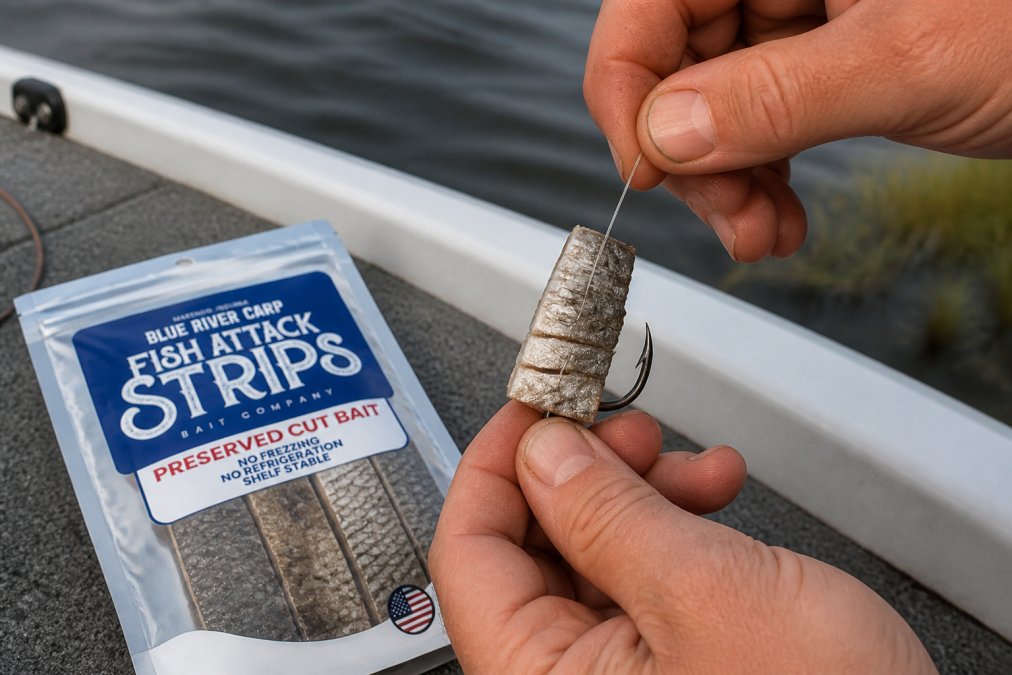
The spring lock effect works because the elastic maintains constant tension, creating mechanical friction that prevents the bait from sliding along the shank. This is especially useful in high-force situations like long-distance casts or fights with large catfish.
When to use bait elastic:
- Casting distance beyond 40 feet
- Using soft bait in warm conditions
- Fishing in current
- Using oversized bait chunks
Casting Techniques That Prevent Bait Loss
How you cast directly impacts whether bait stays on the hook. Excessive casting force, improper grip, and jerky acceleration all contribute to bait slippage.
Casting force is the primary culprit. Many anglers use a hard, fast cast to reach distance, but this creates extreme acceleration that can tear bait off the hook or shift it along the shank. A smoother, more controlled cast keeps bait secure.
During acceleration, the bait experiences inertia that pulls it backward toward the rod. If the hook grip isn't strong enough, the bait slides rearward along the shank. Once it starts sliding, friction decreases further, accelerating the slippage.
Reduce casting force by:
- Using slower acceleration (take 1-2 seconds to build speed rather than snapping hard)
- Releasing the line at the rod's forward position
- Using a smooth, continuous motion rather than jerky acceleration
- Letting the rod's flex do the work instead of muscling the cast
Grip matters too. A loose grip on the rod handle reduces your control and increases erratic acceleration. Hold the rod with moderate pressure, firm enough to control the motion. Your forearm should move in a smooth arc, not jab forward suddenly.
Distance versus bait retention is a real trade-off. A 60-foot cast with moderate force will keep bait on the hook better than an 80-foot cast with hard acceleration. If you're losing bait regularly, reduce your target distance by 10-15 feet and focus on smooth casting mechanics. You'll land more catfish with bait still attached than you will from farther out with bare hooks.
Troubleshooting Bait Slippage Problems
If you're still losing bait despite using correct hook size and threading technique, work through this diagnostic checklist.
Problem: Bait falls off during the cast
This indicates excessive casting force, weak bait grip, or improper threading. Reduce your casting distance by 20 feet and use slower acceleration. If bait stays on, your casting technique is the issue. If it still falls off, check that you're threading nose-to-tail and that the hook point exits cleanly through the bait's body.
Problem: Bait slides off after 5-10 minutes in the water
This usually means the bait has softened from water absorption or temperature. Switch to firmer bait or reduce the time between casting and checking your line. Some anglers recast every 10-15 minutes specifically to refresh the bait and maintain firmness.
Problem: Bait falls off when a catfish takes it
This points to inadequate hook-to-bait ratio or insufficient securing method. Increase your hook size by one increment or add bait elastic to improve mechanical grip. Also check that you're not using oversized bait chunks that create excessive leverage against the hook bend.
Problem: Bait is intact but shifted along the shank
If the bait has slid toward the eye or the bend, your threading wasn't deep enough or your hook gap is too large. Re-thread the bait completely through the body rather than just piercing the nose. Verify your hook size matches your bait size.
Problem: Only one side of the bait stays on
This suggests you threaded at an angle rather than straight through the center. Practice nose-to-tail threading by holding the bait straight and pushing the hook point directly through the center.
When troubleshooting, change only one variable at a time. This systematic approach identifies the real bottleneck.
Bait retention isn't complicated, but it does require attention to detail. The right hook size, proper threading, firm bait, and smooth casting mechanics work together to keep your bait where it belongs, on the hook and in the water where catfish can find it.
If you're using standard bait that softens quickly or loses firmness in warm conditions, upgrading to premium cut bait like Blue River Carp, Inc.'s scent-infused chunks solves a major piece of the puzzle. Our bait maintains firmness for months without refrigeration, which means it grips the hook better and stays secure through casting and fighting fish. Combined with proper technique, quality bait removes one of the most common failure points in catfish fishing.
Start with the hook and threading fundamentals. Get those right, and you'll eliminate most bait-loss problems immediately. Add bait elastic for situations where casting force or water conditions create extra stress. And if your bait is breaking down or turning mushy, switch to shelf-stable bait that maintains integrity regardless of storage conditions.
Frequently Asked Questions
How do I stop bait falling off my hook?
Use a combination of three techniques: match your hook size to your bait (the hook gap should be slightly smaller than the bait's width), thread the bait through the nose for soft baits or thread it lengthwise for cut bait, and secure it with elastic thread wrapped around the shank. Quality bait like cut carp bait stays intact longer because it's firmer and resists slippage better than mushy alternatives.
What's the best way to hook soft bait?
For soft baits, use nose hooking: insert the hook point through the head or nose of the bait and bring it out through the back. This method creates a secure hold because the bait's firmest part grips the hook. Avoid threading through the body, which can tear soft bait. Wrap elastic thread around the hook shank and bait to add a secondary hold that prevents slippage during casting.
Does bait texture affect how well it stays on the hook?
Yes. Firm, dry bait stays on significantly better than mushy or wet bait. Mushy bait tears easily and slides off the hook during casting and when fish bite. Preserved cut bait with a 12+ month shelf life maintains firmness and integrity better than fresh bait that breaks down quickly. Avoid bait that has been stored improperly or exposed to moisture, as it loses its ability to grip the hook.
Should I use one hook or multiple hooks to keep bait on?
A single properly-sized hook with correct threading is usually sufficient. However, treble hooks or multi-hook rigs can help distribute bait weight and create multiple anchor points, reducing slippage. The key is matching hook gauge and bend to your bait size, too small and the bait won't grip; too large and it won't penetrate properly. For most catfish bait, a single hook with elastic thread backup is most effective.
This article was written using GrandRanker