

How to Keep Nightcrawlers Alive for Days: Storage Guide
Table of Contents
- Step 1: Set Up the Right Container and Bedding for Short-Term Storage
- Step 2: Pick the Best Bedding for Nightcrawlers
- Step 3: Dial In Nightcrawler Storage Temperature
- Step 4: How Long Can Worms Go Without Food (and What to Feed Them)
- Step 5: How to Store Nightcrawlers Between Trips
- Troubleshooting Stressed or Dying Nightcrawlers
- Frequently Asked Questions
Last Updated: October 16, 2026
Step 1: Set Up the Right Container and Bedding for Short-Term Storage
Learning how to keep nightcrawlers alive for days starts with one thing: the container, since the right setup is what lets you keep nightcrawlers alive. Get this wrong and nothing else matters. A good setup keeps worms cool, damp, and breathing.
Skip the sealed plastic tub. Worms need air. Use a ventilated bait box or a foam worm cooler with a loose lid. Both hold temperature well and let air move.
Line the bottom with 2 to 3 inches of bedding. Not dirt from the yard. Store-bought bedding or shredded newspaper works better because it holds moisture without packing down.
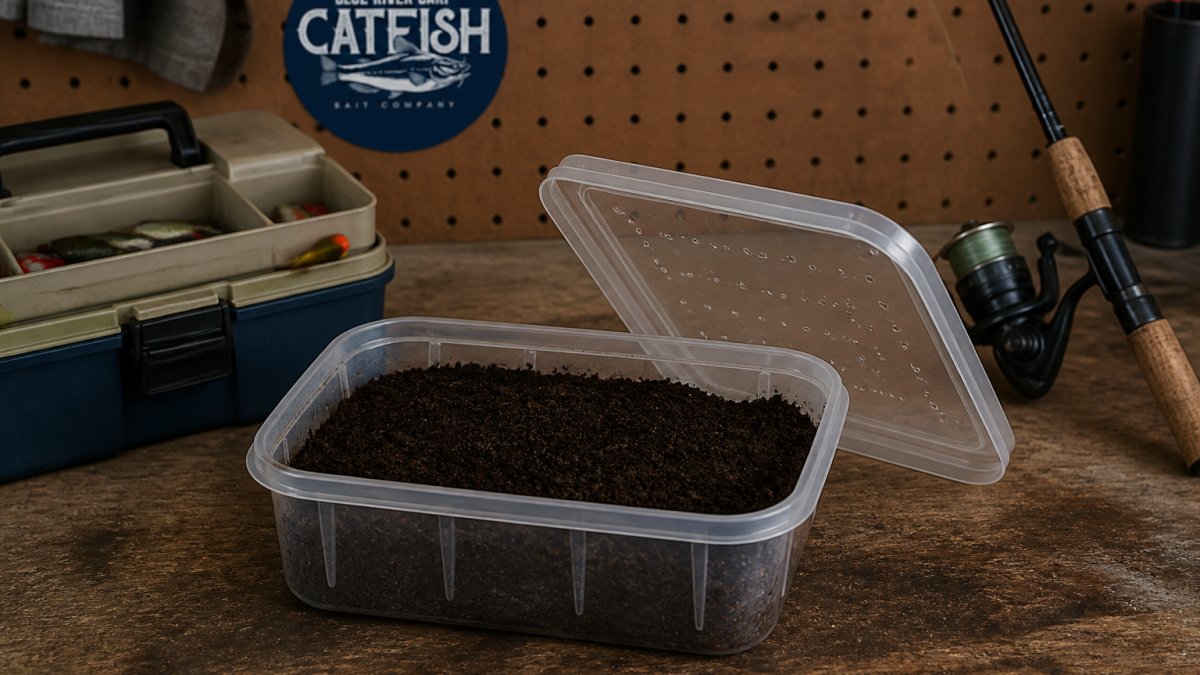
Ventilation, Drainage, and Stocking Density
Air holes matter more than most anglers think. Without them, worms suffocate and turn soft within a day.
Drill or poke small holes in the lid, not the sides. Side holes leak bedding when the box tips.
Drainage is the second half of the puzzle. Worms produce moisture, and wet bedding kills them fast. Add a thin layer of damp, not soaked, material and check for standing water each day.
Stocking density is the part nobody tells you about. A common mistake is cramming a full flat of worms into a small box.
- Keep about one pound of bedding per pound of worms
- Give worms room to move, roughly double their volume
- Split large orders into two containers instead of one deep box
A crowded box heats up. Heat plus moisture equals dead worms.
Step 2: Pick the Best Bedding for Nightcrawlers
The best bedding for nightcrawlers holds moisture, stays loose, and does not sour. That is the whole test. If your bedding packs into a wet brick, worms will not thrive in it.
Here are the options that work, ranked by how easy they are to manage:
| Bedding Type | Moisture Hold | Mess Level | Best For |
|---|---|---|---|
| Shredded newspaper | Medium | Low | Short trips, easy cleanup |
| Peat moss | High | Medium | Multi-day storage |
| Commercial worm bedding | High | Low | Beginners |
| Coconut coir | High | Low | Clean, low-odor storage |
Plain garden soil is the weakest choice. It compacts, dries out fast, and carries pests. Leave the dirt in the yard.
Preparing and Conditioning Bedding Before Worms Go In
Never drop worms into dry bedding. They lose moisture through their skin and dry out quickly.
Condition the bedding first:
- Add water and mix until it feels like a wrung-out sponge
- Let it sit for an hour so moisture spreads evenly
- Squeeze a handful. A drop or two is fine. A stream means too wet
- Fluff it so air pockets remain
This step takes ten minutes and saves your whole batch.
Step 3: Dial In Nightcrawler Storage Temperature
Nightcrawler storage temperature should stay between 50°F and 60°F. Warmer than that and worms get active, burn energy, and die faster. Colder and they slow down, which is fine for a few days but risky near freezing.
A cool, shaded spot works for short storage. A basement corner, a garage shelf out of the sun, or a shaded porch all do the job. What matters is that the spot stays stable, a shelf that swings from 45°F at night to 75°F at midday is worse than a steady 62°F corner.
Why Temperature Matters More Than Most Anglers Think
Nightcrawlers are cold-blooded. Their metabolism tracks the temperature around them. At 50°F to 60°F, they stay calm, use little oxygen, and lose moisture slowly, exactly what you want for a few days of holding. Above 70°F, their metabolism speeds up, they consume bedding moisture faster, and the box can go sour in a day. Below 40°F, they slow to the point of near-dormancy; below 35°F, ice crystals form in their tissue and they do not recover.
That is the mechanism behind the rule: cool is good, warm is fast death, freezing is permanent death.
Refrigerator vs. Cool Shaded Spot: Which Works for a Few Days
For a few days, a shaded spot at 50°F to 60°F is enough. The refrigerator works too, but only in the crisper drawer, never the freezer.
Here is the trade-off:
- Shaded spot: No risk of freezing, easy access, fine for 2 to 4 days. Best if your garage, basement, or porch stays in the 50s to low 60s.
- Refrigerator: Slower worm activity, better for 5 or more days, but cold shock can stun worms. Most household fridges run 35°F to 40°F, which is at the edge of safe for nightcrawlers.
- Freezer: Never. Freezing kills nightcrawlers outright.
If you use the fridge, buffer the cold. Put the worm box inside a second, larger container, or wrap it in a towel, so the bedding sits a few degrees warmer than the fridge air. Check the bedding temperature with a dial thermometer rather than trusting the fridge setting.
Recovering Cold-Stunned Worms Before You Fish
Cold worms move slowly and do not wriggle well on a hook. If your worms have been in the fridge, let them warm up at room temperature for 20 to 30 minutes before you bait up. Do not put them on a hot dashboard or in direct sun to speed it up, that swings the other way and stresses them.
Signs of cold shock: worms balled up tight, barely moving, pale color. Signs of heat stress: worms climbing the walls, limp and pale, sour smell. Both are recoverable if you catch them early. Move the box to the correct temperature range, leave the lid cracked, and give them an hour before you handle them.
Step 4: How Long Can Worms Go Without Food (and What to Feed Them)
How long can worms go without food? A healthy nightcrawler can survive several days without feeding. But they stay livelier, and wriggle better on the hook, if you give them a little food.
Feed lightly. Overfeeding is worse than not feeding at all.
Good worm food includes:
- Cornmeal, a light sprinkle
- Coffee grounds, used and cooled
- Finely ground oatmeal
- Vegetable scraps, no citrus or onion
Sprinkle food on the surface. Worms come up to feed. Remove anything uneaten within a few days so it does not mold.
Step 5: How to Store Nightcrawlers Between Trips
To store nightcrawlers between trips, keep them cool, damp, and dark, then run a short daily check. That routine keeps worms alive for a week or more. The trick is turning vague habits into a repeatable schedule with numbers you can actually hit.
A Day-by-Day Storage Protocol for Short-Term Holding
Most guides blend long-term worm farming with a weekend of fishing. For a few days of storage, the plan is simpler. Here is a day-by-day routine that works for a flat of worms headed to the water in two to five days.
Day 0, Setup. Fill the container with 2 to 3 inches of conditioned bedding. Target 60°F to 65°F bedding temperature at the start, then let it settle toward 50°F to 60°F. Add worms, leave the lid loose, and place the box in a shaded spot or the crisper drawer.
Day 1, First check. Open the lid for 30 seconds to exchange air. Squeeze a handful of bedding: one or two drops of water is the target. If it streams, mix in dry bedding. If it crumbles, mist with dechlorinated water and re-check in an hour.
Day 2, Feed light (optional). If you plan to hold worms past day three, sprinkle a pinch of cornmeal or ground oatmeal across the surface, roughly a teaspoon per dozen worms. Skip feeding if you are fishing tomorrow; a clean gut keeps worms firmer on the hook.
Day 3, Moisture and cull. Re-squeeze the bedding. Pull any worms that are limp, pale, or smell sour. A single dead worm can sour a small box within a day.
Day 4, Temperature check. Aim for 50°F to 60°F. If the box has warmed past 65°F, move it to a cooler spot or add a frozen water bottle wrapped in a towel along one side.
Day 5, Pre-trip prep. Twenty minutes before you leave, pull the worms out at room temperature so they warm up and wriggle. Cold worms hook poorly.
Measurable Targets to Check Every Time
Skip the word 'damp' and use these numbers instead:
- Bedding moisture: wring-out-a-sponge feel; one or two drops from a squeezed handful
- Bedding temperature: 50°F to 60°F for storage; never above 70°F, never below 35°F
- Air exchange: lid cracked or vented; open for 30 seconds once a day
- Check interval: every 24 to 48 hours for the first three days, then daily
- Cull rate: remove any worm that is limp, pale, or foul-smelling the same day you spot it
A cheap dial thermometer stuck into the bedding tells you more than your hand does. So does a squeeze test done the same way every time.
Species Differences: Canadian Nightcrawlers vs. Other Bait Worms
Canadian nightcrawlers, the big ones sold as 'nightcrawlers' in most bait shops, are the least forgiving of the common bait worms. They are field-dug and shipped cool, and they do not handle warmth well. Keep them at 50°F to 60°F, ideally in the low end of that range, and never let the box sit in a warm car or a sunny garage.
European nightcrawlers are more tolerant. They handle slightly warmer and slightly wetter bedding, and they stay lively longer at room temperature, which makes them a better choice for a multi-day trip without refrigeration.
Red wigglers tolerate the warmest and dampest conditions of the three and are the most forgiving if you forget a check. Dew worms behave much like Canadian nightcrawlers and want the same cool setup.
If you are not sure which species you have, err on the cool side and check moisture more often. Cool and slightly dry is safer than warm and wet for every bait worm.
Troubleshooting Stressed or Dying Nightcrawlers
Dying worms usually point to one of three problems: too wet, too warm, or no air. Fix the cause fast and you can often save the rest of the batch.
| Symptom | Likely Cause | Fix |
|---|---|---|
| Worms climbing the walls | Bedding too wet | Drain and add dry bedding |
| Worms limp and pale | Too warm | Move to a cooler spot |
| Strong sour smell | No airflow, spoiled food | Replace bedding, add air holes |
| Worms balled up tight | Cold shock or stress | Warm slowly, do not handle |
Act early. A stressed worm that stays stressed will not wriggle on a hook, and a still worm catches fewer fish.
For anglers who want bait that never needs this kind of babysitting, shelf-stable options solve the problem at the source. That is where Blue River Carp, Inc. comes in. Our scent-infused cut bait, made from invasive carp, holds up for 12+ months with no cooler and no bedding to manage.
Keeping bait alive for days is doable, but it takes the right box, the right bedding, and steady temperature control. Miss one and you are rebaiting with dead worms by mid-trip. If you would rather skip the cooler and the daily checks, Blue River Carp, Inc. offers a simpler path. Our veteran-owned, Indiana-made cut bait stays fresh for 12+ months in the bag, never gets mushy on the hook, and is always ready when you are. Get started with Blue River Carp, Inc. and spend your trip fishing, not fussing over bait.
Frequently Asked Questions
How do you keep nightcrawlers alive for several days?
Use a ventilated container with damp, not soaked, bedding and keep it cool. A 1:1 ratio of bedding to worms by weight works well. Store the container in a refrigerator at 50-55°F or a shaded spot below 65°F. Check moisture daily and mist if the bedding dries. This routine keeps nightcrawlers alive for days without mold or spoilage.
What is the best bedding for keeping nightcrawlers alive?
Shredded black-and-white newspaper, peat moss, and coconut coir are the best bedding for nightcrawlers. Avoid glossy paper, fresh grass clippings, and garden soil with fertilizer or pesticides. Mix bedding with dechlorinated water until it holds together when squeezed but no water drips out. Cured bedding prevents mold and keeps moisture stable for several days.
How long can worms go without food?
Nightcrawlers can survive a week or more without feeding because they consume organic matter in the bedding. For storage of a few days, food is optional. If you keep worms longer, add a small amount of cornmeal or worm food and remove anything uneaten within several days to prevent mold. Overfeeding is a bigger risk than underfeeding.
Can you freeze nightcrawlers for fishing?
Freezing kills nightcrawlers, so it does not work for keeping them alive. Frozen worms turn mushy and fall off the hook. For long-term bait that stays firm, shelf-stable cut bait made from invasive carp lasts 12+ months without refrigeration and holds up on the hook. Live worms need cool storage, not a freezer.


