
How Do You Choose a Catfish Landing Net?
Last Updated: November 11, 2026
Quick Summary
Choose a catfish landing net by matching hoop size and bag depth to the catfish you actually catch, then pick handle reach for your spot. Bank anglers need 8-10 ft handles, boat anglers 6-8 ft, and rubber mesh suits catch-and-release better than nylon.
- Match hoop size and bag depth to your target catfish species and typical weight.
- A net rated for 30 pounds is not a license to lift a 30-pound fish by the handle alone.
- You need a heavy duty catfish net once target fish pass roughly 15 pounds.
- Guide the fish head-first into the bag, keep the hoop low, and lift straight up.
- Rinse your net with fresh water after every trip and dry it fully before storage.
Table of Contents
- Start With the Fish: Matching Your Catfish Net Size to Target Species
- Hoop Size, Bag Depth, and Net Capacity Explained
- Rubber Mesh Fishing Net vs. Nylon: Which Mesh Belongs in Your Boat?
- When You Need a Heavy Duty Catfish Net
- Handle Length and Reach for Bank, Boat, and Shore Fishing
- How to Land a Big Catfish Without Losing It at the Net
- Care, Cleaning, and Storage That Keep a Net Ready
- Pair Your New Net With Bait That Stays on the Hook
- Frequently Asked Questions
Start With the Fish: Matching Your Catfish Net Size to Target Species
The right catfish landing net starts with the fish, not the rack. Match hoop size and bag depth to the catfish you actually catch, and the rest of the decision gets easier.
A catfish landing net is the frame, hoop, mesh bag, and handle used to scoop a hooked catfish out of the water without lifting it by the line.
Catfish species matter more than most guides admit.
- Channel catfish: A mid-size hoop handles most fish. These are the everyday catch for bank anglers.
- Blue catfish: Bigger hoops and deeper bags. Blues run large in open water.
- Flathead catfish: Deep bags matter most. Flatheads are broad and heavy, and a shallow net will not hold them.
If you want the full picture on species behavior and tactics before you size anything, our guide on how to catch catfish effectively covers the groundwork.
Hoop Size and Bag Depth by Fish Weight
Use this as a starting point, then adjust for your water.
| Fish Weight | Hoop Size | Bag Depth | Handle Reach |
|---|---|---|---|
| Under 5 lb | 18-20 in | 18-24 in | 4-6 ft |
| 5-15 lb | 20-24 in | 24-30 in | 6-8 ft |
| 15-30 lb | 24-30 in | 30-36 in | 8-10 ft |
| Over 30 lb | 30+ in | 36+ in | 10 ft or more |
These are practical ranges, not rules. A 20-pound flathead in current needs more bag than the same fish in still water.
Hoop Size, Bag Depth, and Net Capacity Explained
Hoop size sets the target you can hit. Bag depth sets whether the fish stays in once it is inside. Net capacity is the combination of the two, plus how strong the frame and mesh are under load.
A wide hoop is forgiving when a fish rolls at the surface. A deep bag gives a big catfish room to settle instead of thrashing over the rim. But capacity is about weight, not just width. A wide, shallow net looks generous but dumps fish when you lift.
Sizing by Catfish Species and Weight
Use this chart as a starting point, then adjust for current, structure, and how you fish. The hoop and bag dimensions are measured across the rim and from rim to bottom of the bag, respectively.
| Target Catfish | Typical Weight Range | Hoop Size | Bag Depth | Handle Reach | Load Note |
|---|---|---|---|---|---|
| Channel catfish | 1-10 lb | 18-22 in | 20-28 in | 4-8 ft | Most 20-24 in hoops handle these fish with margin |
| Blue catfish | 5-40 lb | 24-32 in | 30-40 in | 8-10 ft | Deep bag matters more than width in open water |
| Flathead catfish | 5-50+ lb | 26-36 in | 34-42 in | 8-12 ft | Broad, heavy fish need a bag that will not roll them over the rim |
| Mixed / unknown | 1-20 lb | 22-28 in | 28-36 in | 6-10 ft | A middle-of-the-road net that covers most trips |
Handle Reach
These are practical ranges, not rules. A 20-pound flathead in current needs more bag than the same fish in still water. A 30-pound blue in a reservoir may fit a 30-inch hoop, but a 30-inch hoop with a 36-inch bag will hold it more securely.
What Load Capacity Actually Means
Net capacity is usually described by the manufacturer as a weight rating, but that rating assumes the load is carried by the frame and bag, not swung by the handle.
- Hoop shape: Round hoops are general purpose. Oval hoops slide under fish in tight spots and fit better in a boat well.
- Bag material weight: Heavier mesh holds shape under a big fish and resists stretching at the rim.
- Frame strength: The hoop must resist bending when you lift a loaded bag; aluminum and composite frames flex differently under load.
- Yoke and lock: The connection between handle and hoop takes the most stress; check that it locks solidly at full extension.
Pick capacity for the biggest fish you realistically catch, then add a margin.
Watch out: a net's weight rating is not a safe-lifting guarantee. Support the bag with a second hand on any fish over roughly 15 pounds, and never hoist a heavy catfish by the handle alone.
Rubber Mesh Fishing Net vs. Nylon: Which Mesh Belongs in Your Boat?
Rubber and coated mesh are generally gentler on fish and snag hooks less than nylon. Nylon is lighter and cheaper, but hooks tangle in it and fish abrasion is worse.
Here is the honest trade-off. Rubber mesh costs more and weighs a little more. Nylon mesh is lighter and packs smaller, which matters if you hike to the bank.
- Rubber or coated mesh: Best for catch-and-release, fewer hook tangles, easier cleanup.
- Nylon mesh: Lighter and cheaper, but hooks catch and fish get scraped.
- Mesh size: Smaller mesh holds small fish and bait; larger mesh drains faster and cuts drag.
When You Need a Heavy Duty Catfish Net
You need a heavy duty catfish net once your target fish pass roughly 15 pounds, or when you fish current, structure, or deep water. At that point, frame strength and bag construction stop being nice-to-haves.
A heavy duty catfish net usually means a stronger frame, a reinforced yoke where the handle meets the hoop, and a deeper bag. Those parts take the load when a big fish surges.
Load Capacity and Safe Lifting Limits
Manufacturers rate nets by a load capacity, but that number describes the frame and bag under a static load, not a swinging lift by the handle.
The connection between handle and hoop is often the weak point on a landing net. That joint fails before the mesh does, especially on telescoping handles where the lock takes the bending load.
- Rated capacity: Treat the manufacturer's rating as an upper bound for a static load, not a target for every fish you land.
- Frame stress: A loaded bag pulls the hoop into an oval; thicker tubing and a reinforced yoke resist that deformation.
- Handle stress: Lifting by the handle alone puts bending force on the yoke and lock; brace the handle against your body or knee and support the bag with a second hand.
- Bag stress: Strong stitching at the rim and a deep bag spread the load instead of concentrating it at the hoop.
Some anglers buy a net rated well above their biggest realistic fish so the frame and yoke have margin when a fish surges at the rim.
Heavy-Duty Features to Check
- Reinforced yoke and locking collar at the handle-to-hoop joint
- Thicker hoop tubing that resists bending under a loaded bag
- Deep bag with strong stitching at the rim and a reinforced bottom
- Handle that locks solidly at full extension, with a metal or heavy-duty composite lock
- Rubber or coated mesh that holds shape and resists hook tangles around treble hooks
Watch out: lifting a big catfish by the net handle alone can bend the frame or snap the yoke. Support the bag with a second hand and keep the lift vertical.
Handle Length and Reach for Bank, Boat, and Shore Fishing
Handle length depends on where you stand. Bank and shore anglers need more reach. Boat anglers need control in a tight space.
For bank fishing, a longer handle lets you reach down steep banks and over rocks without stepping into the water. For boat fishing, a mid-length handle is easier to swing and stow.
- Bank fishing: 8-10 ft handle for steep or rocky banks.
- Boat fishing: 6-8 ft handle for control and storage.
- Shore fishing: 8 ft or more to reach fish in current.
- Telescoping handles: Convenient, but check the lock holds under load.
A common mistake is buying the longest handle you can find. Long handles are harder to control one-handed. Match reach to your actual access point, not the worst case you imagine.
How to Land a Big Catfish Without Losing It at the Net
Landing a big catfish is a sequence, not a scoop. Guide the fish head-first into the bag, keep the hoop low, and lift only when the fish is settled.
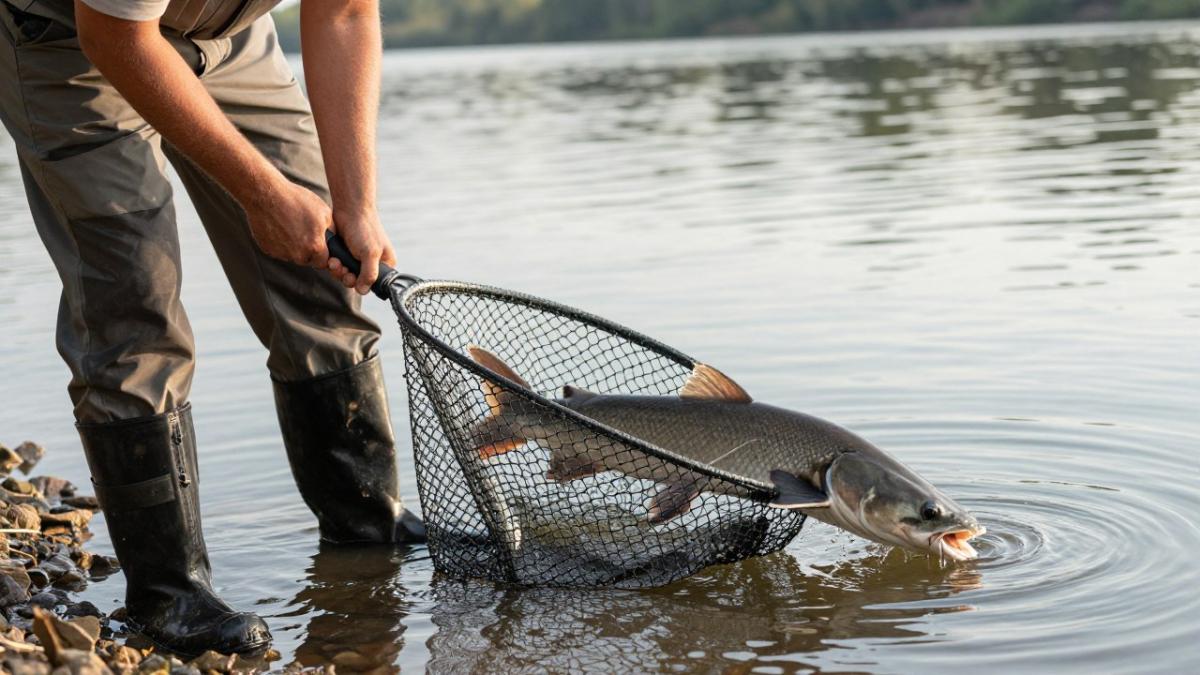
Follow this order:
- Tire the fish first. A green catfish is not ready for the net.
- Position the net in the water before the fish arrives. Do not stab at it.
- Lead the fish head-first into the bag. Catfish do not back out easily.
- Keep the hoop low and let the fish settle into the bag.
- Lift straight up with the handle braced, not with a swinging motion.
- Support the weight with a second hand under the bag on heavy fish.
Watch out: lifting a big catfish by the net handle alone can bend the frame or snap the yoke. Support the bag.
For more strategies on hooking and landing big fish, see our guide on how to catch more catfish.
Care, Cleaning, and Storage That Keep a Net Ready
Rinse your net after every trip and dry it fully before storage. Salt, slime, and bait residue break down mesh and stitching faster than anything else.
Rubber mesh rinses clean quickly. Nylon holds smell and slime, so it needs more attention. Either way, a few minutes after each trip saves the net.
- Rinse with fresh water after every trip.
- Dry fully in the shade before storing.
- Check the yoke and handle lock for wear.
- Store hanging or loosely folded, not crushed under gear.
- Keep a microfiber towel handy for wiping hands, net rims, and boat surfaces.
If you fish messy bait, our guide on gear that makes messy catfish bait easy to handle covers keeping hands and gear clean on the water.
Pair Your New Net With Bait That Stays on the Hook
A bait that stays on the hook keeps your line in the water where it belongs. At Blue River Carp, Inc., we make scent-infused cut bait from invasive carp that holds a 12+ month shelf life with no refrigeration or freezing.
For bait that stays hooked when you put the net to work, read our guide on catfish bait that stays hooked.
The net is the last step in a chain that starts with bait that stays on the hook. If your bait falls off, the best net in the boat never gets used.
Frequently Asked Questions
What size landing net do I need for catfish?
Match the hoop to the fish you expect. A 20-24 inch hoop with a 30-36 inch bag handles channel catfish up to roughly 10 pounds. Step up to a 26-30 inch hoop and a bag at least 40 inches deep for blue and flathead catfish in the 20-50 pound range, and go larger for trophy fish. Undersized hoops are the most common reason big catfish get lost at the boat.
Is a rubber mesh fishing net better for catfish?
Rubber mesh is generally gentler on fish slime and fins than nylon, which can matter if you release fish. Nylon costs less and packs smaller, so it suits anglers who mostly keep fish and want a spare net in the truck.
How do you safely land a large catfish with a net?
Tire the fish first, then lead it head-first into the net rather than chasing it with the hoop. Keep the handle low and let the fish swim over the rim, then lift straight up with one hand on the handle and one on the frame. Do not lift a heavy catfish by the net alone over a gunwale; slide the net aboard or support the fish with a second hand to protect both the frame and the fish.
Do I need a long handle for a catfish landing net?
It depends on where you fish. Bank and shore anglers often need a handle of 6 feet or more to reach fish below a steep bank or around structure. Boat anglers usually do fine with a 4-6 foot handle, and a telescoping model covers both. Check that the handle locks firmly at full extension, since a collapsing handle under load is a common way big catfish escape.


