
How to Catch Catfish Effectively: A Complete Guide
Table of Contents
- Essential Catfish Tackle and Gear Setup
- Best Bait for Catfish: What Actually Works
- Catfish Fishing Rigs for Every Situation
- How to Catch Channel Catfish in Lakes and Rivers
- How to Locate Catfish Using Structure and Depth
- Night Fishing and Seasonal Catfishing Tactics
- Ethical Handling and Conservation for Catfish Anglers
- Troubleshooting: Why You Aren't Catching Catfish
- Frequently Asked Questions
Last Updated: September 19, 2026
Essential Catfish Tackle and Gear Setup
Match your rod, reel, and line to the catfish you're trying to catch catfish from. Channel catfish (2-10 pounds) are the most common target and a medium-heavy setup handles them. Blue and flathead catfish grow much larger, so waters holding those species demand heavier tackle.
Rod, Reel, and Line Requirements
A 7-foot medium-heavy rod with fast action gives you backbone to set a hook and tip sensitivity for light bites. Pair it with a baitcasting reel or a sturdy spinning reel with smooth drag.
- Rod: 7 ft medium-heavy, fast action
- Reel: Baitcasting or 4000-size spinning with reliable drag
- Line: 20-30 lb monofilament or braided
- Hooks: Heavy gauge circle hooks, sizes 5/0 to 8/0
- Terminal tackle: Slip sinkers, barrel swivels, beads
Best Bait for Catfish: What Actually Works
Blue River Carp, Inc. makes shelf-stable cut bait from invasive carp that stays firm on the hook. Their 10oz chunk packages and 7oz nugget packages need no refrigeration and hold up trip after trip.

Catfish Fishing Rigs for Every Situation
Match your rig to the bottom, the current, and the size of fish you expect. Four setups cover almost every situation.
Slip Sinker Rig for Bottom Fishing
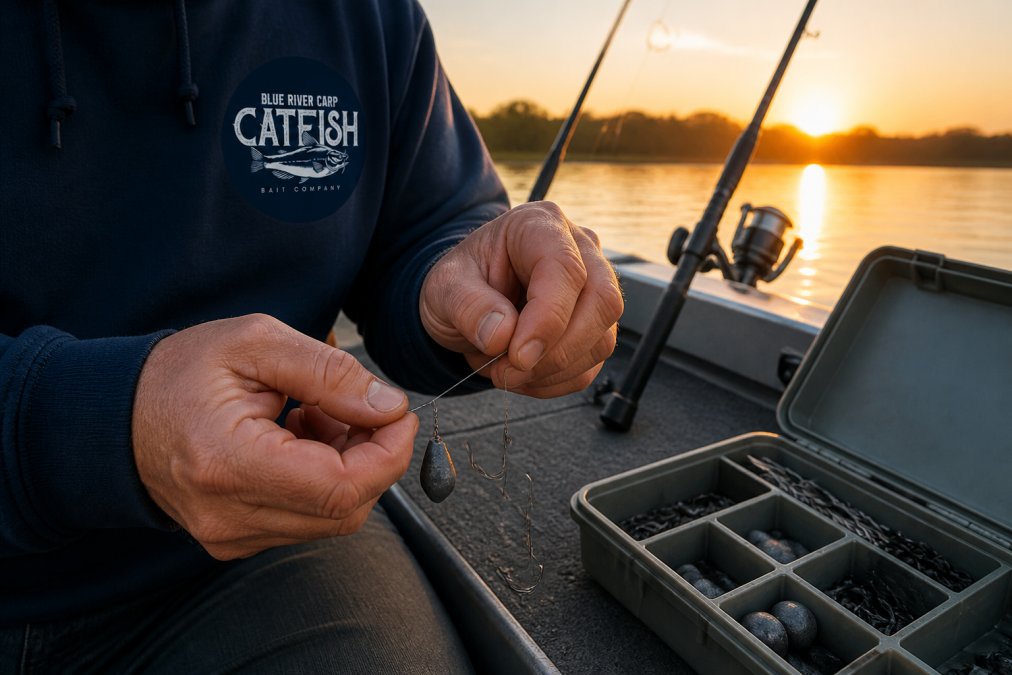
The slip sinker rig is the go-to bottom-fishing setup because a catfish can take the bait without feeling the sinker's weight.
Three-Way Rig for Heavy Current
When the slip sinker rig won't hold bottom, switch to a three-way rig. Tie your main line to a three-way swivel, run a 6-12 inch dropper to a bank sinker heavy enough to hold (often 2-4 ounces in a strong river), and an 18-24 inch leader to your hook.
Santee Rig for Lifting Bait Off Bottom
The Santee rig, also called the Santee Cooper rig, adds a float between sinker and hook. Peg a slip float or foam cigar float a few inches above the hook, with your sinker above it on a short leader.
Drift Rig for Covering Water
When fish are scattered and you have no specific structure to sit on, a drift rig covers water. Use a slip sinker or Santee rig, but let the boat drift with wind or current while you drag bait along the bottom.
- Slip sinker rig: Lakes, ponds, slow rivers; 1/2-2 oz sinker; 12-18 inch leader
- Three-way rig: Strong current; 2-4 oz bank sinker; 18-24 inch leader
- Santee rig: Shallow flats, vegetation, suspended fish; float above hook
- Drift rig: Covering open water; drag a slip or Santee rig behind a drifting boat
Rig Troubleshooting: Why Your Rig Isn't Producing
If you're getting no bites, the rig is often the problem, not the fish.
| Symptom | Rig Problem | Fix |
|---|---|---|
| Bait keeps coming back untouched | Sinker too heavy, bait pinned in silt | Lighten the sinker or switch to a Santee rig to lift bait |
| Constant snags | Bottom rig over timber or rock | Switch to a Santee rig or drift rig |
| Bites but no hookups | Leader too long or hook too small | Shorten leader, step up to a 5/0-8/0 circle hook |
| Rig won't hold in current | Sinker too light | Move to a three-way rig with a 2-4 oz bank sinker |
| Fish feel weight and drop bait | Fixed sinker on a pressured fishery | Switch to a slip sinker rig for a free-sliding line |
How to Catch Channel Catfish in Lakes and Rivers
Channel catfish are the most widespread catfish in the country, and they behave differently in lakes versus rivers. In lakes they roam flats and drop-offs for food; in rivers they sit behind current breaks and wait for food to come to them.
- Lakes: Fish drop-offs and flats, 8-20 feet deep
- Rivers: Target current seams and eddies behind structure
- Best times: Early morning, evening, and after dark
How to Locate Catfish Using Structure and Depth
Finding catfish means finding cover and food. Catfish relate to structure because it breaks current and attracts baitfish, and depth shifts with season, water body, and species.
Read the Water Body Type First
Catfish location strategy changes with the water you're fishing, a reservoir fish behaves differently from a river or pond fish.
- Reservoirs: Catfish follow old creek channels, roadbeds, and submerged timber. The best spots are channel bends, points that drop into deep water, and the edges where a flat meets a channel. Fish the channel edge in summer and the flats in spring and fall.
- Rivers: Current is the whole game. Catfish sit behind current breaks, wing dikes, bridge pilings, rock piles, and the downstream side of bends, and let food come to them. The seam where fast water meets slow water is a highway for catfish.
- Small ponds and lakes: Fish relate to the deepest hole, any submerged brush, and the dam face. In ponds without much structure, the deepest water and the edges of weed beds hold most of the fish.
Use Electronics to Find Structure and Bait
A depth finder shortens the search dramatically. Look for three things: bottom composition changes (hard to soft), baitfish schools, and suspended fish arches.
Depth Ranges by Season
Water temperature drives where fish sit, and the pattern repeats every year.
- Spring (water 55-70°F): Catfish move shallow to feed and spawn. Fish flats, creek mouths, and the backs of coves in 2-10 feet. This is the easiest time of year to find fish.
- Summer (water above 75°F): Fish go deep during the day, often 15-30 feet on reservoirs, and move shallow at night to feed. Target channel edges and deep timber by day, flats and shallow points after dark.
- Fall (water 55-70°F): Fish feed heavily before winter. Cover flats, channel edges, and the mouths of creeks as baitfish move shallow. This is prime time for big fish.
- Winter (water below 50°F): Go deep and slow. Fish the deepest holes, channel bends, and any warm-water discharge. Bites are fewer but often bigger.
Follow the Bait, Not the Calendar
The biggest factor in locating catfish is finding where baitfish concentrate. Fish follow food, so find the bait and you'll find the catfish.
Locating Fish When You Have No Electronics
You don't need a fish finder to find catfish. Work the bank and read the surface.
- Look for current seams, eddies, and foam lines on rivers, these mark current breaks where catfish sit.
- On lakes, cast toward points, laydowns, and the edges of weed beds, and fan your casts across depth zones until you find fish.
- Watch for birds and surface activity at dawn and dusk; both signal baitfish, and baitfish signal catfish.
- Fish the windblown bank. Wind pushes plankton, plankton pulls baitfish, and baitfish pull catfish.
Night Fishing and Seasonal Catfishing Tactics
Catfish feed most actively after dark, especially in summer, when they're on the move and less spooky.
Season by season:
- Spring: Fish shallow flats and creek mouths as water warms. Fish are feeding hard after winter.
- Summer: Fish deep during the day, shallow at night. Target current seams in rivers.
- Fall: Fish feed heavily before cold water slows them down. Cover flats and channel edges.
- Winter: Go deep and slow. Cold water tactics mean fishing the deepest holes and waiting longer for bites.
Ethical Handling and Conservation for Catfish Anglers
Good handling keeps fish healthy and protects the fishery. Wet your hands before touching a catfish, support its belly and head, and never lift a big catfish by the jaw alone.
Troubleshooting: Why You Aren't Catching Catfish
If fish aren't biting, the problem is usually one of four things: wrong spot, wrong depth, wrong bait, or wrong presentation.
Work through this checklist:
| Problem | Likely Cause | Fix |
|---|---|---|
| No bites at all | Fish aren't there | Move to new structure or depth |
| Bites but no hookups | Hook too small or dull | Switch to heavy gauge circle hooks |
| Bait gone, no fish | Small fish stealing bait | Use bigger chunks or live bait |
| Fish short-striking | Bait too soft | Use firmer cut bait that stays on the hook |
Frequently Asked Questions
What is the best bait for catfish?
The best bait for catfish depends on the species and water conditions. Channel catfish respond well to stinkbait, cut bait, and chicken liver. Blue catfish prefer fresh cut bait like shad or skipjack. Flatheads go after live bait such as bluegill. Pre-cut preserved bait chunks and nuggets offer a mess-free alternative that stays on the hook longer and does not require refrigeration, making them practical for anglers who fish spontaneously or want to avoid the hassle of fresh bait.
What time of day is best for catching catfish?
Catfish feed most actively from dusk through the early morning hours, especially during summer. Night fishing puts you in the prime window when channel catfish and blue catfish move shallow to feed. During cooler months, catfish often bite throughout the day. Overcast conditions and rising water after rain also trigger feeding activity regardless of the clock. Focus your efforts on the two hours before and after sunset for the most consistent results.
How do you locate catfish in deep water?
Catfish in deep water concentrate around structure: drop-offs, channel ledges, submerged timber, and current seams where food collects. Use a depth finder to mark bottom transitions and baitfish schools. On rivers, target the outside bends of channels where current slows. In lakes, look for points and humps that drop from shallow flats into deeper water. Catfish relate to the bottom most of the time, so keep your bait near the substrate where scent trails disperse effectively.
Should you grab a catfish by the mouth?
No. Catfish have sharp pectoral and dorsal spines that can cause painful puncture wounds. Instead, slide your hand under the belly and support the fish's weight, or grip behind the head with your thumb and fingers around the pectoral spines. Use a wet hand or landing glove to protect the fish's slime coat. If you plan to release the catfish, keep it in the water as much as possible and use a net or lip grip designed for catfish to minimize stress and injury.
Catfish fishing rewards patience and the right setup, but the bait on your hook often makes the difference between a slow day and a full stringer. Blue River Carp, Inc. makes shelf-stable cut bait that stays firm cast after cast, with no cooler or freezer needed. Their 10oz chunk packages and 7oz nugget packages target big catfish, while their scents and oils build a scent trail that pulls fish in. Get started with Blue River Carp, Inc. and keep your bait ready for every trip.