
How to Rig Circle Hooks for Catfish: A 2026 Guide
Table of Contents
- Why Circle Hooks Outperform J-Hooks for Catfish
- Best Circle Hook Size for Catfish: Matching Hook to Species
- Terminal Tackle Setup: Leader, Sinker, and Knots
- Step-by-Step: How to Rig a Circle Hook for Catfish
- What You'll Need
- Step 1: Attach the Leader to the Swivel [Time: 1 minute]
- Step 2: Thread the Sinker Slide [Time: 1 minute]
- Step 3: Tie the Snell Knot [Time: 2 minutes]
- Step 4: Add the Sinker and Bait [Time: 1 minute]
- Baiting Techniques: Using Scent-Infused Cut Bait for Catfish
- How to Set a Circle Hook: The Steady Pull Method
- Common Mistakes and Seasonal Adjustments
- Conclusion
- Frequently Asked Questions
Last Updated: September 16, 2026
Why Circle Hooks Outperform J-Hooks for Catfish
Circle hooks for catfish have become the standard for anglers tired of gut-hooked fish and missed strikes. The point turns back toward the shank, so it slides to the corner of the mouth as the fish turns away instead of lodging deep in the throat.
Best Circle Hook Size for Catfish: Matching Hook to Species
The best circle hook size for catfish depends on the fish you target. Channel and blue catfish run smaller, flatheads run big, and your hook needs to match the mouth you are aiming for.
Use this as a starting point:
| Target Species | Typical Size Range | Circle Hook Size | Bait Size |
|---|---|---|---|
| Channel catfish | Small to medium | 6 to 4 | Nuggets, small cut bait |
| Blue catfish | Medium to large | 5 to 2 | Chunks, cut bait |
| Bullhead | Small | 8 to 6 | Small nuggets |
| Flathead | Large | 4 to 1/0 | Large chunks, live bait |
Terminal Tackle Setup: Leader, Sinker, and Knots
Build your terminal tackle around the hook. For most catfish rigs, a snell knot on a mono or fluorocarbon leader, a swivel to stop line twist, and a sinker slide above it gives you a clean, tangle-resistant setup.
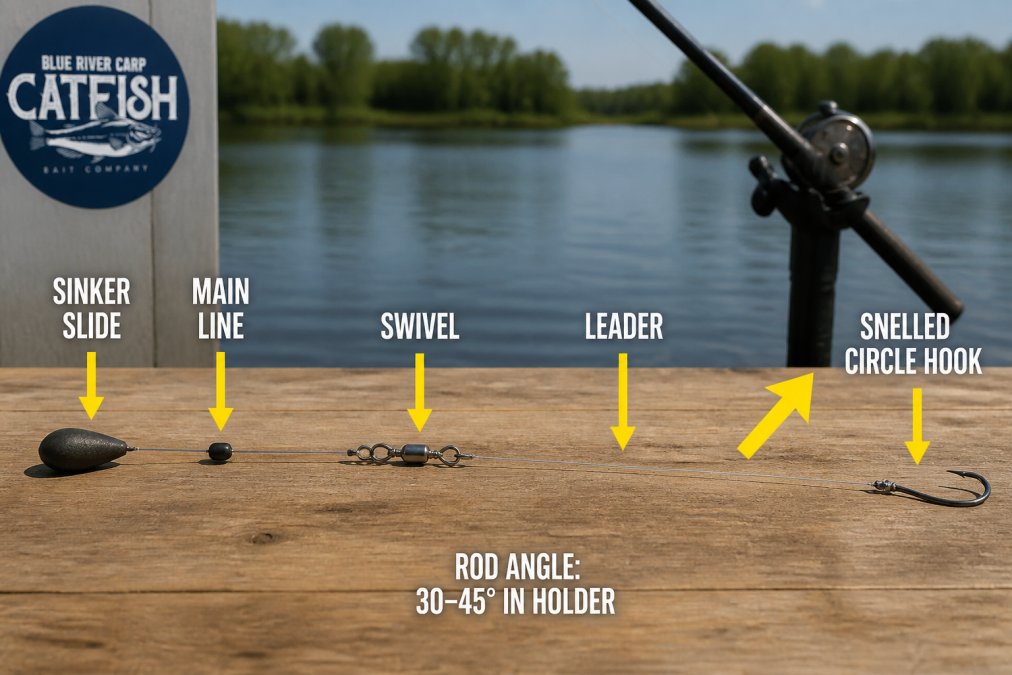
- Main line: 20 to 30 lb braid for sensitivity and thin diameter in current, or 15 to 25 lb monofilament for stretch that absorbs head shakes.
- Sinker slide: a plastic or brass slide that lets the weight travel freely so a fish can pick up bait and move off without feeling the sinker, the most important piece for hook-up ratio on a circle hook rig.
- Swivel: a size 7 to size 10 barrel swivel connects leader to main line and cuts twist. Match its rated strength to your leader, not your main line.
- Leader: 12 to 24 inches of monofilament or fluorocarbon. Go shorter (12 to 15 inches) in heavy current or pressured fish; longer (18 to 24 inches) in clear, still water.
- Hook: your circle hook, tied with a snell knot so the leader exits the eye on the hook's point side.
Rod Action and Line Tension: The Part Most Guides Skip
The rod is part of the terminal tackle. A circle hook needs steady, building tension to rotate into the jaw, and the rod delivers it. The wrong action either smothers the take or fails to load.
- Medium-heavy, fast-tip rods (7 to 8 ft): the best all-around choice for channel and blue catfish. The soft tip shows a soft take before the fish feels pressure, and the backbone loads smoothly when the fish turns away.
- Heavy, fast-action rods: useful for flatheads and big blues around cover, but too stiff to show a light take. Pair them with a looser drag so the fish can move off and load the rod.
- Slow, parabolic rods: forgiving on the fight but slow to load, which can let a fish drop the bait. Use a baitfeeder-style reel or clicker so the fish can run and load the rod for you.
Step-by-Step: How to Rig a Circle Hook for Catfish
Rigging a circle hook for catfish takes about two minutes once you have done it a few times. The sequence matters: leader first, knot second, bait last.
Total Time: 5 minutes Difficulty: Beginner
What You'll Need
- Circle hook in your target size
- 12 to 24 inches of monofilament or fluorocarbon leader
- Swivel
- Sinker slide and sinker
- Cut bait or nuggets
Step 1: Attach the Leader to the Swivel [Time: 1 minute]
Tie your leader to one end of the swivel with a clinch or palomar knot. Pull it tight and trim the tag end.
Expected Result: A secure leader-to-swivel connection that will not slip under load.
Step 2: Thread the Sinker Slide [Time: 1 minute]
Slide the sinker slide onto your main line, then tie the main line to the other end of the swivel. The slide should move freely above the swivel.
Expected Result: A sinker that travels on the main line without binding.
Step 3: Tie the Snell Knot [Time: 2 minutes]
Pass the leader through the eye of the hook from the point side, form a loop along the shank, and wrap the tag end around both the shank and the standing line five to seven times. Pass the tag back through the loop and pull steadily until the wraps seat against the eye.
Expected Result: A knot that pulls the hook straight and keeps the leader aligned with the point.
Step 4: Add the Sinker and Bait [Time: 1 minute]
Clip or thread your sinker onto the slide, then bait the hook so the point and gap stay fully exposed. Cast, set your rod holder, and wait.
10oz Package (Chunks) - Preserved →
Expected Result: A rig that sits on the bottom with the hook point clear and ready.
Baiting Techniques: Using Scent-Infused Cut Bait for Catfish
Using scent-infused cut bait for catfish solves two problems at once: it puts smell in the water and stays on the hook. Catfish hunt by scent first, so a bait that bleeds flavor and holds together through a cast beats a fragile bait every time.
How to Set a Circle Hook: The Steady Pull Method
How to set a circle hook comes down to one instruction: do not set it. When a catfish takes the bait, let the fish load the rod, then reel down and pull with steady pressure until the line comes tight. The hook finds the corner of the mouth on its own.
Here is the sequence when a fish takes:
- Watch the rod tip. A tap or a slow load means the fish has the bait.
- Do not jerk. Let the fish turn and move off.
- Reel down until the line comes tight and you feel weight.
- Pull with a steady, sweeping motion, not a snap.
- Keep tension and start reeling. The fish is already hooked.
How Species Changes the Pull
The steady pull is the same motion for every catfish, but the timing and the amount of pressure change with the fish you are targeting.
- Channel catfish: the most aggressive and forgiving. They turn and run hard, so the hook seats fast. Reel down and pull as soon as the rod loads; a medium-heavy rod with a quarter-strength drag is plenty.
- Blue catfish: often pick up bait and move off slowly, especially big fish. Give them a beat longer before you reel down, pull too early and you pull the bait out before the hook rotates. A slow, building sweep works better than a quick one.
- Flathead catfish: the trickiest on a circle hook because they often grab live bait and hold it without moving. Do not wait for a run that may never come. Reel down until you feel weight, then lean into a steady pull. Flatheads have a wide, bony jaw, so use a hook with a wide enough gap to clear it, a 4 to 1/0 circle hook is the common range.
- Bullhead: small and quick. Downsize the hook and bait and expect a fast take; the same steady pull applies, scaled down.
How Season Changes the Pull
Water temperature changes how hard a catfish takes and how long you should wait before applying pressure.
- Cold water (below about 50°F): catfish are sluggish and mouth bait softly. Downsize your hook and bait, give the fish more time before you reel down, and use a lighter drag. A nugget-sized bait on a 6 to 4 hook beats a big chunk on a 1/0.
- Cool water (50 to 65°F): a transition period. Fish are waking up but not aggressive. Keep the smaller hook and bait, and expect a slow, deliberate take.
- Warm water (above 65°F): fish feed hard and take fast. Size up your hook and bait, and reel down and pull sooner because the fish is already moving off with the bait.
The One Mistake That Kills Hook-Up Ratio
The most common failure is treating the take like a J-hook strike. Snap the rod and you pull the hook straight out of the mouth before it can rotate. The second is slack line: if the line goes slack after the take, the fish can drop the bait before tension builds. Keep light tension from the moment you see the take and let the fish do the work.
Common Mistakes and Seasonal Adjustments
The biggest mistakes with circle hooks all come from treating them like J-hooks: snap the rod and you pull the hook out of the mouth, bury the point in bait and you never get a bite, use a hook too small and it cannot rotate.
Watch for these:
- Hard hook sets that rip the hook free before it seats.
- Bait covering the hook point and gap.
- Undersized hooks that cannot clear the jaw.
- Slack line that lets the fish drop the bait before tension builds.
- Rod holders set too loose, so the rod never loads on the take.
Conclusion
The gap between a frustrating night and a full stringer comes down to two things: a hook sized right and bait that stays put. Get the snell knot right, keep the point clear, and fight every instinct to jerk the rod. The fish will hook itself.
Frequently Asked Questions
Are circle hooks good for catfishing?
Circle hooks are excellent for catfishing because they hook fish in the corner of the mouth, reducing gut-hooking and making release easier. Their design allows the hook to set automatically as the fish swims away, so you don't need to jerk the rod. This leads to higher hook-up percentages, especially with cut bait. Many anglers find circle hooks outperform J-hooks for catfish, particularly when using a rod holder and letting the fish hook itself.
How do you properly set the hook with circle hooks?
To set a circle hook, avoid a hard jerk. Instead, reel down until you feel tension, then apply a steady pull. The hook will rotate and catch in the corner of the fish's mouth. Jerking can pull the hook out before it sets. Let the fish swim away with the bait, then engage the reel and pull smoothly. This method works well with circle hooks for catfish and ensures solid hook penetration.
What is the best size circle hook to use for catfish?
The best circle hook size for catfish depends on the species and bait size. Using scent-infused cut bait chunks of 2x3 inches pairs well with larger hooks, while nuggets are suitable for smaller hooks. Always check local regulations for hook size limits.
What is the best leader length for catfish rigs?
Leader length varies with conditions. A 12- to 18-inch leader is common for most catfish rigs using circle hooks. Adjust based on bait presentation and rod holder setup.