
Choosing the Right Hook Size for Catfish Bait
Table of Contents
- Why Hook Size Matters More Than You Think
- The Best Circle Hook Size for Catfish
- Hook Size for Cut Bait: Matching Bait to Hook
- Catfish Hook Size Chart: A Quick Reference
- Matching Hook Size to Catfish Species
- Common Mistakes When Choosing Hook Size
- Hook Maintenance and Sharpening Tips
- Frequently Asked Questions
Last Updated: September 15, 2026
Why Hook Size Matters More Than You Think
Choosing the right hook size for catfish bait determines whether a catfish gets hooked at all. Too small for a big channel cat and the point never clears the lip; too large for a pan-size fish and you're dragging a door hinge.
At Blue River Carp, Inc., we talk to catfish anglers every week, and the pattern is consistent: bait gets blamed for missed fish when the real culprit is terminal tackle. A hook mismatched to your bait and target species fails no matter how good the bait is.
The American Sportfishing Association's angler participation data confirms catfishing remains one of the most accessible entry points into the sport, which means a lot of new anglers are learning hook selection by trial and error. That's expensive.
Hook size, gap, and wire gauge all interact with bait size and fish size. Get the combination right and your hook-up ratio climbs; get it wrong and you'll watch fish spit bait all afternoon.
The Best Circle Hook Size for Catfish
The best circle hook size for catfish depends on your target fish, but a 5/0 to 8/0 circle hook covers most channel and blue catfish situations. For flatheads, step up to 8/0 through 10/0. For pan-size catfish under two pounds, a 2/0 to 4/0 works fine.
Circle hooks rotate and catch in the corner of the mouth as the fish turns away. That rotation is why gap matters more than overall length, a wide gap gives the hook room to pivot.
Circle Hooks vs. J-Hooks: Which One Hooks More Fish?
Circle hooks win on hook-up ratio for most catfish applications, especially bottom fishing with cut bait. J-hooks require a deliberate hookset that many anglers mistime; circle hooks set themselves as tension builds.
The tradeoff: J-hooks let you strike immediately, which some anglers prefer for live bait or heavy cover. Circle hooks also reduce deep hooking, which matters if you release fish.
Hook Size for Cut Bait: Matching Bait to Hook
Choosing the right hook size for catfish bait starts with matching hook size to bait size, then adjusting for your target species. Too small a hook buries the point in the bait chunk; too large a hook lets the bait slide up the shank on every cast.
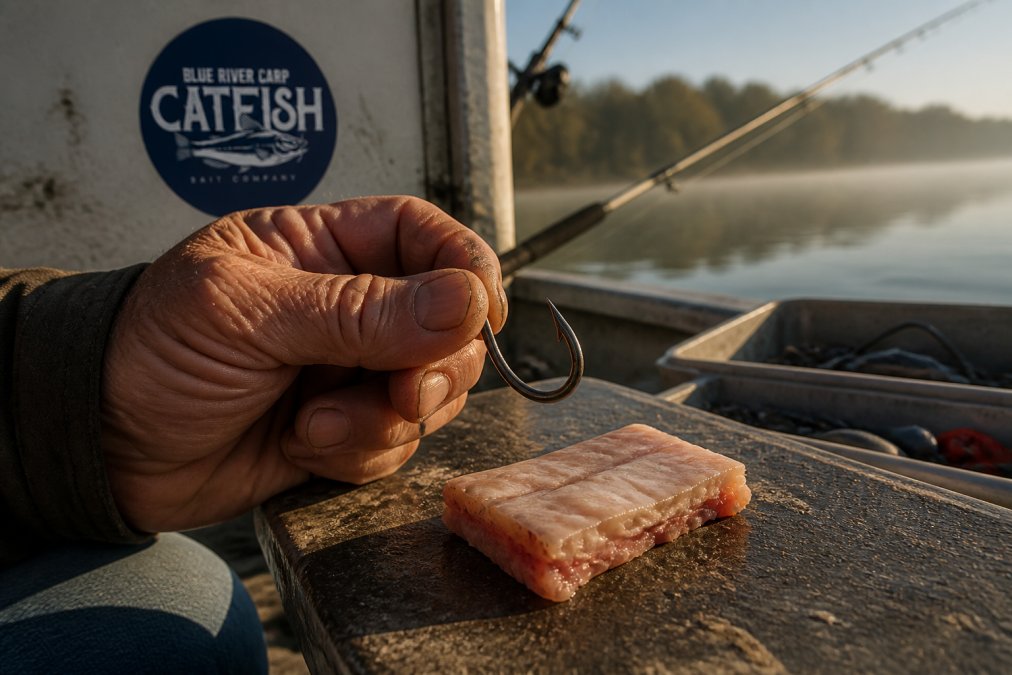
For cut bait, you want the hook point fully exposed and the bait sitting on the bend. Blue River Carp, Inc. pre-cuts bait into consistent sizes for exactly this reason: the 7oz nuggets (about 1 inch by 2 inches) pair well with 4/0 to 6/0 hooks, while the larger 10oz chunks (about 2 inches by 3 inches) suit 6/0 to 8/0 hooks.

That consistency matters. When every piece is the same size, you stop guessing and start dialing in your setup.
Live Bait vs. Cut Bait Hook Selection
Live bait demands a different approach: baitfish move, so you need a hook that keeps them attached without killing them. A 3/0 to 5/0 circle hook through the back or lips works for most presentations (How To Catch Catfish). Cut bait is more forgiving because it doesn't fight back.
For live bait, drop one size from what you'd use with cut bait of the same volume. The bait is denser and more active, so a slightly smaller hook penetrates more reliably.
Catfish Hook Size Chart: A Quick Reference
Use this chart as a starting point, then adjust for water clarity, current, and how the fish are feeding.
| Target Fish | Bait Type | Recommended Hook Size | Hook Style |
|---|---|---|---|
| Channel catfish (pan-size, under 2 lb) | Cut bait nuggets | 2/0 - 4/0 | Circle |
| Channel catfish (2-10 lb) | Cut bait chunks | 4/0 - 6/0 | Circle |
| Blue catfish (10-30 lb) | Large cut bait | 6/0 - 8/0 | Circle |
| Flathead catfish (20 lb+) | Live bait | 8/0 - 10/0 | Circle or J-hook |
| Bullhead catfish | Small cut bait | 1/0 - 2/0 | Circle |
Matching Hook Size to Catfish Species
Species is the first filter, but weight and length tell you which hook to tie on. The three main targets have different mouth anatomy, feeding styles, and size ceilings that drive hook selection more than any single "best size" recommendation.
Channel Catfish
Channel cats are the most common target and the most forgiving. They have a moderate gape, feed aggressively on cut and prepared baits, and most fish run 1 to 10 pounds and 12 to 24 inches, which a 4/0 to 6/0 circle hook handles comfortably. Fish under 2 pounds and 14 inches take a 2/0 to 4/0 cleanly; fish over 10 pounds and 24 inches justify a 6/0 to 8/0, because jaw thickness increases with age and a smaller hook may not rotate deep enough to lock in the corner of the mouth.
Blue Catfish
Blue cats get big and pull hard. Their mouths are thick and bony, with a wider gape than a channel cat of the same length, a 10-pound blue has a noticeably heavier jaw than a 10-pound channel. Step up to 6/0 for 5 to 15 pounds, 8/0 for 15 to 30, and 10/0 or larger past 30 pounds and 36 inches. The gap has to clear the jaw cartilage, and the shank has to survive the initial run without straightening, this is where wire gauge becomes the reason you land the fish.
Flathead Catfish
Flatheads are ambush predators that prefer live bait and have wide, crushing mouths. They tend to swallow bait deep, which is why circle hooks make sense here even though many flathead anglers grew up on J-hooks. An 8/0 to 10/0 with a wide gap is the standard starting point for fish over 20 pounds and 30 inches; smaller flatheads in the 5 to 15 pound range fish fine on 6/0 to 8/0. Because flatheads engulf rather than nibble, the hook needs enough gap to rotate around the jaw as the fish turns, a narrow-gap hook in a wide mouth is a missed fish waiting to happen.
Bullhead and Small Channel Cats
Bullheads and pan-size channel cats under 1 pound and 10 inches are a different game. Their mouths are small, and a 4/0 hook physically won't fit in the corner of the jaw. Use 1/0 to 2/0 circle hooks with small cut bait or worms. Oversizing here is the single most common reason anglers miss bullheads all night and blame the bite.
Quick Weight-to-Hook Reference
| Target Fish | Typical Weight | Typical Length | Recommended Hook Size |
|---|---|---|---|
| Bullhead | Under 1 lb | Under 10 in | 1/0 - 2/0 |
| Channel catfish (small) | 1 - 2 lb | 12 - 14 in | 2/0 - 4/0 |
| Channel catfish (eating size) | 2 - 10 lb | 14 - 24 in | 4/0 - 6/0 |
| Channel catfish (trophy) | 10 - 20 lb | 24 - 30 in | 6/0 - 8/0 |
| Blue catfish (mid) | 5 - 15 lb | 20 - 30 in | 6/0 - 8/0 |
| Blue catfish (large) | 15 - 30 lb | 30 - 36 in | 8/0 - 10/0 |
| Blue catfish (trophy) | 30 lb+ | 36 in+ | 10/0+ |
| Flathead (mid) | 5 - 15 lb | 20 - 30 in | 6/0 - 8/0 |
| Flathead (large) | 20 lb+ | 30 in+ | 8/0 - 10/0 |
Common Mistakes When Choosing Hook Size
Hook Maintenance and Sharpening Tips
The Thumbnail Test
Sharpening Technique
Hook Material and Coating: What You're Actually Buying
Water Clarity and Hook Visibility
Storage and Corrosion Prevention
Frequently Asked Questions
What hook is bigger, #1 or #8?
A #1 hook is larger than a #8 hook. Hook sizes work in reverse: as the number increases, the hook gets smaller. So a #1 is bigger than a #2, which is bigger than a #4, and so on. For catfish, most anglers use sizes between #1 and 5/0, depending on the species and bait size.
Why are circle hooks better for catfish?
Circle hooks are better for catfish because they hook the fish in the corner of the mouth, reducing gut-hooking and making release easier. They also provide a higher hook-up ratio when bottom fishing with cut bait. The curved point and offset design help the hook slide into position as the catfish moves away with the bait.
Do I need a different hook size for channel cats versus flatheads?
Yes. Channel catfish have smaller mouths. Flatheads grow larger and eat bigger prey, so use a larger hook with live bait or large cut bait. Blue catfish fall in between, often taking a mid-range hook depending on the size of fish in your area.
How does bait size influence the hook size I should choose?
Bait size directly affects hook size. A good rule is to leave the hook point and barb fully exposed after baiting. If you use a 2-inch cut bait chunk, a smaller hook keeps the point clear. For larger 3-inch chunks, step up to a larger hook. Blue River Carp's 10oz chunks (about 2x3 inches) and 7oz nuggets (about 1x2 inches) are designed for effective hook presentation.