
How to Rig Ready-to-Use Catfish Bait for More Hookups
Table of Contents
- Start With the Right Rig for Your Fishing Situation
- Catfish Rigs for Beginners: The Slip-Sinker Setup
- Carolina Rig Setup for Ready-to-Use Bait
- Catfish Rigs for Bank Fishing That Hold Bottom
- How to Use an Eagle Claw Catfish Rig With Shelf-Stable Bait
- Hook Size, Bait Portion, and Placement for Ready-to-Use Bait
- Troubleshooting Bait Loss, Missed Hookups, and Stale Bait
- Stock Your Tackle Box With Bait That Stays Ready
- Frequently Asked Questions
Last Updated: November 5, 2026
Start With the Right Rig for Your Fishing Situation
Learning how to rig ready-to-use catfish bait starts with one decision: where the fish are and what the water is doing. A rig that works on a still pond bank will fail in a fast river. This guide focuses on pairing ready-to-use bait with the right setup.
The rule is simple. Match the rig to the water, not the other way around.
Current, Depth, and Bottom Conditions
Fast current calls for more weight. Deep water calls for a longer drop to the bait. Snaggy bottoms call for a rig that lifts the bait slightly off the structure.
Here is how we think about it:
- Strong current: heavier sinker, shorter leader, cast upstream
- Deep holes: slip rig so the fish can take line without feeling the weight
- Mud or soft bottom: bait sits on top, so keep the hook gap clear
- Rock and timber: expect snags, so carry extra rigs
Check the U.S. Fish and Wildlife Service guide to recreational fishing for state rules on gear and seasons before you fish unfamiliar water.
Catfish Rigs for Beginners: The Slip-Sinker Setup
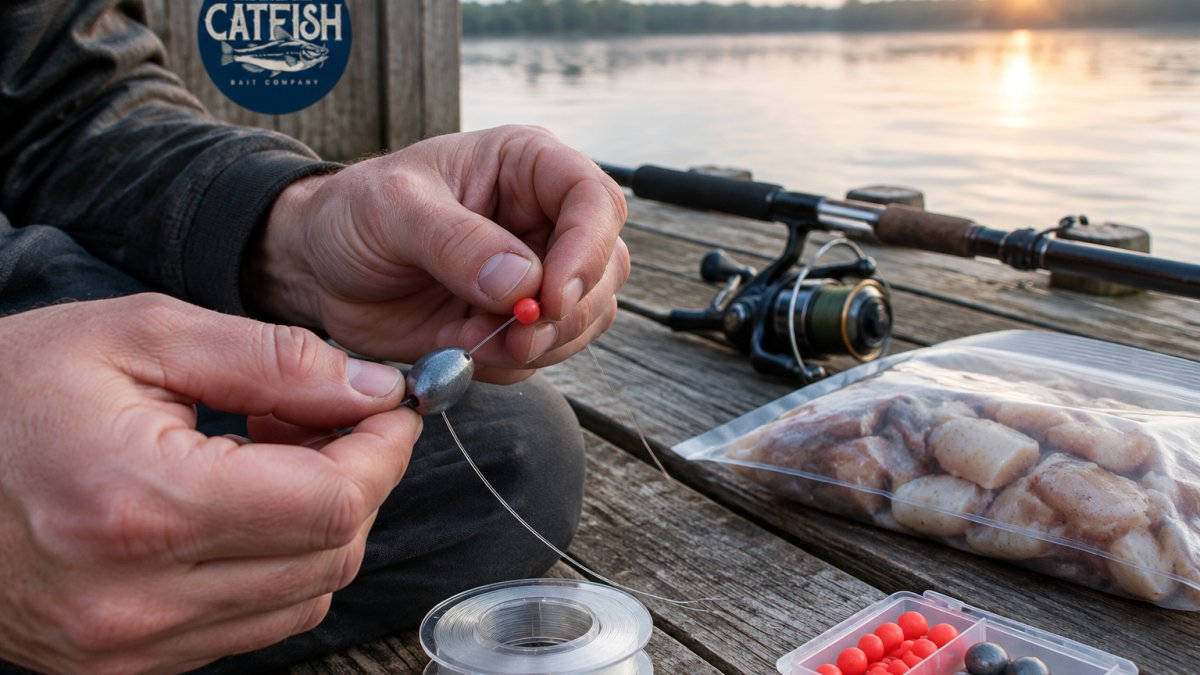
The slip-sinker rig is the best starting point for catfish rigs for beginners. It lets a fish pick up the bait and move off without dragging the sinker. That means fewer dropped baits.
Build it in this order:
- Slide an egg sinker onto your main line
- Add a small bead to protect the knot
- Tie the main line to a barrel swivel
- Tie a leader to the other end of the swivel
- Snell or tie on your hook
The sinker slides freely above the swivel. When a catfish grabs the bait, it feels almost no resistance.
Attaching the Hook and Tying Your Knots
Knot strength decides whether the hookup lands on the bank. Two knots cover most catfish work: the Palomar and the improved clinch.
- Palomar knot: strong, simple, works well with braid
- Improved clinch knot: reliable with monofilament and fluorocarbon
Wet the knot before you pull it tight. A dry knot rubs and weakens. Trim the tag end close, then test the hook with a firm pull.
For heavier setups and bigger fish, our guide to best fishing knots for heavy catfish rigs walks through stronger options step by step.
Carolina Rig Setup for Ready-to-Use Bait
The Carolina rig is the slip-sinker rig with a longer leader. That extra length keeps the bait away from the weight and lets it move naturally in the current.
The Carolina rig is a common choice for bait that needs to stay on the hook through the cast. Use a leader from 18 inches to 3 feet depending on depth and clarity.
A quick comparison of the two setups:
| Rig | Best For | Leader Length | Weight Style |
|---|---|---|---|
| Slip-sinker | Bank and boat, moderate current | 12-18 inches | Sliding egg sinker |
| Carolina | Current, spooky fish, deep water | 18-36 inches | Sliding egg sinker |
| Float rig | Shallow flats, suspended fish | 12-24 inches | Split shot or slip float |
If you want the chunk-style bait that pairs naturally with a Carolina rig, our 10oz catfish cut bait chunks are cut for exactly this setup.

Catfish Rigs for Bank Fishing That Hold Bottom
Bank fishing rewards simplicity. You are often casting to a known hole and waiting. The rig needs to hold bottom and stay put.
Catfish rigs for bank fishing usually mean a heavier sinker and a shorter cast. A slip-sinker rig with a 1 to 2 ounce egg sinker handles most pond and slow-river banks. Add a rod holder so the rod stays ready and the line stays tight.
Watch out: too little weight lets current drag your bait out of the zone, and too much weight makes the bait look unnatural. Start light, then add weight until the rig holds.
How to Use an Eagle Claw Catfish Rig With Shelf-Stable Bait
An Eagle Claw catfish rig is a pre-tied setup, usually built around a circle hook with a wire or mono leader and a snap or loop at the top. It saves time, which is the whole point of shelf-stable bait. But a pre-tied rig only pays off if you attach the bait so the hook can still do its job.
Here is how to use an Eagle Claw catfish rig with preserved bait:
- Clip or tie the rig to your main line. Match the main line to the leader strength; a heavy braid main line with a light mono leader is fine, but do not run a light main line into a heavy wire leader.
- Open the snap or tie a Palomar to the rig loop. Wet the knot and seat it firmly.
- Thread your preserved bait onto the circle hook so the point and gap stay clear. On a pre-tied rig the hook is fixed, so the bait has to fit the hook, not the other way around.
- Cast to your target and let the rig settle. Keep a semi-tight line so you can see the rod load rather than feel a tap.
- When the rod loads, lift and reel. Do not swing.
Circle hooks do the work for you. The hook finds the corner of the mouth as the fish turns away. A hard hookset on a circle hook is the most common reason anglers miss fish on pre-tied rigs.
Attaching Shelf-Stable Bait to a Pre-Tied Rig
Pre-tied rigs usually come with a fixed hook size, so the bait portion has to match that hook. A chunk that is wider than the hook gap will fold over the point on the cast and mask it.
7oz Catfish Cut Bait Nuggets – Preserved Real Fish, 6 Scents →
Watch out: pre-tied rigs with a treble hook are not circle hooks. If your Eagle Claw rig has a treble, you do need a hookset, and the bait should hang from the treble rather than be threaded over it.
When a Pre-Tied Rig Beats a Hand-Tied One
Pre-tied rigs can be convenient for short sessions or switching spots. They lose when you need to change hook size for bait portion, when the wire leader is too stiff for spooky fish, or when the snap is the weak point on a big fish. Carry a few pre-tied rigs for speed and one hand-tied slip-sinker setup for when the bite is finicky.
Hook Size, Bait Portion, and Placement for Ready-to-Use Bait
Hook size should match the bait portion, not the fish you dream about. The number that matters is the hook gap: the distance from the point to the shank.
Use this as a starting point for preserved cut bait:
- Nuggets, about 1 x 2 inches: 3/0 to 5/0 circle hook
- Chunks, about 2 x 3 inches: 5/0 to 7/0 circle hook
- Strips and add-ons: 2/0 to 4/0 depending on lure
A 5/0 circle hook typically has a gap around 3/4 inch. A chunk that is 1 inch thick will not clear that gap cleanly. Trim the chunk or step up a hook size. The same logic runs the other way: a 3/0 hook with a 2-inch-wide chunk leaves no gap at all.
Target fish size matters, but less than most anglers think. A 5/0 circle hook lands eater-size channel cats and still holds a 10-pound fish. The bait portion is the variable you change most often, because preserved bait comes in fixed shapes.
Threading Nuggets and Chunks So They Stay On
Threading is where most bait loss happens. Push the hook through the bait twice so the hook point and gap stay clear, and so the bait cannot rotate around the shank.
- Run the hook through one end of the nugget
- Turn the bait and pass the hook through again, offset from the first pass
- Leave the hook point and gap fully exposed
- Slide the bait up the shank so it sits tight below the eye
A single pass lets the bait spin on the cast, which twists the leader and eventually masks the point. A double pass locks the bait in line with the hook.
Watch out: if the bait slides down over the point after a cast, the second pass was too close to the first. Offset the passes by about a third of the bait length.
Matching Portion to Hook Gap
A quick field check: hold the threaded bait up against the hook. If you cannot see daylight between the bait and the point, the portion is too big for that hook. Trim it, or move up one hook size. For the ready-to-use nuggets this section describes, our 7oz catfish cut bait nuggets are pre-cut to a size that threads cleanly on a 3/0 to 5/0 circle hook. If you are still dialing in hook size, our guide to choosing the right hook size for catfish bait breaks it down by bait type.

Troubleshooting Bait Loss, Missed Hookups, and Stale Bait
Bait loss and missed hookups usually trace back to three things: a buried hook point, a bait that is too soft, or a hookset that is too hard.
- Bait keeps flying off on the cast: thread it twice and keep the hook gap clear
- Fish steal the bait: downsize the portion or switch to a smaller hook
- Missed hookups: stop setting the hook hard, let the circle hook turn
- Bait feels stale: check the seal on the bag and store it cool and dry
Firm bait tends to stay on the hook better than soft bait. For deeper fixes on keeping bait on the hook, read why bait falls off the hook.
Stock Your Tackle Box With Bait That Stays Ready
Bait that turns mushy can fall off the hook, which is why shelf-stable bait is useful. It does not need a cooler.
Blue River Carp, Inc. makes scent-infused cut bait from invasive carp. It is veteran-owned, made in Indiana, and has a 12+ month shelf life with no refrigeration or freezing required.
Our Catfish Weekend Kit bundles four 7oz nuggets in Blood, Garlic, Shad, and Natural plus a 4oz blood-scented attractant. For a lighter start, the Fish Attack Strips add real scent to any lure.

Before you fish, confirm local rules through the Association of Fish and Wildlife Agencies and your state wildlife office.
Frequently Asked Questions
How do you keep ready-to-use catfish bait on the hook?
Thread the hook through the bait at least twice so the point exits the same side it entered, then slide the bait up past the barb. A firm, preserved nugget about 1 x 2 inches is easier to keep on the hook. Match hook size to portion: a 4/0 to 6/0 circle hook suits a 7oz nugget, while the larger 10oz chunks pair better with 7/0 and up. Check the bait after each cast and re-seat it if it slides down the shank.
Can you use ready-to-use catfish bait on a Carolina rig?
Yes, and it works well because preserved bait stays firm through the cast. Slide an egg sinker onto your main line, add a bead, tie on a swivel, then attach a 12 to 18 inch leader with your circle hook. Thread a chunk or nugget onto the hook and cast. The sinker slides freely so a biting catfish feels little resistance, which improves hookups on Carolina rig setups in current and on hard bottoms.
What hook size should I use for catfish bait?
For most channel and blue catfish on rod and reel, a 4/0 to 6/0 circle hook covers standard 7oz nuggets. Step up to 7/0 or 8/0 for the larger 10oz chunks when you are targeting bigger fish. Circle hooks set in the corner of the mouth as the fish turns away, so leave the hook point exposed and never bury it in the bait. Match hook gap to bait thickness so the point clears the meat on the strike.
How long should I let my catfish bait sit?
Give a soaked bait 20 to 30 minutes before moving it, and longer in cold water when catfish are sluggish. If nothing happens after 30 minutes, recast to a new spot rather than leaving it indefinitely. Shelf-stable bait does not need refrigeration or freezing. Fish dawn, dusk, and overnight hours when catfish feed most actively.
Ready to stop losing bait and start landing more catfish? Get started with Blue River Carp, Inc. and fish bait that stays firm, stays scented, and stays ready in your tackle box.


