
Best Fishing Knots for Heavy Catfish Rigs in 2026
Table of Contents
- Why Knot Choice Decides Your Catfish Rig
- Strong Fishing Knots for Heavy Line: What Actually Holds
- The Palomar Knot for Catfish: Simple and Reliable
- The Uni Knot for Catfish Rigs: Versatile and Forgiving
- Fishing Knots for Braided Line: Handling Slick, Thin Line
- Snell and Trilene Knots: Hook Attachment That Stays Put
- Knot Failure, Strength Testing, and Field Checks
- Frequently Asked Questions
Last Updated: October 17, 2026
Why Knot Choice Decides Your Catfish Rig
A knot is the weakest link in any catfish rig, and on heavy tackle it usually fails first. The best fishing knots for heavy catfish rigs are the ones you can tie consistently under pressure, with heavy line, in bad light, on a moving boat.
Knot choice is not a style preference. Each knot has a job, and a knot tied outside its job loses strength.
Below, we break down the knots that hold on heavy catfish rigs, how to tie each one, and which line and hook combinations they suit, plus the failures that cost fish, because knowing why a knot breaks is how you stop it happening.
Strong Fishing Knots for Heavy Line: What Actually Holds
Strong fishing knots for heavy line share three traits: they grip without crushing the line, they seat with a firm pull, and they tolerate a little imperfection. Heavy mono and fluorocarbon resist tight bends, so knots with sharp turns or many wraps underperform. Braid is the opposite: slick and thin, it needs more wraps to grip and will slip on knots designed for mono.
A common mistake is assuming a knot rated for 20-pound line scales up to 65-pound braid. It does not. The geometry changes, the wraps need to increase, and the tag end needs more room to seat.
How Line Material Changes the Knot
Most knot failures on heavy catfish tackle trace back to tying a knot built for one material onto another.
Monofilament. Mono is stretchy with high friction, so it grips itself well, which is why simple knots like the improved clinch and the Trilene work on mono.
Fluorocarbon. Fluoro is denser, stiffer, and more abrasion-resistant than mono of the same break strength, which is why it shows up as leader material around rocks and timber.
Braid. Braid is slick, thin, and has almost no stretch, so it will not generate the friction a mono knot relies on, knots need more wraps and a clean, firm seat.
Matching Knot to Line Diameter
Line diameter, not just stated break strength, decides how many wraps a knot needs. Thin braid needs more wraps to build friction; thick mono needs fewer wraps but a longer tag end so the knot can cinch without the tag slipping back through.
A practical rule: if the knot seats with a hard, sudden pop rather than a smooth slide, the wraps are too few or the line is too stiff for that knot. Add a wrap on braid, switch to a single-pass knot on heavy mono, and always wet the line before the final pull.
The Palomar Knot for Catfish: Simple and Reliable
The Palomar knot for catfish is the best all-around choice for attaching a hook to braid and is easy to tie in the dark, strong, compact, and forgiving of a slightly uneven pull.
How to tie it:
- Double about 6 inches of line into a loop.
- Pass the loop through the hook eye.
- Tie a loose overhand knot with the doubled line, leaving the hook hanging.
- Pass the loop back over the hook and pull it above the eye.
- Wet the knot and pull the standing line and tag end together to cinch.
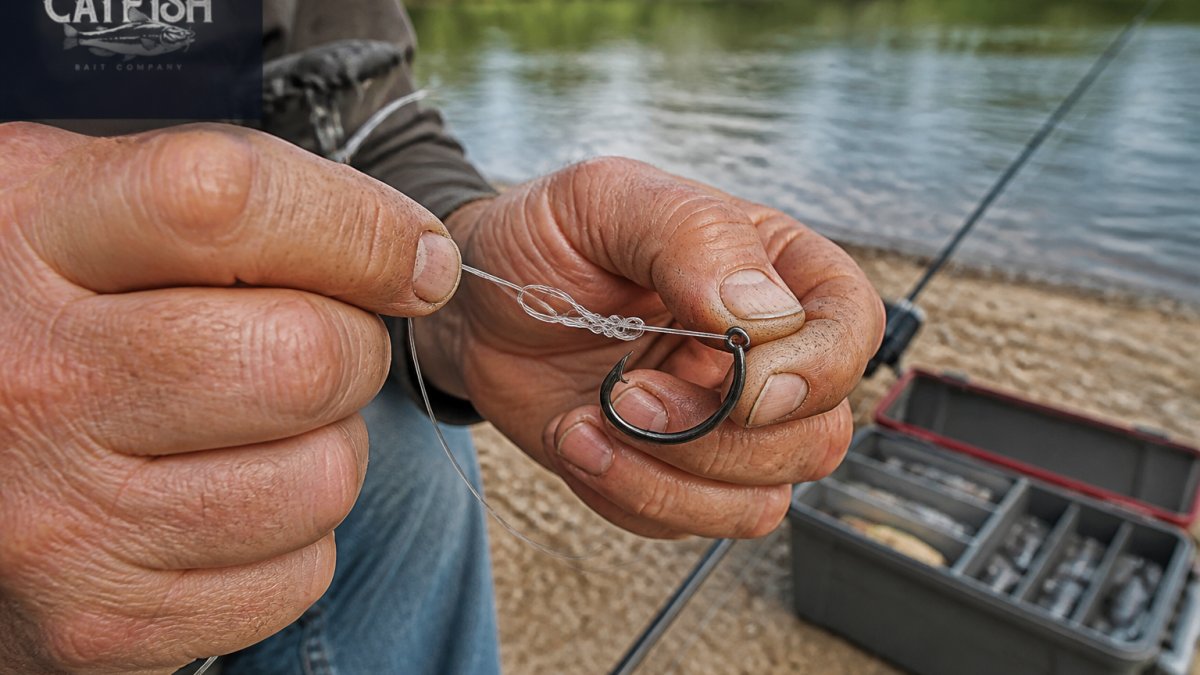
The Palomar shines on braid and works fine on light mono. On heavy, stiff monofilament it can be fussy because the doubled line is hard to bend through the eye, if you fish 50-pound mono to a big circle hook, expect to fight it a little.
The Uni Knot for Catfish Rigs: Versatile and Forgiving
The Uni knot for catfish rigs earns its place because one knot covers several jobs: tie it to a hook eye, a swivel, or a lure, or double it up to join two lines. That flexibility matters on a heavy rig where you switch terminal tackle in the field. Mastering this versatile connection ensures your line remains secure even when you transition to weedless jig heads to navigate through dense, rocky cover.
How to tie it:
- Run the tag end through the hook eye and double it back alongside the standing line.
- Form a loop with the tag end.
- Wrap the tag end around both lines and through the loop 5 to 7 times.
- Wet the knot and pull the tag end to snug the wraps.
- Slide the knot down to the eye and pull the standing line to seat it.
The Uni handles heavy mono and fluorocarbon better than the Palomar, and it holds on braid when you add wraps. It is slower to tie than a Palomar and easier to get wrong with cold hands.
Fishing Knots for Braided Line: Handling Slick, Thin Line
Fishing knots for braided line need more wraps and a clean seat, because braid is slick and thin and will slip where mono grips. The Palomar is the standard for braid to hook. For line-to-line connections, the double Uni and the improved clinch with extra wraps are common, and a Bimini twist or spider hitch builds a doubled section when you need extra strength.
A reliable approach on heavy catfish rigs: Palomar to the hook, a double Uni to join braid to a mono or fluorocarbon leader. The leader gives abrasion resistance near rocks and structure; the braid gives strength and low diameter on the reel.
Snell and Trilene Knots: Hook Attachment That Stays Put
The snell knot and the Trilene knot solve two different problems, and both belong in a heavy catfish kit.
The snell knot for catfish is the choice when hook presentation matters. Snelling ties the line to the shank rather than the eye, aligning the pull with the hook point and keeping the hook straight, ideal with circle and offset hooks where a straight pull helps the hook rotate into the corner of the mouth.
How to snell a hook:
- Thread the tag end through the eye and lay it along the shank.
- Wrap the tag end around the shank and the standing line 5 to 7 times, working toward the bend.
- Pass the tag end back through the eye from the same side.
- Wet the knot and pull the standing line while holding the hook, so the wraps stack neatly.
The Trilene knot is a strong, compact connection for mono and fluorocarbon to a hook eye or swivel, using two passes through the eye and several wraps to build friction and resist slipping on heavier lines.
Snelling a Circle Hook vs a J-Hook
Circle hooks and J-hooks want different things from a knot. A circle hook rotates into the corner of the mouth, so a snell that keeps the hook in line with the pull helps it do its job. A J-hook relies on a direct hookset, and a snug eye knot like a Palomar or Trilene keeps the point where you put it. Match the knot to how the hook is designed to catch, not to habit.
| Knot | Best Line | Best Hook | Strength Notes |
|---|---|---|---|
| Palomar | Braid, light mono | Circle, J-hook | Strong on braid, fussy on heavy mono |
| Uni | Mono, fluoro, braid | Circle, J-hook, swivel | Versatile, needs extra wraps on braid |
| Snell | Mono, fluoro, braid | Circle, offset | Aligns pull with hook point |
| Trilene | Mono, fluoro | J-hook, swivel | Compact, resists slipping on heavy line |
Knot Failure, Strength Testing, and Field Checks
Knot failure almost always traces to one of four causes: a dry cinch that heat-damaged the line, too few wraps for the line type, a tag end too short to seat, or a knot tied outside its intended line class. Understanding each mechanism lets you catch a bad knot before a fish does.
Why Knots Actually Break
A fishing knot fails in one of two ways: it slips, or the line breaks at the knot. Slippage happens when friction between wraps is insufficient for the line's slickness, common on braid with too few wraps, or on fluoro that was not wetted and never fully seated.
A third, often-missed cause is damage that predates the knot: a rough guide, a nicked hook eye, or abrasion above the knot weakens the line right where the knot concentrates load. Inspect the hook eye and the first few inches of line before you tie.
A Simple Pre-Fish Knot Test
You do not need a scale to know whether a knot is seated. After tying and wetting, hold the hook and pull steadily on the standing line until the knot cinches. A well-seated knot slides down smoothly and stops; a poorly seated one pops, jumps, or leaves the tag end pulled short.
For a more deliberate check at home, tie the knot to a solid anchor and pull until it seats, then examine the line just above the knot for the curl or whitening that signals stress damage. A knot that whitens the line on a test pull will do the same on a fish.
Field Checks and Retie Intervals
In the field, recheck after every fish and every snag. Heavy line takes abrasion damage near rocks and structure, and a knot that held on the last cast can fail on the next. Run the first few inches above the knot between your fingers; if it feels rough or flat, cut back and retie. A practical interval on heavy catfish rigs: retie after every fish over roughly 20 pounds, after any snag you had to break off, and at the start of every trip.
Bait matters here too. A bait that stays on the hook through a hard cast and a long soak keeps your knot under steady tension instead of letting the hook work loose.
Frequently Asked Questions
What is the most effective knot for fishing catfish?
For most heavy catfish rigs, the Palomar knot is the go-to for tying a hook or swivel to the main line because it is simple, strong, and holds well with monofilament and braid. The snell knot is better when you want the hook to sit straight and pull from the eye, which helps with circle hooks on big fish. The Uni knot works well as a backup and for connecting lines. Match the knot to your line material and hook style rather than using one knot for everything.
Is a Palomar or Uni Knot stronger?
Both are strong, but they fail differently. The Palomar keeps a high percentage of line strength with monofilament and braid, and it is fast to tie. The Uni knot is more forgiving with mismatched line diameters and works well for line-to-line connections. On heavy line, the Palomar's doubled line through the eye adds security, while the Uni's multiple wraps spread load. Test both on your actual line and hook before trusting either on a big catfish rig.
How can you keep fishing knots from slipping under heavy loads?
Lubricate every knot with water or saliva before pulling it tight, then cinch it down slowly and firmly so the wraps seat evenly. Leave a short tag end, about 1/8 inch, and trim it clean. For braided line, add extra wraps because slick fibers slip more easily. Re-tie after any hard snag or long fight, and check the knot by pulling against the drag before casting. A knot that looks fine but was cinched dry can fail under load.
Which knot is best for tying a hook to heavy monofilament?
The Palomar knot is the most practical choice for heavy monofilament because the doubled line through the hook eye adds strength and the knot is easy to inspect. The Trilene knot is another solid option, especially with lines over 20-pound test, since its double pass through the eye reduces friction and slippage. For circle hooks where presentation matters, a snell knot keeps the hook aligned. Whichever you use, wet the knot before tightening and test it before your first cast.


