
Best Fishing Line for Trophy Catfish: 2026 Guide
Table of Contents
- Best Fishing Line for Trophy Catfish: Key Specs That Matter
- Monofilament vs Braid for Catfish: Which Wins on Big Fish
- Best Pound Test for Trophy Catfish: Matching Line to Fish Size
- Catfish Leader Line Setup: Fluorocarbon, Mono, or Braid
- Baitcaster vs Spinning Reel: Line Capacity and Spooling
- Line Maintenance, Storage, and Temperature Performance
- Knot Integrity and Hook Sets for Trophy Catfish
- Conclusion
- Frequently Asked Questions
Last Updated: September 20, 2026
Best Fishing Line for Trophy Catfish: Key Specs That Matter
Choosing the best fishing line for trophy catfish comes down to three specs: diameter, abrasion resistance, and stretch. Get those wrong and you will lose the fish of a lifetime at the net. This guide covers what matters when targeting fish over 30 pounds.
Line Diameter and Abrasion Resistance
Line diameter is the thickness of your line, measured in thousandths of an inch, and it controls how much abrasion the line survives. A thicker line resists cuts from rocks, mussel beds, and submerged timber far better than a thin one.
Stretch Factor and Hook-Setting Power
Stretch factor is how much a line elongates under load, and it decides how much of your hook set reaches the fish. Monofilament stretches noticeably, cushioning surges but softening hook penetration at distance. Braid barely stretches, so your hook set transfers almost directly.
Monofilament vs Braid for Catfish: Which Wins on Big Fish
Braid wins for trophy-class catfish; monofilament wins for everything else. Braid gives you smaller diameter at the same pound test, near-zero stretch, and better sensitivity for subtle bites.
| Factor | Monofilament | Braided Line |
|---|---|---|
| Stretch | High, cushions runs | Minimal, direct hook set |
| Abrasion resistance | Moderate | Good, but frays on sharp rock |
| Sensitivity | Low | High, detects subtle bites |
| Diameter at 50 lb | Thicker | Much thinner |
| Best for | Snaggy water, beginners | Trophy catfish, long casts |
Best Pound Test for Trophy Catfish: Matching Line to Fish Size
The best pound test for trophy catfish starts at 30 lb and scales to 80 lb or more, but species is only the first variable. Cover density, current speed, water temperature, and bait presentation all push the number up or down. Match your line to the fish you realistically expect and the water you actually fish.
Channel, Blue, and Flathead Pound Test Ranges
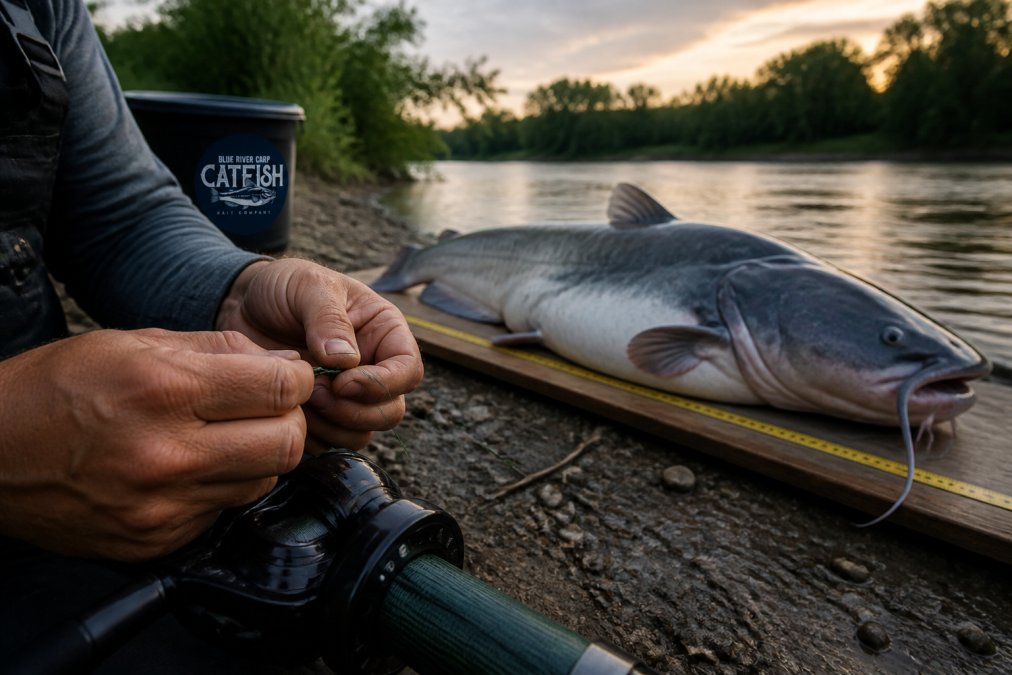
Channel cats are the most forgiving. A 20 to 30 lb mainline handles most channel cats in open water. Blue catfish run bigger and pull harder, so 40 to 65 lb braid is a common working range. Flathead catfish combine weight with a habit of burying into cover, which is why many anglers step up to 50 to 80 lb.
| Species | Typical Trophy Weight | Open Water | Heavy Cover or Strong Current |
|---|---|---|---|
| Channel catfish | 10-20 lb | 20-30 lb | 30-40 lb |
| Blue catfish | 30-60 lb | 40-50 lb | 50-65 lb |
| Flathead catfish | 30-50 lb | 50-65 lb | 65-80 lb |
Why Cover and Current Push You Up a Step
A 40 lb blue cat in open water fights differently than the same fish under a wing dike in a tailrace. In current, the fish's body acts like a sail, roughly doubling the load on your line. That is why tournament anglers in tailraces routinely run 65 to 80 lb braid even when the average fish is 25 lb.
Seasonal and Temperature Adjustments
Cold water changes the math. Below about 50 degrees, catfish metabolize slowly and fight shorter, so you can often drop one step in pound test. In summer, when fish feed aggressively and run hard, stay at the top of the range for your target species.
Matching Line to Presentation
- Anchor or drift fishing with cut bait: 50-80 lb braid mainline, short leader. You are fishing vertically and can afford heavy line.
- Casting to structure: 40-65 lb braid. You need distance and control, so diameter matters.
- Live bait for flatheads: 50-80 lb braid with a mono leader. Flatheads run for cover immediately, and you need stopping power from the first second.
- Light-tackle channel cat fishing: 20-30 lb mono or braid. Fish are smaller and often in open water.
A common mistake is fishing too light because the line "feels strong enough." It is not, once a 40 lb blue cat turns into current or wraps a stump. The other mistake is going so heavy that you lose casting distance and bite detection. The right number is the lightest line that still gives you a realistic chance of landing the biggest fish you might hook that day.
Catfish Leader Line Setup: Fluorocarbon, Mono, or Braid
Your catfish leader line setup should use fluorocarbon in clear water and monofilament in stained or muddy water. Fluorocarbon is denser, sinks faster, and nearly invisible underwater, which helps with pressured fish. Monofilament is more abrasion-resistant against rough structure and cheaper to replace. Pairing these specialized leader materials with quality fishfinder electronics ensures you can accurately track trophy catfish as they navigate the varying depths and structures of your chosen water.
- Fluorocarbon leader: clear water, pressured fish, sinking bait presentations
- Monofilament leader: stained water, rocky bottoms, budget setups
- Braid leader: rare, but useful when you need maximum strength in heavy timber
Baitcaster vs Spinning Reel: Line Capacity and Spooling
Baitcasting reels hold more line at heavier pound tests, which matters when spooling 65 lb braid. Spinning reels are easier for beginners but run out of spool capacity faster with heavy line.
Line Maintenance, Storage, and Temperature Performance
Line maintenance is the gap most guides ignore, and it costs trophy hunters fish. Braid and monofilament degrade from UV exposure, heat, and harsh chemicals, and the damage is invisible until the line fails. A spool that sat on a boat deck all summer is not the line you bought in spring.
How Line Actually Degrades
UV exposure breaks down polymer chains in monofilament and fluorocarbon, making the line brittle and reducing knot strength. Braid is more UV-resistant because the fibers are tightly woven, but dyes fade and the abrasion-protective coating wears off. Anglers often notice mono getting stiff and chalky after a season of sun, then assume it is fine because it looks intact.
Storage Practices That Actually Work
- Keep spools in a cool, dark place. A closed cabinet or a soft tackle bag in the shade is fine. A hot garage or a truck bed is not.
- Store bulk spools on the original spool, not wound onto a reel. Line under tension on a reel takes a set over time. Bulk spools keep the line relaxed.
- Use line conditioner sparingly. A light application can reduce memory and improve casting, but heavy application can attract grit that accelerates abrasion.
- Label spools with the date you bought them. Monofilament has a practical working life of about one season in heavy use, two at most in storage. Braid lasts longer, often several seasons, but the working end still needs to be stripped and replaced.
Temperature Performance: What Changes and Why
Cold water stiffens monofilament and increases line memory, the tendency to hold the shape of the spool. Stiff mono casts poorly, coils off the reel, and transmits less feel. Fluorocarbon is even stiffer in cold water, which is why some winter anglers switch to a softer mono leader or braid mainline with a short fluoro section.
A Simple Seasonal Maintenance Routine
- Before each trip: Run the first 10 to 15 feet of line through your fingers. Feel for rough spots, flat sections, or memory coils. If you find them, cut back past the damage.
- After every big fish or structure contact: Retie. A knot that survived one fight is a knot with hidden damage.
- Once a month during the season: Strip 20 to 30 feet off the working end of your mainline and re-spool if needed. The working end takes almost all the abuse.
- At the end of the season: Pull the line off the reel, inspect the spool for corrosion or grit, and decide whether to reverse the line on the spool or replace it. Reversing gives you a fresh working end from what was the backing.
- Annually: Replace monofilament mainlines and leaders. Replace braid every two to three seasons, or sooner if you fish heavy cover often.
For bait, the same logic applies. A shelf-stable bait that does not need refrigeration keeps you ready for spontaneous trips.
Knot Integrity and Hook Sets for Trophy Catfish
Knot integrity decides whether all that line selection pays off. Braid needs knots that grip without slipping, such as a Palomar or doubled uni. Monofilament and fluorocarbon need knots that seat under pressure, always wet the knot before cinching.
Conclusion
Trophy catfish punish every weak link, and line is the link most anglers underestimate. Braid mainline, a fluorocarbon or mono leader, matched pound test, and tight spooling keep you in the fight when a 50 lb blue cat makes its run.
Frequently Asked Questions
Is a 20 lb line good for catfish?
For channel cats up to about 10 pounds, 20 lb mono works fine. For trophy-class blues or flatheads over 30 pounds, 20 lb is too light. Step up to 40-65 lb braid or 30-40 lb mono. Heavy cover, current, and submerged timber all push you toward the upper end of that range.
What pound test line is best for trophy catfish?
Most trophy hunters run 50-80 lb braided mainline with a 40-60 lb fluorocarbon or mono leader. Braid's small diameter lets you pack more line on the spool and cut current drag. The leader adds abrasion resistance near rocks and mussel beds where big blues and flatheads feed.
Do I need a leader line when targeting trophy catfish?
Yes, in most situations. A 3-6 foot leader of 40-60 lb fluorocarbon or heavy mono absorbs abrasion from rocks, timber, and the catfish's own pectoral spines. Use a shock leader on braid mainline to add stretch and protect against break-offs on the hook set.
Is fluorocarbon or mono better for catfish?
Fluorocarbon sinks faster, has less stretch, and is nearly invisible underwater, which helps with pressured fish and clear water. Mono stretches more, costs less, and floats, which can help with certain float rigs. Many anglers use braid mainline with a fluorocarbon leader to combine sensitivity with abrasion resistance.