

How to Remove Human Scent from Fishing Lures
Last Updated: October 31, 2026
Quick Summary
To remove human scent from fishing lures, rinse them in clean water, wash with plain unscented soap, rinse again, and air dry completely before storage. Skip harsh cleaners and solvents, which strip paint and can leave a residue that smells worse than what you were trying to remove.
- Never soak hard baits with wooden bodies, because water swells the wood and ruins the finish.
- Avoid soap on soft plastics, since porous baits hold soap residue that keeps smelling after drying.
- Do not use bleach, acetone, alcohol, or citrus-based cleaners on soft plastics.
- Let baits dry fully before storage, because trapped moisture in sealed bags grows funk.
- Wash your hands with plain unscented soap before you handle tackle.
Table of Contents
- Why Human Scent on Lures Can Cost You Bites
- How to Clean Fishing Lures Without Damaging Them
- How to Remove Odor from Soft Plastic Baits
- How to Clean a Tackle Box and Keep It Odor-Free
- Fishing Lure Storage Tips That Block Contamination
- When to Mask Scent vs. When to Remove It
- Build a Scent-Free Routine Before Your Next Trip
- Frequently Asked Questions
Why Human Scent on Lures Can Cost You Bites
Catfish hunt with their noses first. Their eyesight is poor, especially in muddy water, so smell and taste do most of the work. That single fact explains why so many anglers want to know how to remove human scent from fishing lures before they ever make a cast.
Scent drives bites. So it stands to reason that the wrong scent, like the oils on your hands, can work against you.
Here is the honest version: human scent is one variable among many. It is not a magic switch. But on pressured water, small edges stack up.
What Fish Actually Detect
Fish scent detection is real and well documented. Catfish carry taste receptors across their skin and barbels, not just in their mouths (pubmed.ncbi.nlm.nih.gov).
What does that mean for your lure? A baitfish profile with a clean surface still smells like something. A lure smeared with sunscreen, gasoline, or hand lotion smells like something else entirely.
Fish response to foreign odors varies. Some anglers report short strikes or dropped baits. Others notice nothing. The cautious approach costs you almost nothing, so it is worth taking.
Skin Oils and Hand Odor Transfer
Every time you touch a lure, you leave something behind. Skin oils, sweat, and whatever you handled last all transfer to the surface.
Think about a typical trip. You pump gas. You eat a snack. You spray insect repellent. Then you tie on a soft plastic and work it through a brush pile.
The transfer is invisible, which is exactly why it gets ignored. Hand odor moves from fingers to line to lure in seconds. On porous baits, it soaks in.
If you want to go deeper on which scents actually pull catfish in, read our guide to the best scent for catfish bait.
How to Clean Fishing Lures Without Damaging Them
Cleaning a fishing lure is simple: rinse it in clean water, wash it with plain unscented soap, rinse again, and let it air dry completely before it goes back in the box. Skip harsh cleaners and solvents.
Different materials need different handling. Get this part right and your baits last longer and fish cleaner.
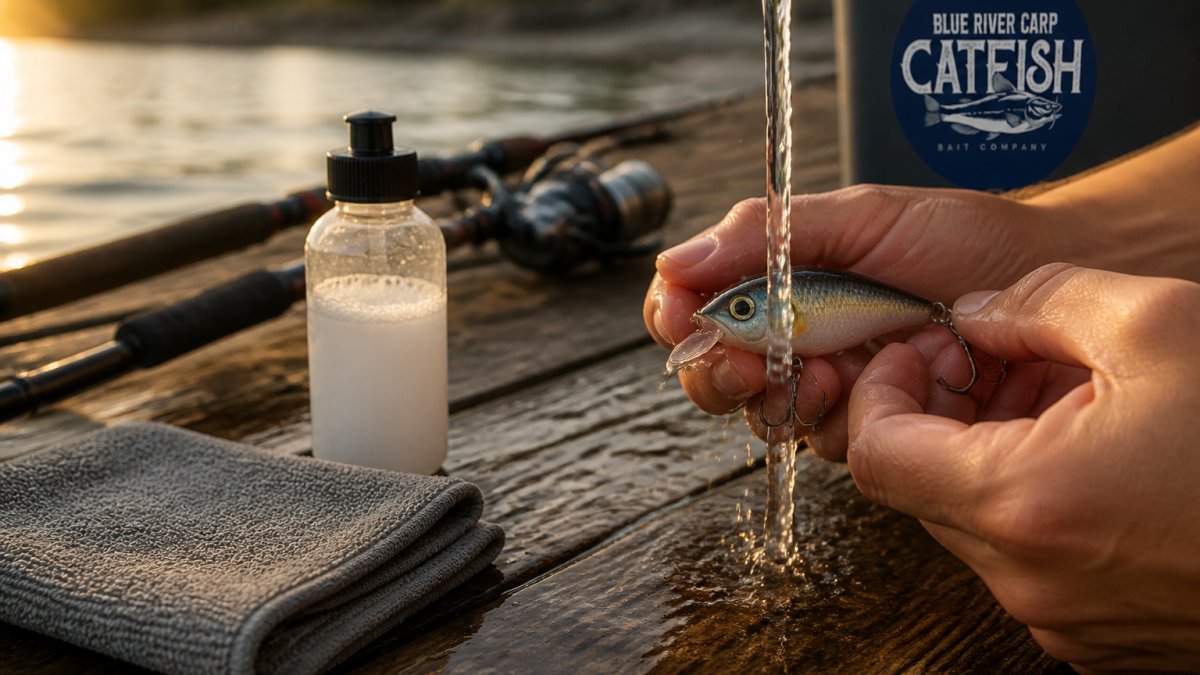
Hard Baits: Rinse, Wash, Dry
Hard baits are the easy ones. Crankbaits, lipless baits, spoons, and jigs have sealed surfaces that shrug off a wash.
- Rinse the lure in clean water to float off loose dirt and bait residue.
- Add a drop of plain unscented soap to your palm and work it over the body.
- Use a soft brush on the bill and around the eye sockets.
- Rinse thoroughly until no soap film remains.
- Air dry on a towel, hooks up, away from direct sun.
Watch out: never soak hard baits with wooden bodies. Water gets under the clear coat, swells the wood, and ruins the finish.
Soft Plastics: Handle with Care
Soft plastics are porous, and that changes everything. They absorb oils, bait juices, and whatever is on your hands.
Rinse them in clean water and pat them dry. Avoid soap on soft plastics when you can. Many formulations hold soap residue, and that residue keeps smelling long after the bait dries.
If a soft plastic is badly contaminated, retire it. A bait that smells like old sunscreen is not doing you any favors.
Here is how the two main lure materials should be handled.
| Lure type | Cleaning method | Key caution |
|---|---|---|
| Hard baits | Rinse, wash with unscented soap, rinse, air dry | Never soak wooden bodies |
| Soft plastics | Rinse in clean water and pat dry | Avoid soap; porous baits hold residue |
How to Remove Odor from Soft Plastic Baits
Soft plastics are the hardest lures to de-scent because they are not sealed.
Start with triage. Sort baits into three piles: clean, questionable, and done.
Clean pile. These baits have no visible residue and no strong smell. Rinse in clean water, pat dry with a paper towel, and return them to a dedicated bag.
Questionable pile. These baits smell faintly of hands, bait, or storage. Work through this sequence:
- Rinse in clean water to float off loose dirt and bait residue.
- Soak briefly, no more than a few minutes, in water with a small amount of plain unscented soap. Avoid dish soaps with degreasers, fragrance, or dye; those additives can cling to the plasticizer surface.
- Rinse again until the water runs clear and no soap film remains.
- Pat dry with a paper towel, then air dry in a well-ventilated spot out of direct sun. Heat drives plasticizers to the surface and can pull absorbed odor back out with them.
- Smell the bait after it dries. If a faint odor remains, repeat once. If it still smells, move it to the done pile.
Done pile. Cut your losses. Toss baits that smell like gasoline, mold, rotten bait, or insect repellent.
A common mistake is sealing damp soft plastics in a bag. Trapped moisture grows funk, and that funk is a foreign odor you cannot wash out later. Let baits dry fully before they go back in storage.
If a bait still smells after two rinse-and-dry cycles, consider retiring it rather than fishing it.
How to Clean a Tackle Box and Keep It Odor-Free
A clean lure in a dirty box picks up odor again. That is the part most guides miss. Your tackle box is a closed environment, and smells concentrate inside it.
Empty the box completely. Vacuum or wipe out crumbs, sand, and dried bait residue. Wash plastic trays in warm water with unscented soap, then rinse and dry fully.
Check the soft side of the equation too. Fabric bags and foam inserts hold odor.
Let everything dry open for a full day before you reload. A tackle box that smells like a bait shop is a tackle box that is seasoning your lures for you.
Fishing Lure Storage Tips That Block Contamination
Good fishing lure storage tips come down to separation. Keep scented items away from clean ones. Keep wet items away from dry ones.
- Store soft plastics in their own bags, not loose with hard baits.
- Use divided trays so hooks and baits do not rub and transfer residue.
- Keep a dedicated bait container so juices stay contained.
- Add a small silica packet to sealed boxes to manage moisture.
- Never store baits in a hot car or a garage that bakes in summer.
Scent transfer is a two-way street. A garlic-soaked bait sitting against a clean crankbait will scent that crankbait whether you planned it or not.
For more on keeping bait fresh between trips, see our guide on how to store prepared catfish bait. And if you fish shelf-stable baits, this piece on storing shelf stable bait covers containers and hot-weather handling.
When to Mask Scent vs. When to Remove It
Here is where strategy matters more than scrubbing. Sometimes you want a clean lure. Consistency in your approach extends beyond the tackle box, as maintaining fishing apparel ensures that lingering odors do not compromise your presentation when the wind shifts.
Mask scent when:
- You are fishing pressured water where fish have seen the same presentations repeatedly.
- You have handled fuel, insect repellent, sunscreen, or food and cannot fully wash up.
- You want a neutral, food-like profile that fish do not shy from.
- You are fishing murky or stained water where smell travels farther than sight.
Remove scent when:
- You are fishing clear water where fish can inspect a lure visually before committing.
- Fish are finicky or short-striking, which can signal they are reacting to something off.
- You want a lure to run clean and natural with no added attractant.
- You are switching between scented and unscented presentations and do not want cross-contamination.
Applying scent to fingertips or directly to the bait is a middle path. You can also browse scents and oils to add a fish-attracting cover scent to your lures and bait. Our guide on the benefits of using scented fishing bait explains how scented bait masks human odor and increases your catch rate.
A practical framework: if you can smell your hands on the lure, mask it or wash it. If the lure smells neutral and the water is clear, leave it alone.
One caution: masking scent does not fix a contaminated lure. A bait that smells like gasoline or mold will still smell that way under a cover scent. Remove the contaminant first, then decide whether to add attractant.
Build a Scent-Free Routine Before Your Next Trip
The best defense is a routine you run before you touch the water. Prevention beats cleaning every time.
- Wash your hands with plain unscented soap before you handle tackle.
- Skip scented lotions, sunscreen on the hands, and insect repellent on the palms.
- Rinse lures in lake or river water before the first cast.
- Keep a clean towel in the boat for drying hands.
- Store clean baits apart from scented ones.
- Re-rinse after any bait change or fuel stop.
That is the whole method for how to remove human scent from fishing lures: wash with plain soap, rinse well, dry fully, and store smart. Do it consistently and your baits stay clean, your tackle box stays fresh, and your presentation stays honest.
Frequently Asked Questions
How do you remove human scent from fishing lures?
Rinse each lure in clean water, wash it with a few drops of unscented soap, and dry it with a clean cloth before storing it. For soft plastics, wipe the surface instead of scrubbing. Keep washed lures in a separate box so they don't pick up oils from your hands or from other tackle. Repeat the rinse after every trip, especially if you handled bait or sunscreen before touching the lure.
Can the oil or scent on your hands affect fishing success?
It can. Skin oils, food residue, and sunscreen transfer to lures and line, and fish can detect many of those compounds in the water. That doesn't mean every fish turns away, but on pressured water or for finicky catfish, a clean lure removes one variable. Wash your hands with unscented soap before tying on a lure, and rinse the lure if you handle bait in between casts.
Can soap or household cleaners damage fishing lures?
Harsh cleaners can. Bleach, degreasers, and scented dish soaps can strip paint, dry out soft plastics, and leave a residue that fish may detect. Stick to a few drops of unscented soap in water, rinse thoroughly, and air-dry. Avoid soaking wooden or painted baits for long periods, and never use solvent-based cleaners on soft plastic baits.
Should you wash fishing lures after every trip?
A quick rinse after every trip is the easiest habit to keep. Full washing with soap is worth doing when you've handled bait, used sunscreen, or fished muddy water. Between trips, store lures dry and separated so moisture and odors don't spread. If a lure still smells after washing, set it aside and clean it again before the next outing rather than masking the odor with scent.
Scent control is only half the battle. The other half is the bait on the end of your line, and that is where we come in. Blue River Carp, Inc. makes scent-infused cut bait from invasive carp, with a 12+ month shelf life and no refrigeration or freezing required, so it stays ready and will not get mushy on the hook. Get started with Blue River Carp, Inc. and put a bait that works as hard as you do in front of every catfish you chase.


