
Benefits of Using Scented Fishing Bait
Table of Contents
- How Scent Attracts Fish and Triggers Feeding Response
- Scented Bait for Catfish: Species-Specific Advantages
- Scented vs. Unscented Fishing Bait: What the Differences Mean
- Masking Human Odor: Why It Matters for Your Catch
- How Long Does Fishing Bait Scent Last in the Water
- How to Use Fishing Bait Attractant: Application and Reapplication
- Water Conditions, Temperature, and Seasonal Effectiveness
- Measuring Results: Does Scent Actually Improve Your Catch Rate
- Frequently Asked Questions
Last Updated: October 15, 2026
How Scent Attracts Fish and Triggers Feeding Response
Scented fishing bait works because fish rely heavily on their sense of smell to find food. Fish detect scent particles dispersing through the water from significant distances. When a scent trail reaches a fish, it triggers a natural feeding response that makes them more likely to strike and hold onto the bait.
The mechanism is straightforward: fish have olfactory receptors that pick up chemical signals in the water. These signals tell the fish that food is nearby. A strong scent creates a wider search corridor, meaning fish find your bait faster.
Our blood scent and shad oil formulations replicate the odors catfish encounter in their natural environment. When fish detect these familiar scents, their feeding instinct activates almost immediately.

The scent also encourages fish to hold the bait longer. An unscented piece of cut bait might get a quick investigation. A scented piece triggers sustained interest. The fish bites down harder and holds on, giving you a better chance at a solid hookup.
Scented Bait for Catfish: Species-Specific Advantages
Channel catfish, blue catfish, and flathead catfish all respond strongly to scented bait. These species hunt primarily by smell, making scent one of the most effective tools in your tackle box.
Channel catfish prefer milder scents like shad oil. They're aggressive feeders but often cautious about unfamiliar smells. Shad oil matches their natural diet and triggers confident strikes. Blue catfish, the larger cousins, tolerate stronger scents. Blood scent works exceptionally well for blues because they're more predatory and hunt larger prey.
Flathead catfish are pure predators and respond best to live or fresh-cut bait with strong scent. These fish actively hunt rather than scavenge, so the scent needs to signal fresh, viable prey. Our carp oil-based formulations work well here because they're thick, long-lasting, and intensely aromatic.
The advantage of using scented bait for catfish is that it creates an active search pattern, meaning fish follow the scent trail directly to your hook. Unscented bait requires fish to stumble upon it by chance.
For catfish specifically, scent is not optional, it's fundamental to their hunting strategy. Catfish in murky water, heavy current, or low-light conditions depend almost entirely on smell to locate food.
Scented vs. Unscented Fishing Bait: What the Differences Mean
The core difference between scented and unscented bait comes down to attraction speed and bite frequency. Scented bait pulls fish in faster. Unscented bait relies on fish finding it by chance or through visual cues.
In clear water with good visibility, unscented bait performs reasonably well. Fish can see the bait and investigate. In murky water, heavy current, or at night, the gap widens dramatically. Scent becomes the primary detection method. Unscented bait becomes nearly invisible to hunting fish.
Scented bait also produces longer bite windows. Once a fish detects the scent and commits to investigating, the bait's flavor and texture keep it interested. Unscented bait gets a brief inspection. If the fish doesn't immediately recognize it as food, it moves on.
Quality scented bait from Blue River Carp, Inc. offers increased chances of catching fish, ensuring you're prepared for every trip.
Many anglers start with unscented bait because it's cheaper. Switching to scented bait can increase your chances of catching fish.
| Bait Type | Detection Speed | Bite Hold Time | Best Conditions | Cost |
|---|---|---|---|---|
| Scented | Fast | Long | All conditions | Higher |
| Unscented | Slow | Short | Clear water only | Lower |
Masking Human Odor: Why It Matters for Your Catch
Fish are sensitive to human odors. Sunscreen, fuel, cigarette smoke, and sweat all leave traces on your hands and bait. These foreign smells can spook fish or make them cautious about taking the bait.
Sunscreen is particularly problematic. Most commercial sunscreens contain chemicals that smell nothing like natural food. When you handle bait with sunscreen-covered hands, you transfer these chemicals directly to the bait. Fish detect the mismatch and hesitate.
Fuel and cigarette smoke present similar problems. Gasoline residue on your hands from filling the boat tank transfers to bait. Cigarette smoke clings to your fingers and clothes.
The solution is simple: wash your hands thoroughly before handling bait. Use unscented soap or just water. Avoid sunscreen on your hands entirely, use a hat and long sleeves instead. Don't smoke while fishing or handling bait.
The strong, familiar scent of blood or shad oil can help attract fish. Even if your hands aren't perfectly clean, the bait's scent can still be effective.
How Long Does Fishing Bait Scent Last in the Water
Scent dispersal depends on water conditions. In still water, scent spreads slowly and creates a localized cloud. In moving water, current carries scent downstream, creating a longer trail that attracts fish from greater distances.
Temperature affects scent dispersal significantly. Warm water speeds up molecular movement, spreading scent faster but also dissipating it more quickly. Cold water slows dispersal but allows scent to linger longer in the water column.
Most fishing attractants remain effective for 30 minutes to 2 hours in active water. In still water or slow current, scent can persist for several hours.
This is why reapplication matters. If you're fishing in moving water, you'll want to reapply scent every 30-45 minutes to maintain a strong scent trail. In still water, you can go longer between applications.
Water clarity also plays a role. In turbid water with high sediment, scent disperses more slowly because particles interfere with molecular movement. In clear water, scent travels farther and faster.
How to Use Fishing Bait Attractant: Application and Reapplication
Applying Scent to Cut Bait and Soft Plastics
The most effective application method depends on your bait type. For cut bait, apply scent directly to the surface of the meat.
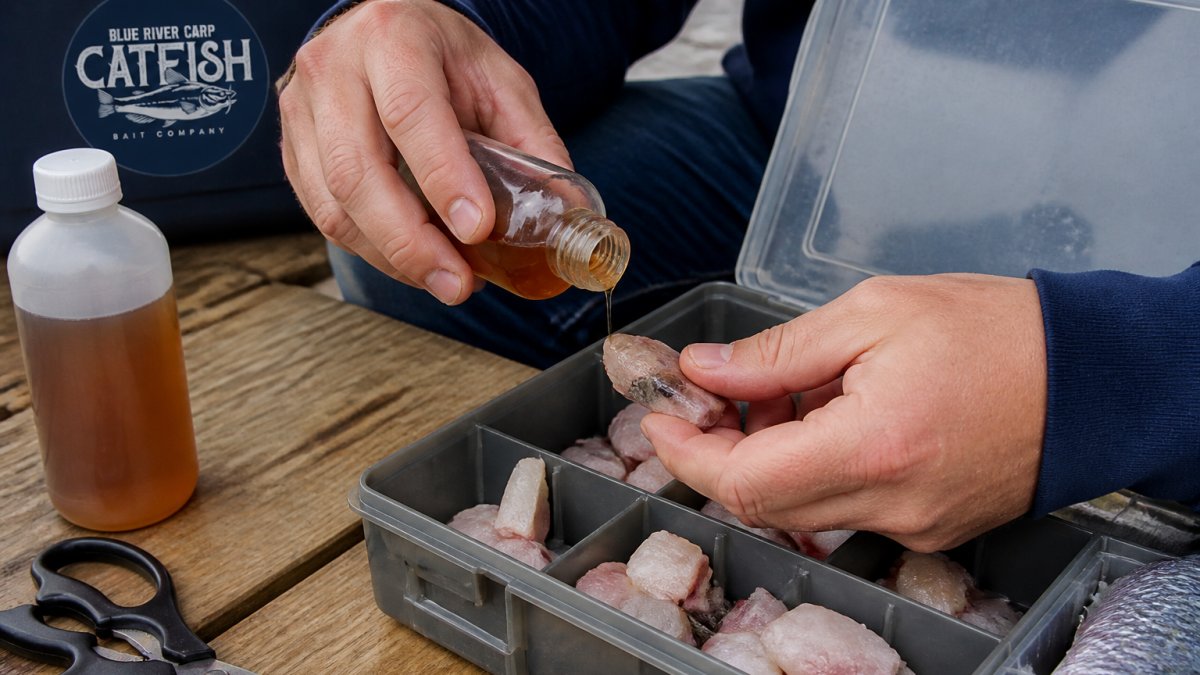
For soft plastics, apply scent in a thin layer across the body. Soft plastics absorb liquid attractants slowly, so the scent remains on the surface longer.
Blue River Carp, Inc. offers both our 7oz Catfish Cut Bait Nuggets and 10oz Catfish Cut Bait Chunks pre-scented with your choice of formulations.

For maximum scent release, apply attractant just before casting. Fresh application ensures the strongest scent trail. If you're fishing for extended periods, reapply every 30-45 minutes or after each cast in active water.
Use a small brush or your finger to apply scent evenly. Avoid clumping or pooling. The goal is a thin, uniform coating that disperses gradually as the bait sits in the water.
Reapplication and Storage Considerations
Reapplication frequency depends on water conditions and how long you're fishing. In fast current, reapply every 30 minutes. In slow current or still water, you can extend this to 45-60 minutes.
Store scented bait in a cool, dry place. Our products from Blue River Carp, Inc. maintain their potency for 12+ months without refrigeration because they're specifically formulated for shelf stability.
If you're using liquid attractants like our blood scent or shad oil, store them in a dark container away from direct sunlight. UV light degrades most scent compounds over time.
Don't over-apply scent to your bait storage container. Excess scent can create an overpowering smell that actually repels fish. The goal is attraction, not overwhelming intensity. A light coating is always more effective than heavy saturation.
If your bait has been sitting in the water for an hour without producing bites, reapply scent before moving locations. Fresh scent often triggers strikes from fish that were already in the area but hadn't committed yet.
Water Conditions, Temperature, and Seasonal Effectiveness
Scent effectiveness varies with water conditions. In warm water (above 70°F), fish are more active and more responsive to scent. Scent disperses faster, so you'll need to reapply more frequently.
Cold water (below 50°F) slows fish metabolism and reduces their responsiveness to scent. However, scent still works, it just takes longer for fish to detect and respond.
Spring and fall are ideal seasons for scented bait. Fish are actively feeding as they prepare for seasonal transitions. Water temperatures are moderate, scent disperses efficiently, and fish respond quickly to attractants.
Summer presents challenges in shallow water. Scent can dissipate rapidly in warm water, and fish may be less aggressive during the hottest parts of the day.
Murky water increases scent's value. When visibility is low, fish rely almost entirely on smell. Scented bait becomes essential rather than optional.
Heavy current increases scent dispersal. The moving water carries your scent trail farther and faster, attracting fish from greater distances. Slack water or still conditions require stronger scent or more frequent reapplication.
Measuring Results: Does Scent Actually Improve Your Catch Rate
The best way to measure scent effectiveness is to compare results directly. Fish two identical locations or times with scented bait and unscented bait. Track the number of bites, hookups, and fish landed in each session.
More bites means more opportunities to land fish.
Document your conditions each time you fish. Note water temperature, clarity, current speed, time of day, and weather. Over time, patterns emerge.
Keep a simple log: date, location, water conditions, bait type (scented or unscented), and number of bites. After 10-15 outings, the data will show you exactly how much scent improves your results in your specific situation.
Don't expect dramatic differences in ideal conditions. Clear water, good visibility, and active fish reduce scent's advantage. In challenging conditions, murky water, cold weather, slow periods, scent can increase your chances of catching fish.
The real value of scented bait appears over time. One trip might not show a huge difference. But across a season, scented bait can increase your chances of catching fish.
Catching more catfish means using the tools fish actually respond to. Start with our 7oz Catfish Cut Bait Nuggets or 10oz Catfish Cut Bait Chunks, or customize your own with our DIY Dried Cut Bait and scent oils.

Frequently Asked Questions
Does scented fishing bait actually help you catch more fish?
Yes. Scented fishing bait works by triggering a catfish's natural feeding response through their highly developed sense of smell. Fish detect scent particles dispersed in the water and follow the trail to the bait. Scent also encourages fish to hold onto bait longer, increasing hookup rates. However, results depend on water conditions, species, and proper application. In clear water with adequate current, scent creates a stronger advantage than in stagnant or murky conditions.
How does scented bait for catfish compare to unscented options?
Scented bait for catfish outperforms unscented bait in most conditions by attracting fish from greater distances and encouraging longer bait retention. Unscented bait relies on visual detection and natural fish behavior, which works but limits your reach. Scented options create an aroma trail that draws catfish to your location faster. The tradeoff is cost: scented bait typically costs more upfront, but it offers increased chances of catching fish.
How long does fishing bait scent last in the water?
Scent dispersal depends on water movement and oil type. In moving water with current, scent disperses quickly, creating a trail that lasts 30 minutes to 2 hours depending on flow strength and temperature. In still water, scent lingers longer but covers less area. Thicker oils like carp oil stay put longer on the bait itself, releasing scent gradually. Thinner liquids disperse faster. Reapplication every 30-45 minutes in slow water or every 45-60 minutes in moving water keeps scent levels optimal.
What's the best way to apply scent attractant to bait?
Soak or coat your cut bait or soft plastics with the attractant, ensuring full coverage. For oils, apply generously to all surfaces. For gels, work them into crevices and seams where they'll release slowly. Store scented bait in a sealed container to preserve potency. Reapply after 30-60 minutes of fishing or after catching a fish, as handling and water exposure reduce scent effectiveness. Keep your hands clean and avoid sunscreen or fuel contamination.


