
Bank Fishing Techniques for Murky Water: What Works?
Last Updated: October 29, 2026
Quick Summary
Effective bank fishing techniques for murky water replace sight with sound, vibration, and scent by slow rolling Colorado-blade spinnerbaits, bumping rattling crankbaits off cover, and soaking strong-smelling catfish bait on a slip sinker rig. Check clarity with the hand test first, then match lure color to that range and cast parallel to the bank.
- Use the hand test at the water's edge to sort clarity into clear, stained, murky, or muddy.
- Slow roll a Colorado-blade spinnerbait just fast enough to keep the blades turning.
- Add sound before shine: a rattling dark bait beats a silent bright one below about 6 inches of visibility.
- Cast parallel to the bank so your lure stays in the shallow zone where post-rain fish feed.
- Thread cut bait onto a 5/0 to 8/0 circle hook and check it every 20 to 30 minutes.
Table of Contents
- Why Murky Water Changes Everything for Bank Anglers
- The Best Lures for Muddy Water and How to Fish Them
- What Color Lures for Murky Water: Bright, Dark, or High-Contrast?
- Bank Fishing After Rain: Positioning, Casting Angles, and Safety
- Catfish Bait for Murky Water: Scent, Sink, and Staying on the Hook
- A Sequenced Plan: Working the Bank Step by Step
- Stock Your Tackle Box for the Next Muddy Trip
- Frequently Asked Questions
Why Murky Water Changes Everything for Bank Anglers
Muddy water cuts a fish's vision to inches, so bank fishing techniques for murky water must replace sight with sound, vibration, and scent, reshaping lure choice, color, retrieve speed, and where you stand.
Clear-water habits may not work as well in brown water; fish may find food differently.
The core idea most guides skip: in murky water, visibility is a range, not a yes-or-no. Stained water still shows a silhouette at a few feet; chocolate-milk water does not.
How to Read Water Clarity Before You Cast
Water clarity is how far a fish can see a lure, and you can measure it in under a minute without any gear. Wade to the edge, kneel down, and look at your hand in the water.
- Clear: you see your fingers clearly at 18 inches or more
- Stained: your hand fades around 8 to 12 inches
- Murky: you lose your hand past 6 inches
Check the shallow edge, not the middle, bank anglers often misjudge clarity by only looking at the deep channel. For a deeper walkthrough, our guide on reading water for bank fishing covers current seams, eddies, and mapping a stretch before you fish it.
The Best Lures for Muddy Water and How to Fish Them
The best lures for muddy water are the ones fish can feel before they see them: spinnerbaits, crankbaits, and soft plastics with real movement, fished slowly and deliberately.
Forget finesse. In low visibility, a lure that pushes water, rattles, or knocks bottom gives fish a target to track; bass, catfish, and most bank-caught predators hunt by lateral line and sound when their eyes fail them.
Spinnerbaits: Slow Rolling and Vibration
Slow rolling is the technique: cast, let the spinnerbait sink to your target depth, then reel just fast enough to keep the blades turning. No faster.
- Use a Colorado blade for maximum thump in dirty water
- Add a trailer for extra bulk and a bigger profile
- Keep the bait deep and slow through cover
A common mistake is reeling too fast. Speed lifts the bait and kills the vibration. Slow rolling keeps the blades thumping and the bait in the strike zone longer.
Crankbaits: Deflection and Bottom Contact
Crankbait fishing in muddy water is about contact. Bump the bait into rocks, stumps, and laydowns; that deflection triggers reaction strikes from fish that cannot see the lure well.
- Choose a squarebill for shallow cover
- Pick a wide-wobble bait over a tight one
- Use a rattling model when the water is really thick
The pause matters more than the retrieve. When a crankbait ricochets off cover, a short stop lets a following fish close the gap.
What Color Lures for Murky Water: Bright, Dark, or High-Contrast?
The best color lures for murky water are black, black and blue, and chartreuse, because they create the strongest contrast against brown water. Bright and dark colors both work, but for different reasons at different visibility ranges.
The mechanism most guides skip: a fish in muddy water sees a silhouette (the bait's outline against the lighter background) and a flash point (a bright edge or blade catching what little light penetrates).
Match Color to the Clarity Range
| Water Condition | Primary Color Strategy | Best Specific Colors | Why It Works |
|---|---|---|---|
| Stained (hand visible 8-12 in) | Bright flash point | Chartreuse, white, firetiger, white/chartreuse spinnerbait skirts | Fish still see edges; bright blades and skirts pop against brown |
| Murky (hand fades past 6 in) | Dark silhouette | Black, black and blue, dark red, junebug | Outline reads best; fish track the shape, not the detail |
| Muddy (no hand visible) | Contrast plus sound | Black with chartreuse tail, black/blue with rattles, loud Colorado blades | Silhouette plus vibration; color is secondary to noise |
| Cold and muddy | Dark, slow, bulky | Black/blue jig with chunk trailer, dark red crankbait | Easy target, low energy cost for lethargic fish |
Lure-by-Lure Color Calls for Bank Anglers
Generic color advice fails because each lure family presents color differently. Applying it on the bank:
- Spinnerbaits: In stained water, a white or chartreuse skirt with gold Colorado blades gives the strongest flash. In muddy water, switch to a black or black/blue skirt with a single large Colorado blade, the thump matters more than the skirt color, but the dark skirt tightens the silhouette.
- Crankbaits: A chartreuse squarebill is the stained-water standard. In muddy water, a black or dark red wide-wobble rattling bait outscores natural patterns because the silhouette reads at distance. Avoid translucent or natural shad patterns entirely, they vanish.
- Soft plastics: Black and junebug worms and creatures with a chartreuse-dipped tail give you both silhouette and a flash point in one bait. A dark body with a bright tail is the single most versatile muddy-water soft plastic for bank anglers.
The One-Change Rule
If you can only change one thing on a slow day, add sound before you add shine. Flash does less in truly muddy water than vibration: a rattling dark bait beats a silent bright one once visibility drops below about 6 inches. Carry one loud, dark bait and one bright, silent bait to cover both ends of the clarity range without re-rigging.
For a deeper walkthrough on matching lure color to light conditions across the water column, our guide on reading water for bank fishing covers how depth and clarity interact.
Bank Fishing After Rain: Positioning, Casting Angles, and Safety
Bank fishing after rain is about reading runoff.
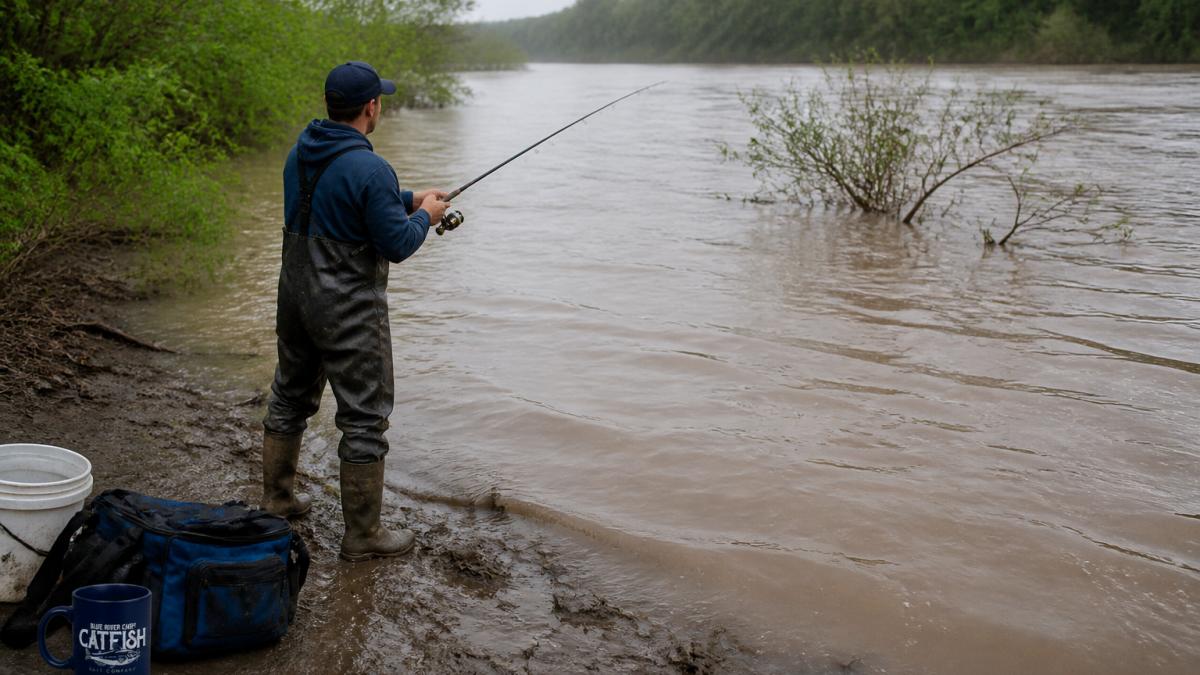
Stand where you can cast parallel to the bank rather than straight out.
10oz Catfish Cut Bait Chunks – Preserved Real Fish, 6 Scents →
Watch out: wet banks collapse. Clay edges give way after heavy rain and flooded timber hides drop-offs.
A few positioning rules that hold up:
- Fish the dirty-to-clean seam, not the middle of the mud
- Cast upstream and retrieve with the current
- Target flooded cover on the inside of bends
If you're planning a muddy trip and want your setup sorted first, our list of essential catfish gear for bank fishing covers rods, rigs, and holders.
Catfish Bait for Murky Water: Scent, Sink, and Staying on the Hook
Catfish bait for murky water has to do three jobs: smell strong, sink fast, and stay on the hook through a cast. Scent is the whole game when a catfish cannot see your bait, but delivery matters as much as the bait.
Catfish hunt by smell and taste, and in muddy water a scent trail is the difference between a bite and a wasted soak. Blood bait, shad oil, and cut bait all pull fish in from distance.
Species Matter: Channel vs. Flathead vs. Blue
Most murky-water catfish advice treats all catfish the same. They are not.
- Channel catfish are the most scent-driven and the most common bank-caught catfish. They respond to strong, oily, blood-based scents and will move several feet to track a trail. Cut bait, blood bait, and prepared stink baits all work. Channel cats also feed more during the day than the other two species, which matters for bank anglers who fish mornings and evenings.
- Flathead catfish are predators first and scavengers second. They prefer live bait, a live bluegill or bullhead on a heavy rig, and they ambush from cover rather than roaming a scent trail. In muddy water, a live bait that struggles sends vibration a flathead can feel. Scent bait is a secondary option for flatheads, not the primary one.
- Blue catfish sit between the two. They take cut bait readily and respond well to strong scent, but they tend to hold in deeper current seams than channel cats. From the bank, that means casting to the edge of the channel rather than the shallow flat.
If your target is channel catfish, the most realistic bank target in most muddy water, scent bait is the right call. If flatheads are in the mix, keep a live-bait rod rigged.
Rigging Scent Bait So It Survives the Cast
The other half of catfish bait is presentation. Soft, mushy bait flies off the hook on the cast. Our cut bait is made from invasive carp and infused with scent. But the rig matters too:
- Circle hooks in the 5/0 to 8/0 range are the bank-angler standard for cut bait. They hook fish in the corner of the mouth and reduce gut-hooking, which matters when you are releasing fish.
- A slip sinker rig (egg sinker above a swivel, with a 12- to 18-inch leader) lets a catfish pick up the bait without feeling weight. In current, go heavier on the sinker, 1 to 2 ounces, so the bait stays put.
- Thread the bait onto the hook rather than balling it up. A chunk of cut bait threaded once through the meat and once through the skin stays on through a hard cast and still releases scent.
Building a Scent Trail from the Bank
You cannot chum from a boat, but you can still build a scent trail: cast upcurrent and let the bait soak down through the scent cone. Our guide to choosing the best catfish scent breaks down which attractants suit channel versus flathead catfish.
If bait loss is your problem, our proven fixes for why bait falls off the hook walk through seven ways to keep it pinned.
A Sequenced Plan: Working the Bank Step by Step
The full sequence we would run on a muddy bank, start to finish:
- Check clarity with the hand test at the water's edge
- Pick your color from the table above based on what you see
- Rig a vibration bait first, spinnerbait or rattling crankbait
- Cast parallel to the bank and slow roll through cover
- Pause on contact every time the lure hits structure
- Switch to scent bait if bass are quiet and catfish are the target
- Work the seam where runoff meets clean water
- Move every 15 minutes until you find a grouped pocket of fish
That is the whole loop. Clarity, color, vibration, scent, movement. Most bank anglers skip step one and guess at the rest.
Stock Your Tackle Box for the Next Muddy Trip
Muddy water rewards preparation more than skill. The anglers who catch fish after rain already had the right bait in the bag.
Our cut bait comes in a resealable bag and needs no refrigeration or freezing. It has a shelf life of 12 months or more.
You can browse the full lineup of preserved cut bait, scents, and tackle and be ready before the next storm hits.
Frequently Asked Questions
What color lure do I use in murky water?
Start with high-contrast colors that stand out against brown water: black and blue, chartreuse, and solid white or fire tiger. Dark colors like black and blue create a strong silhouette, while chartreuse adds flash. Carry both and switch if one pattern gets no reaction after 20 to 30 casts.
How fast should I retrieve a lure in muddy water?
Slow down more than you think. Slow rolling a spinnerbait just fast enough to keep the blades turning is one approach. For crankbaits, use a steady crawl that keeps the bait in bottom contact. Add pauses of one to three seconds, especially around cover.
What bait works best for catfish in murky water?
Scent matters most when catfish cannot see well, so use bait that bleeds flavor and stays on the hook. Blue River Carp's 10oz Catfish Cut Bait Chunks ($12.00) and 7oz Nuggets ($11.00) are made from real fish and require no refrigeration or freezing.
Where should I fish from the bank when the water is muddy?
Target current seams, eddies, and the slower water just outside the main flow. Cast parallel to the bank or upstream and let your lure drift into those zones. Fish deeper water if the bank is shallow and muddy. Stay off slick, undercut banks after heavy rain.
Brown water is not a reason to stay home. It is a reason to change how you fish. Blue River Carp, Inc. makes scent-infused cut bait that stays on the hook and stays fresh for 12+ months without a cooler, so your bait is ready when the runoff is. Get started with Blue River Carp, Inc. and fish the mud with bait that works as hard as you do.


