
Essential Catfish Gear for Bank Fishing in 2026
Table of Contents
- What You Actually Need: Essential Catfish Gear for Bank Fishing
- Rod, Reel, and Line Specs That Handle Bank Catfishing
- Best Catfish Rigs for Bank Fishing
- Best Bait for Bank Catfishing: What Stays on the Hook
- Bank Fishing Rod Holders and Terminal Tackle
- Budget-Tier vs. Pro-Tier Gear and Weather Optimization
- Bank Mobility, Leave-No-Trace, and Safety
- Frequently Asked Questions
Last Updated: September 28, 2026
What You Actually Need: Essential Catfish Gear for Bank Fishing
Bank fishing for catfish means targeting channel, blue, and flathead catfish from shore with tackle adapted for stationary fishing. This guide from Blue River Carp, Inc. covers the essential catfish gear for bank fishing, rod specs, rigs, and safety.
Most bank anglers overpack.
Rod, Reel, and Line Specs That Handle Bank Catfishing
A medium-heavy rod paired with a baitcasting reel spooled with braided main line is the standard bank catfishing setup: enough backbone for heavy sinkers, enough sensitivity to detect a soft bite at distance.
Rod Length and Power for Shore Fishing
For bank fishing, a 7 to 8-foot medium-heavy rod with moderate action is the sweet spot. The extra length clears shoreline brush and casts past the drop-off; the moderate action absorbs head shakes without pulling hooks.
American Sportfishing Association angler resources
Reel Size, Drag System, and Line Choice
Match a 4000 to 6000-size spinning reel or a 300-level baitcasting reel to that rod. Drag matters more than gear ratio: smooth, consistent pressure beats maximum pounds.
| Component | Bank Fishing Spec | Why It Matters |
|---|---|---|
| Rod | 7-8 ft medium-heavy | Casts heavy sinkers, clears brush |
| Reel | 4000-6000 spinning | Smooth drag for long runs |
| Main line | 30-50 lb braid | Distance and bite detection |
| Leader | 20-30 lb monofilament | Stretch and abrasion resistance |
Best Catfish Rigs for Bank Fishing
The best catfish rigs for bank fishing are the slip sinker rig and the three-way rig, because both hold bottom in current and let a catfish take bait without feeling the weight. Rig choice comes down to water conditions. Staying focused on these rigs during long sessions under the sun requires durable fishing shirts that keep you comfortable while you wait for a bite.
Best Bait for Bank Catfishing: What Stays on the Hook
The best bait for bank catfishing survives the cast, stays on the hook through current, and keeps releasing scent.
Bait Types Ranked by How They Behave on a Bank
- Cut bait (firm fish flesh): The workhorse. Firm enough to stay rigged through a hard cast, releases scent steadily, and holds up in current.
- Chicken liver: Catches fish, but flies off on the cast and dissolves fast. Wrap it in nylon or thread it on a treble to hold it.
- Shrimp and squid: Firm and easy to thread, but wash out faster than cut bait in moving water. Best in still water or as a scent carrier alongside a firmer bait.
- Dough and dip baits: Excellent scent dispersion, poor castability. Best at close range or in a bait holder, not on a long cast.
- Live bait (bluegill, shad): Top producer for flatheads, but needs a bucket, aerator, and cooling, a lot to carry down a bank.
Matching Bait Size to the Fish You're Targeting
Bait size is a targeting decision. A channel cat has a smaller mouth than a trophy blue or flathead, and oversized bait gets picked apart without a hookup.
- Channel cats: Bait pieces roughly 1 x 2 inches. Small enough to fit in the mouth, large enough to hold scent.
- Blue cats: Bait pieces roughly 2 x 3 inches. Blues are more aggressive and will take a larger offering.
- Flatheads: The largest pieces you can cast, or live bait. Flatheads are ambush predators and respond to a big, moving profile.
Storage and Transport on the Bank
On a boat you have a cooler and livewell; on a bank you have what you can carry.
- Shelf-stable preserved bait goes in the tackle bag or bucket with no cooler, no ice, and no leakage. That's the difference between a bait you'll actually bring and a bait you'll leave in the truck.
- Frozen bait needs a cooler and ice, adding weight and a second trip if you're walking far. Fine for a short walk, painful for a quarter-mile hike.
- Live bait needs a bucket with an aerator and a battery. That's a third item to carry and a third thing to fail.
Bank Fishing Rod Holders and Terminal Tackle
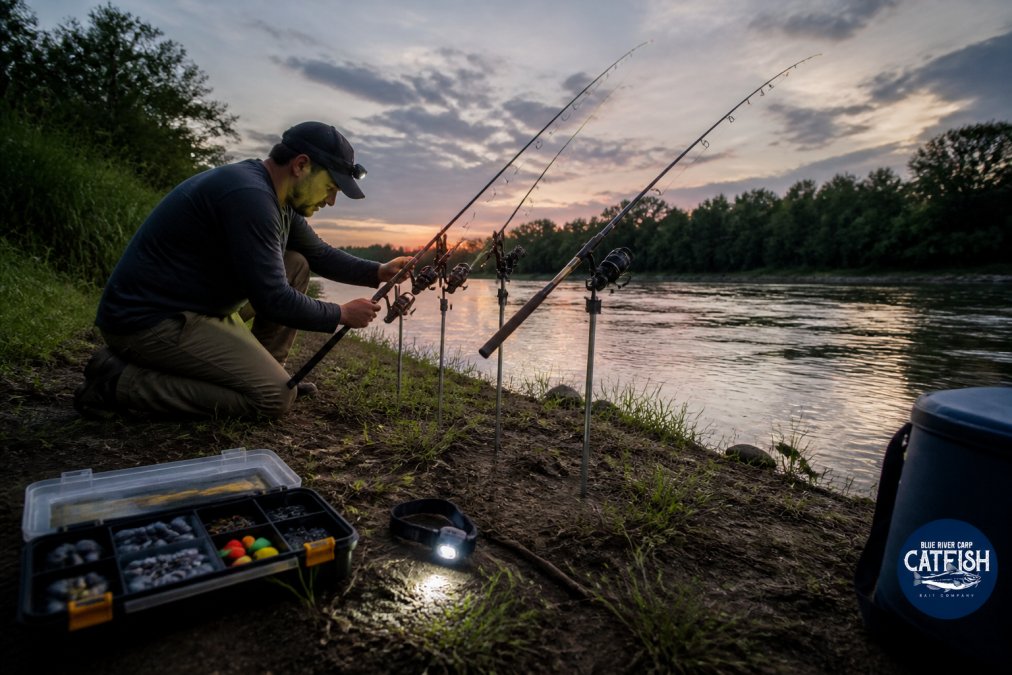
Bank fishing rod holders let you fish multiple rods while keeping your hands free for rigging, the single biggest upgrade for shore anglers. A holder also sets the hook on a running fish better than a forked stick, so the circle hook rotates into the corner of the mouth.
Catfish Weekend Kit - 4 x 7oz Nuggets →
Rod Holder Types and When Each One Works
- Sand spikes (sand tubes): PVC or aluminum driven into soft bank. Fast to set, useless in rock or packed clay. Best on reservoir shorelines and sandbars.
- Bank stands with adjustable angle: A tripod or stake base with a pivoting cradle. Angle adjustment matters more than brand, keep the rod tip low and pointed at the water on windy days so line doesn't bow and drag your sinker.
- PVC DIY holders: Cheap, customizable, and standard for anglers fishing three or more rods. Cut the top at an angle so the rod butt seats without spinning.
- Rod quivers and shoulder-strap carriers: Carrying holders, not fishing holders. A quiver strapping two or three broken-down rods to your back moves a multi-rod setup down a bank in one trip.
Terminal Tackle: Sizing It to the Water in Front of You
Terminal tackle for a bank kit scales with current, depth, and casting distance.
- Sinker slides and bank sinkers: Use 1 to 2 ounces in still water and light current; step to 3 ounces or more when the river is up or you're casting across a channel.
- Barrel swivels: One above the leader reduces line twist from current and spinning baits. Size the swivel to your main line, not your leader.
- Circle hooks in 5/0 to 8/0: Match hook gap to bait width, not the fish you hope to catch.
- A landing net with a long handle: Steep banks and riprap are where fish get lost. A 6 to 8-foot handle lets you reach water without leaning over the edge.
- Fish bonker and pliers: Pliers for hook removal, bonker for dispatching a kept fish. Both belong on a lanyard, not loose in a bag.
The Bank-Specific Problem Nobody Plans For: Getting It There
Most gear guides assume you park next to your spot. On real banks you often walk, a quarter mile of trail, a slope, stairs at a tailwater access, and that changes what you carry.
What works:
- A folding cart with pneumatic tires rolls over gravel and grass where hard plastic wheels bog down, carrying a cooler, bucket, and two rod cases in one trip.
- A bucket with a lid doubles as a seat, bait container, and carry-all, the single most useful piece of bank gear after the rod itself.
- A rod quiver or two-rod soft case strapped to the cart or worn on your back keeps rods off the ground while you set up.
- A headlamp worn on the head, not held, you need both hands for the walk in and setup.
Budget-Tier vs. Pro-Tier Gear and Weather Optimization
Budget-tier gear gets a beginner on the bank; pro-tier gear buys durability and casting distance.
| Category | Budget Tier | Pro Tier | What You Gain |
|---|---|---|---|
| Rod and reel | Entry combo | Medium-heavy rod + baitcaster | Distance, drag smoothness |
| Line | 30 lb braid, mono leader | 50 lb braid, fluoro option | Abrasion resistance |
| Rod holders | PVC or sand spikes | Adjustable bank stands | Angle control, stability |
| Bait | Cut bait, shelf-stable | Same, in bulk kits | Fewer trips to the store |
Bank Mobility, Leave-No-Trace, and Safety
Bank mobility is the gear problem nobody talks about: you carry everything you brought, sometimes a quarter mile, sometimes down a slope.
Safety basics for shore anglers:
- A headlamp plus a backup light for night fishing
- A first aid kit with hook cutters
- A life jacket if you fish steep, undercut banks
- Tell someone your location and return time
U.S. Fish and Wildlife Service fishing safety guidance
Frequently Asked Questions
What is the best rig for bank fishing for catfish?
A slip sinker rig with a 1 to 3 oz egg sinker, barrel swivel, 12 to 18 inch monofilament leader, and a 5/0 to 8/0 circle hook works for most bank situations. The fish can take line without feeling weight, and circle hooks set in the corner of the mouth. For bigger blues and flatheads, a fish-finder rig with a 2 to 4 oz sinker and a heavier leader holds bottom in current.
What is the best bait for bank catfishing when you have no cooler?
Shelf-stable preserved cut bait made from invasive carp gives you real cut bait without refrigeration. Blue River Carp nuggets are about 1 x 2 inches and chunks about 2 x 3 inches, with a 12+ month shelf life in a resealable pouch. The firm texture stays on the hook through casts and current, unlike chicken liver or thawed shad that turn mushy.
How do you choose the right rod and reel for bank catfishing?
A 7 to 9 foot medium-heavy rod with moderate action gives you casting distance from shore and enough backbone to turn a big catfish. Pair it with a 4000 to 6000 size spinning reel or a baitcasting reel with a smooth drag system, spooled with 20 to 30 lb braided main line and a monofilament leader. That setup handles channel, blue, and most flathead catfish from the bank.
What bank fishing rod holders work best on uneven shorelines?
Sand spikes push into soft dirt or sand but tip over on rock. Ground stakes with a wide base and adjustable angle hold better on gravel and packed clay. For concrete or riprap, a clamp-on or weighted base holder is the only option that stays put. Set rods at a 30 to 45 degree angle to the water so a running fish can pull line without dragging the rod in.