
Prepared Cut Bait vs Fresh Cut Bait: Which Wins?
Table of Contents
- Prepared Cut Bait vs Fresh Cut Bait: Quick Comparison Table
- How Scent Trails and Decomposition Drive Catfish Strikes
- Hook Retention: Why Fresh Bait Falls Off and Prepared Bait Stays Put
- How to Store Cut Bait: Freezing, Thawing, and Shelf-Stable Options
- Best Bait for River Fishing: Current, Cover, and Cut Bait Choices
- Cost, Convenience, and the DIY vs Store-Bought Trade-Off
- Conclusion
- Frequently Asked Questions
Last Updated: September 22, 2026
Prepared Cut Bait vs Fresh Cut Bait: Quick Comparison Table
Prepared cut bait vs fresh cut bait comes down to one trade-off: fresh bait releases a stronger scent trail early, while prepared cut bait stays on the hook longer and stores without a cooler. For most catfish anglers fishing a few hours at a time, prepared bait wins on convenience and hook retention. Fresh bait wins when you're targeting trophy fish in heavy current and can keep it cold.
| Factor | Fresh Cut Bait | Prepared Cut Bait |
|---|---|---|
| Scent strength | Strongest in first 30 minutes | Consistent, long-lasting |
| Hook retention | Soft, falls off easily | Firm, stays put |
| Storage | Ice or cooler required | Shelf-stable, no refrigeration |
| Cost per trip | Higher with waste | Lower, resealable and reusable |
| Best for | Short, targeted sessions | All-day and spontaneous trips |
How Scent Trails and Decomposition Drive Catfish Strikes
- Channel catfish are the most opportunistic and the most scent-driven. They respond strongly to fresh, oily bait and to prepared baits with a heavy amino-acid load. A fast, loud trail works.
- Blue catfish are open-water roamers that feed heavily on shad and other baitfish. They key on both scent and the visual profile of a baitfish chunk, and they will follow a long, sustained trail across current. Firm, oily cut bait that keeps bleeding over time fits them best.
- Flathead catfish are ambush predators that prefer live prey and fresh-cut baitfish. They are the least likely to commit to a heavily aged or shelf-stable bait. If flatheads are your target, freshness and firm texture matter more than trail duration.
The practical takeaway. Scent is a function of surface area, freshness, and species. A thin, freshly cut strip bleeds more scent than a thick chunk that's been sitting in a bucket, and the right bait for a channel cat is not automatically the right bait for a flathead. Match the trail to the fish you're actually chasing.
Hook Retention: Why Fresh Bait Falls Off and Prepared Bait Stays Put
Fresh cut bait falls off because its cellular integrity breaks down within minutes of cutting. Once the tissue softens, a hard cast or a current rips it clean off the hook. Prepared bait solves this by firming up the texture so the piece holds its shape through casting, current, and a catfish's first strike.
How to Store Cut Bait: Freezing, Thawing, and Shelf-Stable Options
How you store cut bait decides how it performs on the hook. Freezing, cooler-and-ice, and shelf-stable packaging cover almost every angler, but the difference between good and bad results is in the details of each method.
Freezing: a step-by-step protocol
Freezing does not preserve bait perfectly. Ice crystals puncture cell walls, and when the bait thaws, those ruptured cells leak their contents and the tissue turns soft. You cannot eliminate that damage, but you can minimize it:
- Cut to fishing size before freezing. Every cut you make after thawing exposes new surface and accelerates spoilage. Portion the bait into the sizes you'll actually fish.
- Pat the pieces dry. Surface water becomes surface ice, which adds freezer burn and dilutes the scent profile on thaw.
- Bag in small, single-trip portions. A large block that you thaw and refreeze repeatedly degrades faster than several small bags you open one at a time.
- Press out the air and seal tight. Oxygen drives oxidation of the oils that carry scent. Vacuum sealing is best; pressing air from a zip-top bag is the practical minimum.
- Freeze fast and cold. A freezer at 0°F or below freezes tissue quickly, which produces smaller ice crystals and less cell damage than a slow freeze in a half-full freezer.
- Label with the date. Most anglers find frozen cut bait is at its best within three to six months, and noticeably weaker after a year.
Thawing: the step most anglers get wrong
Thaw slowly and cold. Move the bag from the freezer to the refrigerator the night before, or let it thaw in a cooler with a little ice. Thawing under warm water or in the sun speeds bacterial growth and turns bait mushy before it ever reaches the hook. A slow, cold thaw keeps more of the tissue structure intact, which is what holds the bait on the hook.
Cooler and ice: a one-day solution
A cooler with ice is fine for a single trip. Keep bait on ice, not sitting in meltwater, and drain the cooler periodically. Bait still softens by afternoon, so this method suits a morning session rather than an all-day one.
Shelf-stable: no cold chain at all
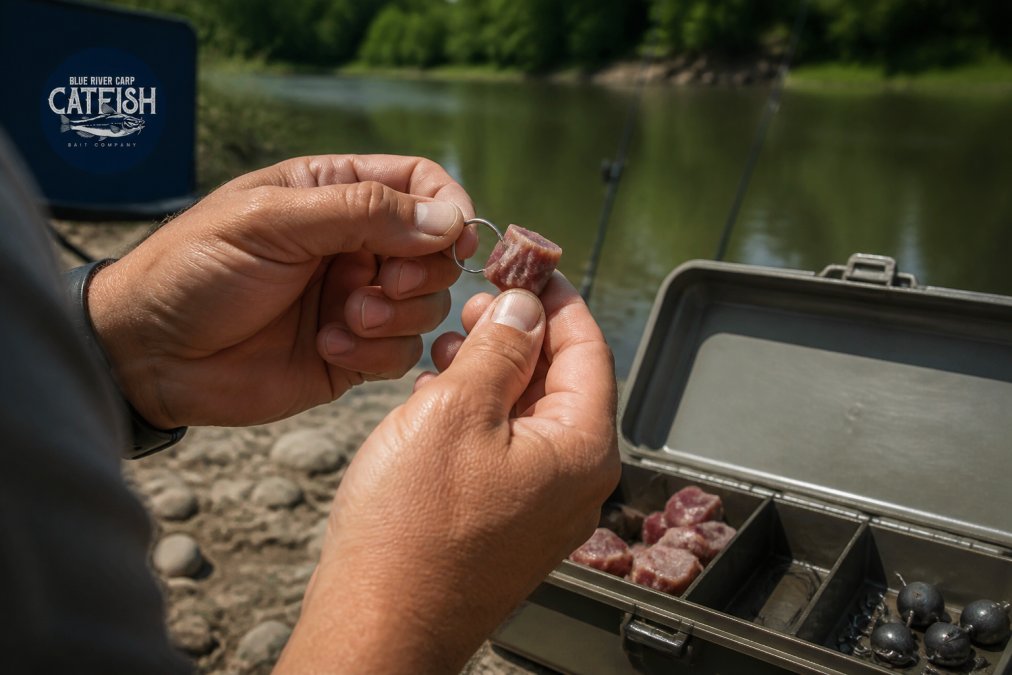
Shelf-stable prepared bait removes the freeze-thaw problem entirely. It stays firm and ready straight from the bag, needs no refrigeration, and leftover pieces go back in the resealable package for the next trip. For anglers who fish sporadically or who don't want to manage a cooler, this is the lowest-friction option. The trade-off is that you give up the fresh-tissue scent profile that some species, flatheads in particular, respond to best.
Matching storage to your fishing pattern
- Fish weekly: freeze in small portions and rotate stock so you're always using the oldest bag first.
- Fish monthly or less: shelf-stable bait avoids the waste of thawing more than you use.
- Targeting flatheads: prioritize fresh or freshly frozen bait and skip long-term storage.
- Targeting channels and blues: frozen or shelf-stable bait with a strong amino-acid load performs well.
Best Bait for River Fishing: Current, Cover, and Cut Bait Choices
The best bait for river fishing is firm cut bait that survives current and stays on the hook through repeated casts. Rivers punish soft bait. Moving water strips oils and scent downstream fast, and it pulls loose pieces right off the hook.
- Fast current: Use firm chunks or strips that hold shape. Soft bait won't survive the drift.
- Deep holes and cover: Larger chunks sink and sit where catfish feed. Blue River Carp, Inc.'s 10oz chunks are approximately 2" x 3", sized for bigger fish.
- Shallow flats: Smaller nuggets around 1" x 2" cast cleanly and cover more water.
Cost, Convenience, and the DIY vs Store-Bought Trade-Off
DIY cut bait looks cheaper until you count the whole trip. You buy baitfish, keep it cold, cut it on the bank, and throw away whatever softens before you're done. Store-bought prepared bait trades that prep time for a set price and almost no waste.

Run the numbers on a per-trip basis:
| Approach | Upfront Cost | Waste | Prep Time |
|---|---|---|---|
| DIY fresh | Baitfish plus ice | High | 20-30 min per trip |
| Store-bought prepared | Fixed, resealable | Low | None |
| Blue River Carp, Inc. strips | $6.00 per pack | Minimal, reusable | None |
Conclusion
The real challenge with cut bait isn't choosing a side. It's keeping bait firm, scented, and ready when the fish are biting, without hauling a cooler on every trip. Blue River Carp, Inc. makes that simpler with veteran-owned, Indiana-made bait crafted from invasive carp. The strips stay on the hook, the resealable packages hold for 12+ months without refrigeration, and the pieces won't go mushy on a long cast.
Frequently Asked Questions
Does freezing cut bait make it less effective?
Freezing slows decomposition but does not stop it. Ice crystals rupture cell walls, so when the bait thaws, it releases fluids and scent faster and turns soft, which weakens hook retention. A partially thawed fillet can slide off during a cast. Prepared cut bait skips the freeze-thaw cycle entirely because it is preserved and shelf-stable, so it stays firm on the hook and keeps its odor profile intact trip after trip.
Is fresh cut bait always better than prepared bait?
No. Fresh cut bait has a strong initial scent trail, but it degrades quickly in warm water and often falls off the hook on the cast or during a predatory strike. Prepared cut bait holds together longer, requires no cooler, and still carries natural oils and amino acids that trigger feeding behavior. On many river trips, the bait that stays on the hook out-fishes the bait that smells best for the first ten minutes.
How long does prepared cut bait last on the hook?
Prepared cut bait chunks and nuggets stay secured through repeated casts and extended soak times, unlike fresh bait that softens and slips off. The firm texture resists the mushy breakdown that happens when frozen bait thaws in a live well or on a stringer. You can also reuse leftover pieces because they do not spoil between trips when stored in a resealable bag.
What are the benefits of using scent-infused cut bait?
Scent-infused cut bait releases a steady odor profile that disperses through the water column and creates a scent trail catfish follow upstream. Blood, garlic, and shad flavors mimic the natural oils and amino acids found in baitfish, so channel, blue, and flathead catfish respond with a predatory strike. Because the scent is built into the bait, you do not need to re-bait as often to keep attractant in the water.
How does invasive carp compare to other cut bait species?
Invasive carp like silver and bighead have oily, firm flesh that holds scent well and stays on a hook longer than soft baitfish such as shad. Using them also removes a destructive species from rivers where they crowd out native fish. Prepared cut bait made from invasive carp gives you the natural oil dispersion of fresh baitfish with the durability of a preserved product, and it supports sustainable bait sourcing.