
River Fishing Knots for Beginners: A Practical Guide
Table of Contents
- Why Knot Selection Matters for River Fishing
- Easy Fishing Knots for Beginners: Where to Start
- The Uni Knot for Fishing: Your First Essential Knot
- The Palomar Knot for Fishing: Strength and Simplicity
- The Improved Clinch Knot: A Reliable Standard
- Fishing Line to Line Knot: Joining Two Lines Effectively
- Matching Knots to Your Fishing Line Type
- Common Mistakes Beginners Make When Tying Knots
- Frequently Asked Questions
Last Updated: October 8, 2026
Why Knot Selection Matters for River Fishing
The right knot can mean the difference between landing a fish and watching your line snap. River fishing demands knots that hold under pressure, stay secure in moving water, and work with different line types. Most beginners tie whatever knot they learned first and hope it works.
Anglers can lose fish because their knots aren't matched to their setup. A knot that works great with monofilament might slip on braided line. A knot that holds a small hook can fail with heavier terminal tackle. The key is understanding which knots solve which problems.
River fishing creates unique challenges. Moving water puts constant pressure on your connections. Your leader needs to absorb shock when a catfish hits hard. Your main line needs to stay connected to your leader without slipping.
Easy Fishing Knots for Beginners: Where to Start
For river fishing knots beginners should start with knots that do one thing well. Don't chase complicated knots that promise everything. Simple knots that you can tie consistently in the dark will outperform fancy knots you tie wrong half the time.
The best beginner fishing knots share three qualities:
- Easy to tie: You can learn them in 5 minutes
- Hard to mess up: They work even if your technique isn't perfect
- Strong enough: They hold 90%+ of your line's breaking strength
Focus on these three first:
- The Uni Knot for attaching hooks and lures to your main line
- The Palomar Knot for a backup option with slightly different advantages
- A line-to-line knot like the FG knot for connecting your main line to your leader
Master these three and you'll handle 95% of river fishing situations. Add more knots later once you're comfortable with these basics.
The Uni Knot for Fishing: Your First Essential Knot
The Uni Knot is the foundation every angler should build on. It's versatile, reliable, and forgiving. Use it to attach hooks, lures, swivels, and sinkers to your main line. It works with monofilament, fluorocarbon, and even braided line, though braided requires slightly tighter cinching.
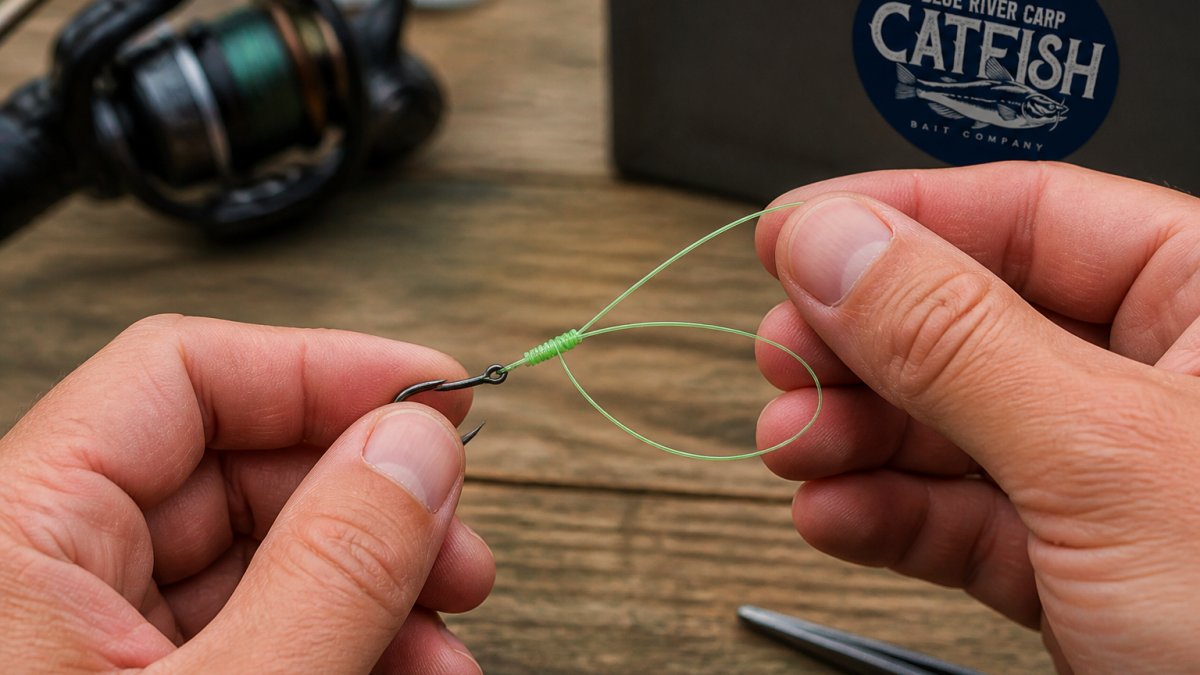
This knot's strength comes from how it wraps around the hook eye. The wraps create friction that holds the knot tight. Even if your tension isn't perfect, the knot still performs well. That's why beginners succeed with it.
Step-by-Step Uni Knot Instructions
Follow these steps exactly:
- Thread your line through the hook eye, Leave about 6 inches of tag end hanging
- Make a loop, Bring your tag end back parallel to your main line, creating an open loop
- Wrap the tag end around both lines, Start wrapping at the base of the loop, moving toward the hook eye. Make 4-6 tight wraps
- Pull the tag end to tighten, Hold your main line steady and pull the tag end. The wraps will slide down and cinch around the hook eye
- Trim the excess, Cut the tag end close to the knot
The whole process takes 20 seconds once you've practiced it a few times. The wraps should be tight and evenly spaced. Sloppy wraps create weak points.
When to Use the Uni Knot
Use the Uni Knot whenever you're attaching terminal tackle to your main line. That means hooks, lures, swivels, and sinkers. It's your primary knot for everyday fishing.
The Uni Knot works best with:
- Monofilament line: Your standard choice for river fishing
- Fluorocarbon leaders: Invisible to fish, works perfectly with this knot
- Light braided line: Test it first; some braided lines slip more
Where it falls short: With very heavy braided line, the wraps can slide slightly under extreme pressure. If you're fishing with 50-pound braided main line, consider the Palomar Knot instead.
The Palomar Knot for Fishing: Strength and Simplicity
The Palomar Knot is arguably the strongest knot for attaching terminal tackle. It's also one of the easiest to tie. The downside is it requires a bit more line and won't work with some lures that have small eyes.
This knot's strength comes from the doubled line passing through the hook eye. You're essentially creating a mechanical lock. It's nearly impossible to tie this knot wrong, which makes it perfect for beginners who want maximum reliability.
Tying the Palomar Knot
Follow these steps:
- Double your line, Fold about 6 inches of line back on itself, creating a doubled section
- Pass through the hook eye, Thread the doubled line through the hook eye
- Tie an overhand knot, Tie a simple overhand knot with the doubled line. Don't tighten it yet
- Pass the hook through the loop, Hold the overhand knot loosely. Slide the hook eye through the loop you've created
- Tighten firmly, Pull both lines tight. The knot will cinch down around the hook eye
- Trim the tag end, Cut close to the knot
This knot takes about 30 seconds. The doubled line makes it thicker, which actually helps with grip and strength.
Palomar Knot Advantages for River Conditions
The Palomar Knot excels in river fishing because it handles shock loads well. When a catfish hits your bait hard, the knot absorbs that sudden pressure without slipping.
Use the Palomar Knot for:
- Heavy hooks and sinkers: The strength is overkill for light tackle but perfect for serious river fishing
- Braided main line: This knot grips braided line better than most alternatives
- High-pressure situations: When you're fishing in fast current or targeting large fish
The limitation: Lures with tiny eyes won't fit the doubled line through. Stick with the Uni Knot for small lures.
The Improved Clinch Knot: A Reliable Standard
The Improved Clinch Knot is what most anglers learn first. It's been around for decades and works reliably when tied correctly. The knot wraps around your main line, then the tag end threads back through two loops.
This knot's weakness is that beginners often tie it wrong. The final step, threading through both loops, gets skipped or done incorrectly. When tied properly, it's strong. When tied wrong, it fails.
For river fishing, use the Improved Clinch Knot as a backup option. It works, but the Uni Knot and Palomar Knot are better choices. If you already know the Improved Clinch Knot, stick with it. Don't switch just for the sake of switching. Consistency matters more than picking the theoretically perfect knot.
Fishing Line to Line Knot: Joining Two Lines Effectively
River fishing often requires connecting two different lines. Your main line might be monofilament or braided. Your leader is usually fluorocarbon. You need a knot that joins them securely without slipping.
This is where line-to-line knots become essential. These knots differ from terminal knots because they're joining two separate lines of potentially different materials and thicknesses.
When You Need a Line-to-Line Connection
Use a line-to-line knot when:
- Connecting main line to leader: Your main line is thicker; your leader is thinner and invisible to fish
- Joining two monofilament lines: Upgrading to a stronger section for a specific stretch
- Attaching braided to monofilament: Braided main line to monofilament leader for shock absorption
The connection point is a stress point. Current pulls on it. Fish pull on it. Your knot must hold under constant pressure and sudden shocks.
Tying the FG Knot for Leader Connection
The FG Knot is the best line-to-line knot for river fishing. It's small, strong, and reliable. It takes practice to master, but the effort pays off.
Follow these steps:
- Create a loop with your main line, Make a small loop at the end of your main line
- Thread your leader through the loop, Pass your leader through the main line loop
- Wrap the leader around both lines, Starting at the base of the loop, wrap your leader around the main line and the standing part of your leader. Make 8-10 tight wraps moving away from the loop
- Reverse direction, Wrap back toward the loop, creating a crossing pattern
- Thread through the original loop, Pass your leader back through the main line loop
- Tighten by pulling both lines, Pull your main line and leader in opposite directions. The wraps will cinch down
- Trim both tag ends, Cut close to the knot
The FG Knot takes 2-3 minutes to tie once you know the pattern. It's worth the time. The knot is smaller than other line-to-line options, which helps it pass through guides smoothly.
Matching Knots to Your Fishing Line Type
Different lines behave differently. Your knot choice should match your line choice.
Monofilament line is the most forgiving. It grips most knots well. Use any of the knots in this guide. The Uni Knot is your best all-around choice.
Fluorocarbon line is slippery. It needs knots that create strong friction. The Palomar Knot works best because the doubled line creates extra grip. The Uni Knot works too if you add an extra wrap.
Braided line is the trickiest. It's slippery and requires tight cinching. The Palomar Knot is your best choice. Make sure your wraps are extremely tight.
When you're starting out, stick with monofilament or fluorocarbon. They're more forgiving. Once you're comfortable with knot tying, experiment with braided line.
Common Mistakes Beginners Make When Tying Knots
Most knot failures come from these preventable errors:
Loose wraps. Sloppy, uneven wraps create weak points. Take your time. Make each wrap tight and close to the previous one.
Not enough wraps. Fewer wraps means less friction. Add an extra wrap if you're unsure. More wraps are almost always better than fewer wraps.
Wet knots. Tie your knots when your line is dry. Wet line is slippery.
Wrong knot for the line type. A knot that works perfectly on monofilament might slip on braided. Match your knot to your line.
Trimming too close. Leave a tiny bit of tag end. If you trim right at the knot, the knot can unravel.
Not testing the knot. Before fishing, pull hard on your knot. If it slips, retie it.
Forgetting to practice. Tie each knot 10 times at home before using it on the water.
| Knot | Best For | Line Types | Difficulty |
|---|---|---|---|
| Uni Knot | Hooks, lures, swivels | Mono, fluorocarbon, light braided | Easy |
| Palomar Knot | Heavy tackle, braided line | All types | Very easy |
| Improved Clinch | General purpose | Mono, fluorocarbon | Medium |
| FG Knot | Joining two lines | Main line to leader | Hard |
River fishing knots beginners need to master start with knots you can tie consistently.
At Blue River Carp, Inc., we know that good equipment starts with reliable connections. Pair them with quality bait like our scent-infused cut bait, and you've got everything you need for a successful river fishing trip.
Frequently Asked Questions
What is the easiest fishing knot for beginners to learn?
The Uni knot is the easiest knot for most beginners because it requires only a few simple turns and works reliably with monofilament, fluorocarbon, and braided line. It takes 2-3 minutes to master and creates a strong connection to your hook. Start by forming a loop, threading your line through it, and wrapping the tag end around the main line five to seven times before cinching tight.
Do I need different knots for monofilament and braided line?
The Uni knot and Palomar knot work well with both monofilament and braided line, though braided line sometimes requires an extra wrap or two for security. Fluorocarbon leader material benefits from the FG knot when joining to braided main line, as it creates a smoother connection that passes through rod guides. Test your knots in your tackle box before fishing to ensure they hold under tension.
What is the strongest knot for river fishing?
The Palomar knot consistently retains 95% of your line's breaking strength and is considered one of the strongest options for river fishing. The improved clinch knot ranks close behind at around 85% strength. Both outperform many other knots, but the Palomar's simplicity makes it reliable even under stress. Test your knot's strength by pulling hard on the tag end after tightening, it should not slip or come loose.
How do I tie a fishing line to line knot for joining leader to main line?
The FG knot is the most popular fishing line to line knot for joining braided main line to fluorocarbon leader. Wrap the leader around the main line eight to ten times, then thread the leader back through the wraps and cinch tight. The uni-to-uni knot is simpler: tie a Uni knot with each line, then slide the loops together and tighten. Both methods create a secure connection that holds under river current and catfish runs.


