
How to Safely Unhook a Catfish: Step-by-Step Guide
Table of Contents
- Why Catfish Require a Different Unhooking Approach
- Best Tools for Unhooking Catfish (and What to Skip)
- How to Hold a Catfish Safely Before You Touch the Hook
- Step-by-Step: Removing a Hook by Location
- Catfish Swallowed Hook? What to Do When Removal Isn't Safe
- Spine Puncture First Aid and How to Release a Catfish Safely
- Frequently Asked Questions
Last Updated: October 6, 2026
Why Catfish Require a Different Unhooking Approach
Learning how to safely unhook a catfish starts with one fact most beginners learn the hard way: catfish have sharp, venomous spines on their pectoral and dorsal fins that can inflict real pain.
A catfish spine is a bony, needle-sharp fin ray with a venom gland at its base, locked outward when the fish is threatened.
Pectoral and Dorsal Spines: What You're Dealing With
Pectoral spines sit just behind the gills on each side. The dorsal spine stands up on the back. On a big channel cat or blue cat, these spines are thick and hard.
The venom is mild compared to a stingray, but a puncture still burns, swells, and can get infected. According to the CDC guidance on animal bites and puncture wounds, any puncture wound from an animal needs prompt cleaning and monitoring for infection.
The rule is simple: control the fish before you touch the hook.
Species and Size Differences That Change Your Grip
- Small bullheads and channels (under 2 pounds): easy to grip, small spines
- Medium channels and blues (2-10 pounds): need a firm behind-the-spine hold
- Large blues and flatheads (10+ pounds): use both hands or a fish grip, and watch the dorsal spine
Match your grip to the fish in front of you.
Best Tools for Unhooking Catfish (and What to Skip)
The best tools for unhooking catfish are long-nose pliers, needle-nose forceps, a dehooker, and a fish grip. Skip bare hands, short pliers, and anything that puts your fingers near the hook point:
- Long-nose pliers (6-9 inch): reach deep hooks without crowding your hand
- Needle-nose forceps: best for small fish and shallow hooks
- Dehooker: pushes the hook back out along its path of entry
A common mistake is buying short pliers. They force your hand too close to the mouth and the spines. Buy the longest pair you can manage.
Pinching Down the Barb Before You Cast
Pinching down the barb is the single best move for easy hook removal. Use flat-nose pliers to press the barb flat against the hook shank.
Do this before you cast, especially if you plan to release fish. Check your state's fishing regulations through the U.S. Fish and Wildlife Service state fishing resources before you fish.
How to Hold a Catfish Safely Before You Touch the Hook
The safe hold on a catfish is a grip behind the pectoral spines, with the dorsal spine pinned down.
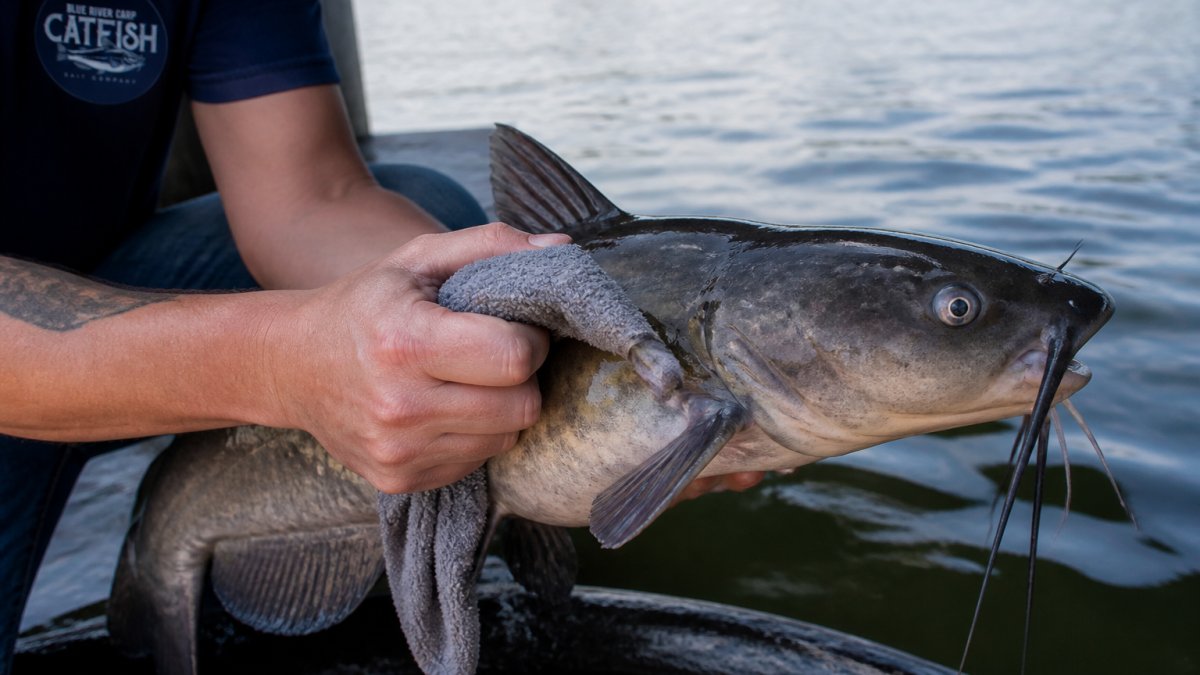
Never grab a catfish by the belly with fingers spread. That puts your hand right between the pectoral spines. Never lip a catfish like a bass either.
For big fish, use a fish grip on the lower jaw and support the belly with your other hand, keeping the fish over water or a wet surface.
Step-by-Step: Removing a Hook by Location
Hook location decides your method. Work from the easiest spot to the hardest, and never force a hook that will not move.
| Hook Location | Best Tool | Method | When to Cut |
|---|---|---|---|
| Lip or jaw edge | Long-nose pliers | Grip hook, push down and back | Almost never |
| Corner of mouth | Needle-nose forceps | Follow the shank, twist out | Rarely |
| Roof of mouth | Long-nose pliers | Push hook forward, then out | If it will not budge |
| Deep near throat | Forceps or dehooker | Push hook back out along entry path | If bleeding is heavy |
| Gut hook | Line cutters | Cut the line, leave the hook | Always |
The General Rule: Reverse the Entry Path
Every safe hook removal follows the same principle. The hook went in point-first along a specific path. It comes out the same way. Pushing the hook forward a quarter inch to disengage the barb, then backing it out along that original path, is almost always less damaging than pulling straight back against the barb.
If you cannot picture the entry path, stop and look. A few seconds of inspection beats a torn mouth every time.
Hook in the Lip or Jaw Edge
This is the easy one, and where you should build your technique.
- Control the fish first. Grip behind the pectoral spines with a wet rag or bare wet hand. Pin the dorsal spine with your thumb or forearm.
- Open the mouth slightly with your non-dominant hand if the fish will allow it. Do not pry.
- Slide long-nose pliers down the shank until the jaws are on the bend of the hook, not the eye.
- Push down and slightly back to free the barb from the tissue.
- Back the hook out along the entry path. Steady pressure, not a yank.
If the hook is barbless or the barb is pinched, this takes two seconds. If the hook is barbed and buried past the bend, see the roof-of-mouth section.
Hook in the Corner of the Mouth
The corner of the mouth is thicker tissue than the lip, and the hook often sits at an angle. Forceps beat pliers here because their jaws are narrower and rotate.
- Grip the hook shank with forceps, not the eye.
- Rotate the forceps so the hook rolls out of the corner rather than pulling straight back.
- Follow the shank with your eyes. If the point is buried, push forward first to free the barb.
- Twist and lift in one smooth motion.
A common mistake is grabbing the hook by the eye. That gives you no leverage on the bend and forces you to pull against the barb.
Hook in the Roof of the Mouth
A hook in the hard roof of the mouth is where most anglers tear tissue. That tissue is tough but not elastic, and a barbed hook pulled straight down will rip a channel.
- Use long-nose pliers. Forceps are usually too short to reach the roof without putting your knuckles near the teeth.
- Push the hook forward and slightly up, deeper into the mouth, following the curve of the roof, until the barb clears the tissue.
- Then rotate the hook out along the entry path.
- If the hook will not budge after two or three attempts, stop. Cut the line and leave the hook. A hook left in the roof of the mouth has a better survival outcome than a torn palate.
Deep Hook Near the Throat
A deep hook near the throat is where most people make the mistake of pulling. Do not pull. Use a dehooker or long forceps to push the hook back out along its path of entry. The barb slides back through the same hole it made.
- Keep the fish in the water if you can. A fish held over the bank while you work a deep hook is losing oxygen the whole time.
- Slide the dehooker or forceps down the line until you feel the hook.
- Push the hook back and out in one motion. The dehooker's curved end is designed to catch the bend and reverse it.
- If you cannot see the hook point, stop. Blind pulling tears tissue and kills fish.
- If bleeding is heavy or the hook is embedded in the gill arch, cut the line. Gill tissue does not heal the way mouth tissue does.
Gut Hook (Swallowed Past the Throat)
A gut hook means the hook is in the esophagus or stomach. There is no safe way to remove it through the mouth. Cut the line and leave the hook.
- Cut the line as close to the hook as you can reach without pulling.
- Do not pull the hook or the line. Pulling drives the hook deeper and tears the esophagus.
- Release the fish quickly using the revival steps in the release section.
- The hook will work loose, pass, or rust out over time. Modern hooks rust more slowly than old carbon-steel hooks, but survival rates for fish released with hooks in place are still better than for fish with hooks torn out.
According to the American Fisheries Society research on catch-and-release survival, fish released with hooks left in place often survive better than fish with hooks torn out. Use a circle hook next time to reduce gut hooks in the first place, circle hooks are designed to slide to the corner of the mouth rather than being swallowed.
A Quick Decision Tree
If you remember nothing else from this section, remember this order:
- Can you see the hook point? If no, cut the line.
- Is the hook in the lip, corner, or roof of the mouth? Use pliers or forceps and reverse the entry path.
- Is the hook near the throat or gills? Use a dehooker, push forward, and stop if you cannot see the point.
- Is the hook past the throat? Cut the line, leave the hook, release the fish.
When in doubt, cutting the line is the lower-risk choice. A hook left in a fish is survivable; a torn gill arch or esophagus is not.
Catfish Swallowed Hook? What to Do When Removal Isn't Safe
When a catfish has swallowed the hook, cut the line and leave the hook in place. This is the standard answer for gut hooks, and it gives the fish the best chance of survival.
Here is the process:
- Cut the line as close to the hook as you can
- Do not pull the hook or the line
- Release the fish quickly
- The hook will work loose or rust out over time
According to the American Fisheries Society research on catch-and-release survival, fish released with hooks left in place often survive better than fish with hooks torn out.
Spine Puncture First Aid and How to Release a Catfish Safely
Most guides tell you catfish spines hurt. Almost none explain why, where the spines sit, or what to do in the ten minutes after a puncture.
Where the Spines Actually Are (and Where They Are Not)
A catfish has three primary spines you need to track:
- Two pectoral spines, one just behind each gill cover, angled slightly outward and back. These are the ones that catch anglers sliding a hand under the belly.
- One dorsal spine, on the leading edge of the dorsal fin, on top of the back. It locks upright when the fish is stressed.
- Adipose fin, the fleshy tab between the dorsal and tail. No spine. Safe to touch.
The spines are modified fin rays with a locking mechanism at the base. When threatened, the fish locks the spine extended and holds it there, a locked pectoral spine will not fold down just because you push on it. That is why the safe grip works: your palm sits behind the pectoral spines, your thumb or forearm pins the dorsal spine flat, and the fish cannot rotate a spine into your hand.
What the Venom Does
Catfish venom is a protein-based irritant produced in glandular tissue along the spine. It is not the same class of toxin as a stingray barb and is not typically life-threatening to a healthy adult, but it causes immediate, intense burning at the puncture site, followed by swelling, redness, and sometimes a throbbing ache that radiates up the limb for hours.
A few things make it worse:
- Depth of the puncture. A shallow graze stings. A deep jab that deposits venom under the skin hurts far more and swells longer.
- Broken spine fragments. Catfish spines are brittle at the tip and snap off in the wound more often than people expect.
- Secondary infection. Warm freshwater, fish slime, and a puncture that seals over at the surface are a bad combination. Infection is the most common serious outcome, not the venom itself.
Immediate First Aid After a Puncture
- Stop fishing and get off the water's edge. Dizziness and throbbing are common in the first few minutes. Sit down.
- Inspect the wound in good light. Look for a dark speck or a hard ridge under the skin, that is a spine fragment.
- Remove visible fragments with clean tweezers. Do not dig. If you cannot see it clearly, leave it for a medical professional.
- Wash with soap and warm water for several minutes. Warm water is more comfortable than cold on a venom wound and helps dilate the tissue.
- Control bleeding with direct pressure if the wound is actively bleeding. Most punctures ooze rather than bleed heavily.
- Soak the hand or foot in hot water, as hot as you can comfortably tolerate, roughly 110-113°F, for 30 to 90 minutes. Heat breaks down many protein-based venoms and is the standard field treatment for this type of sting. Refresh the water as it cools.
- Cover with a clean, dry bandage once the soak is done.
- Take over-the-counter pain relief if needed and you have no contraindications.
Warning Signs That Mean See a Doctor
Go to urgent care or an emergency department if any of these apply:
- The spine broke off and you cannot see or reach the fragment
- The wound is deep, gaping, or on a joint, tendon, or the hand
- Bleeding will not stop with ten minutes of steady pressure
According to the CDC guidance on animal bites and puncture wounds, puncture wounds are prone to deep infection because the surface opening closes before the interior heals. That applies to fish spines as much as to teeth.
Releasing a Catfish Without Making It Worse
A fish handled for a spine injury or a difficult unhooking needs a clean release. The steps are simple but the details matter:
- Wet your hands or the rag before you touch the fish. Dry hands strip the slime coat, the fish's first line of defense against infection.
- Keep the fish over the water or on a wet, cool surface. Never lay a catfish on hot concrete, dry grass, or a boat deck in direct sun, a few seconds on a hot surface can do lasting damage.
- Minimize air exposure. Aim for under 30 seconds out of the water for a healthy fish, and less if the fight was long or the water is warm. Warm water holds less oxygen, so summer releases are the riskiest.
- Support the belly with one hand and the lower jaw with the other for larger fish. Do not hold a big catfish vertically by the jaw alone, that stresses the spine and internal organs.
- Lower the fish headfirst into the water. Do not toss it from height. Let it rest upright in your hands until it kicks free.
- If the fish rolls belly-up, hold it upright in the water with a hand under the belly until it regains balance and swims off under its own power. This can take a minute or two on a hot day.
- Revive in clean, moving water when possible. Avoid releasing into stagnant, low-oxygen backwater if you can walk the fish to better water.
A Note on Saltwater Catfish
Hardhead and gafftopsail catfish in coastal waters carry the same spine-and-venom setup, and their punctures are widely reported as more painful than freshwater species of similar size. The first-aid steps above still apply, but the hot-water soak matters more, and any saltwater catfish puncture is worth a medical look because of the additional risk of marine bacteria.
Why This Matters More Than the Hook
A clean hook removal takes ten seconds. A spine puncture can cost you the rest of the trip and a doctor's visit. Treat the grip and the release as seriously as the unhooking itself, and you will spend more days on the water and fewer in the urgent care waiting room.
Frequently Asked Questions
What is the easiest way to unhook a catfish?
For a hook in the mouth or jaw, the easiest method is to grip the catfish behind its pectoral spines with a wet rag, then use long-nose pliers or forceps to push the hook back out the way it came in. Pinching down the barb before you cast makes this faster and causes less damage to the fish. If the hook is deep, switch to a dehooker or cut the line instead of forcing it.
Should you grab a catfish by the mouth?
You can grip a catfish by the lower jaw, but only on larger fish where your hand fits without touching the pectoral spines. Small catfish and bullheads have spines that flare outward, so a mouth grip puts your hand right in the danger zone. The safer approach for most anglers is to hold the fish behind the pectoral spines with a wet rag or fish grips, keeping your fingers clear of the dorsal spine.
How do you avoid catfish spines while handling one?
Approach the catfish from above, not the side. Slide your hand down the back until you reach the space behind the pectoral spines, and grip there with a wet rag. Never wrap your fingers around the belly or slide your hand forward from the tail, since both put you in contact with the spines. Fish grips or a landing glove add another layer of protection, especially with larger channel and blue catfish.
What should you do if a catfish has swallowed the hook?
If the hook is past the throat or in the gut, do not try to dig it out. Cut the line as close to the hook as possible and release the fish. Barbed hooks left in place have a better survival rate than hooks torn out of the gut, and the hook will work loose over time. Carry sharp line cutters so you can make a clean cut without stressing the fish further.
Catfish have teeth, spines, and a talent for swallowing hooks. That combination punishes anglers who fish unprepared. Blue River Carp, Inc. makes scent-infused cut bait from invasive carp that stays firm on the hook, holds a 12+ month shelf life with no refrigeration, and keeps you ready for every trip. Get started with Blue River Carp, Inc. and spend your time unhooking fish, not fixing bait.