
How to Anchor Bait in High Flow Rivers: Rig & Weight Guide
Table of Contents
- What Anchoring Bait Actually Means in Fast Water
- Reading Current Speed and River Conditions Before You Rig Up
- Choosing the Best Sinker for Fast Current Fishing
- River Fishing Rigs for Catfish That Hold Bottom
- How to Keep Bait on the Bottom in River Current
- How to Fish Cut Bait in a River Without Losing It
- Troubleshooting Snags, Rolling Sinkers, and Bait Loss
- Frequently Asked Questions
Last Updated: October 21, 2026
What Anchoring Bait Actually Means in Fast Water
Anchor bait in high flow rivers means holding your bait near the river bottom in one spot, not anchoring your boat. The goal is to keep scent and flavor parked in the strike zone where catfish feed.
Most guides blur these two ideas. They talk about boat anchors and never explain how to keep bait from tumbling downstream. That's the gap we want to close. Below, we'll show you exactly how to anchor bait with the right sinker, rig, and hook placement.
A common mistake is casting into the fastest water and hoping for the best. Fast current rips bait off the hook in seconds. The fix is reading the river first, then rigging for the conditions in front of you.
At Blue River Carp, Inc., we build bait that stays on the hook in current. Our preserved cut bait holds together cast after cast, so you spend less time re-baiting and more time fishing.

Reading Current Speed and River Conditions Before You Rig Up
Start by watching the surface for 60 seconds before you tie anything on. Fast current shows as choppy riffles, standing waves, and visible drift lines. Slack water looks smooth and glassy.
Check these before you rig up:
- How fast debris moves past a fixed point
- Where the main river channel runs
- Where current breaks around rocks or timber
- Water depth with a weight or depth finder
Finding Seams, Eddies, and Slower Water
A seam is the line where fast water meets slow water. Eddies form behind rocks, bridge pilings, and points of land. Catfish sit in these slack pockets and face into the current, waiting for food to wash past.
Cast upstream at an angle and let your bait settle into the seam. Fish the edge, not the middle of the fast lane. That's where current-facing fish hold.
Choosing the Best Sinker for Fast Current Fishing
The best sinker for fast current fishing is a flat or bank-style weight that grips the bottom instead of rolling. Round sinkers roll in high water. Flat sinkers dig in and hold.
Match weight to current speed, not to your personal preference. Too light and your bait drags downstream. Too heavy and you can't feel a strike.
Sinker Weight Selection Chart
Use this as a starting point, then adjust on the water:
| Current Speed | Water Depth | Sinker Weight | Style |
|---|---|---|---|
| Slow | Under 6 ft | 1/2 to 1 oz | Egg or bullet |
| Moderate | 6 to 12 ft | 1 to 2 oz | Flat bank |
| Fast | 6 to 12 ft | 2 to 4 oz | Flat bank |
| Fast | Over 12 ft | 4 to 6 oz | No-roll flat |
| Heavy flow | Any depth | 6 oz and up | No-roll flat |
River Fishing Rigs for Catfish That Hold Bottom
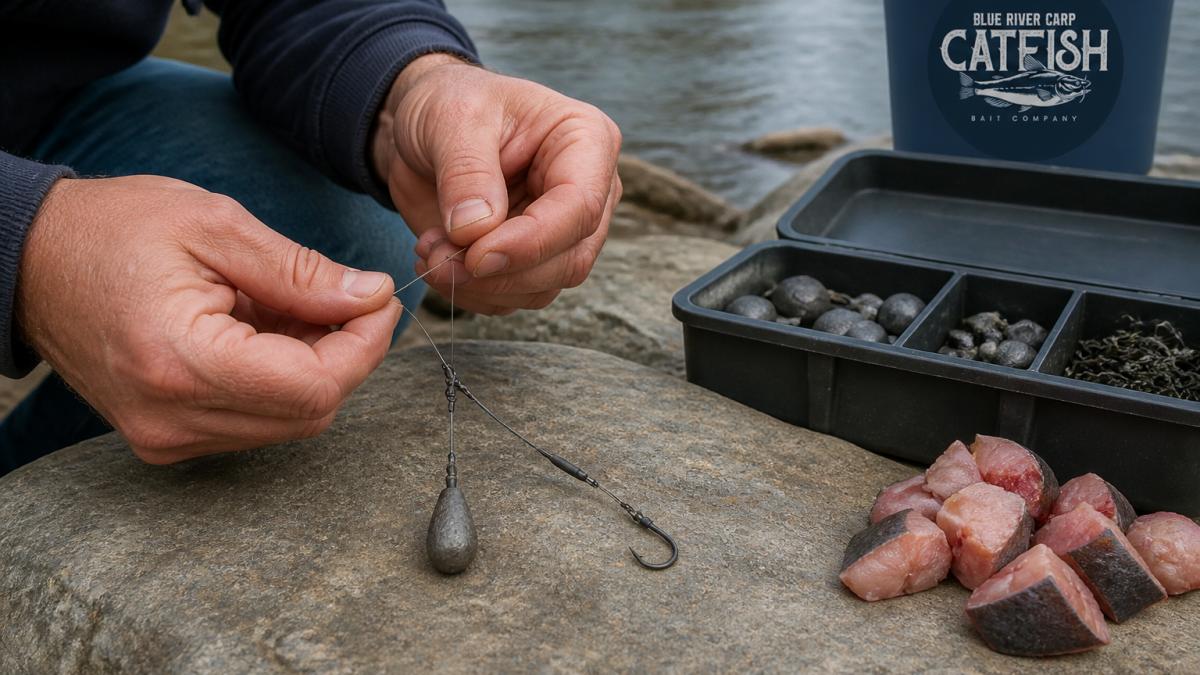
River fishing rigs for catfish need one job: keep bait pinned near the bottom without burying the hook. Two setups do this well, the three-way rig and the dropper rig. Below is the knot-by-knot build for each, plus a sliding-sinker variant for when you need the fish to feel zero resistance.
Three-Way Rig: Knot by Knot
The three-way rig uses a swivel with three connection points. Build it in this order so the dropper stays shorter than the leader:
- Main line to swivel: Tie your main line to one eye of a three-way swivel with a palomar knot. Wet the knot, pull it snug, and trim the tag close.
- Dropper line: Cut a 6- to 10-inch length of line for the dropper. Tie one end to the second eye with an improved clinch knot, then tie the other end to your sinker eye with the same knot. Keep this dropper shorter than your leader so bait rides above the weight.
- Leader and hook: Tie a 12- to 18-inch leader to the third eye with an improved clinch knot, then attach your hook with a snell knot or a palomar, depending on hook style.
- Check the geometry: Hold the rig up. The sinker should hang below the swivel and the hook should sit above and downstream of the weight. If the dropper is longer than the leader, bait will drag and snag.
Dropper Rig: Faster to Tie, Fewer Snags
The dropper rig skips the three-way swivel. Tie a loop in your main line about 12 to 18 inches above the hook, pass the tag through your sinker eye, and add your hook below. It is faster to tie and snags less in rocky water because the sinker can pivot on the loop instead of levering against a swivel.
- Loop size: Keep the loop small, about 2 to 3 inches, so the sinker stays close to the main line.
- Hook attachment: Tie the hook directly to the main line below the loop with an improved clinch or snell knot.
- When to choose it: Rocky, snag-heavy bottom where a three-way swivel would catch and lever loose.
Sliding Sinker Rig for Finicky Fish
When catfish are pressured or the current is moderate, a sliding sinker rig lets the fish take bait without feeling the weight. Thread a sliding sinker onto your main line above a barrel swivel, tie a leader to the swivel, and add your hook. The sinker stays put while the leader slides through the swivel. This is the rig to use when you are getting taps but no hookups.
Leader and Dropper Length Adjustments
Length matters more than most anglers think. A long dropper lets the sinker roll ahead of the bait and tangle. A short dropper keeps the bait tight to the weight but can bury the hook in soft bottom.
Bentonite - heavy binder and scent-dispersion matrix - 2.2lbs or 1kg →
- Fast current: Shorten the dropper to 4 to 6 inches and lengthen the leader to 18 to 24 inches so bait rides up and away from the weight.
- Moderate current: 6- to 10-inch dropper and a 12- to 18-inch leader is a good starting point.
- Snaggy bottom: Shorten the dropper and lift the rod tip slightly to keep the sinker ticking bottom instead of plowing into it.
How to Keep Bait on the Bottom in River Current
Keeping bait on the bottom in river current comes down to three things: enough weight, the right bait texture, and a hook that holds. Get one wrong and the current wins.
Soft bait is the biggest culprit. Chicken liver and fresh cut bait turn mushy and slide off in fast water. Firmer bait stays put.

- Use bait that grips the hook, not bait that melts
- Match hook size to bait size
- Check your bait every 10 to 15 minutes
- Cast upstream and let the current set the bait down
How to Fish Cut Bait in a River Without Losing It
Fishing cut bait in a river without losing it starts with hook placement. Run the hook through the tough end of the chunk, then out the side. Leave the point exposed.
Cast upstream at a 45-degree angle. Let the sinker hit bottom, then reel up slack until you feel the weight. Bounce along bottom with short lifts, then let it settle.
Our 7oz Catfish Cut Bait Nuggets are pre-cut to about 1 x 2 inches, which makes them easy to thread and hard to tear off. For bigger fish, our 10oz Catfish Cut Bait Chunks give you larger pieces that stay pinned in heavy flow.
Species-Specific Bait and Rig Recommendations
Match bait and rig to the fish you're after:
- Blue catfish: Big chunks, heavy flat sinker, three-way rig in deep current.
- Channel catfish: Nugget-sized bait, dropper rig, fish the seams.
- Flathead: Live bait or large chunks near timber and brush.
- Bullhead: Small pieces, light weight, slack water near the bank.
Troubleshooting Snags, Rolling Sinkers, and Bait Loss
Snags, rolling sinkers, and bait loss all point to the same problem: your rig isn't matched to the bottom. Fix the rig and the problems go away.
- Rolling sinker: Switch to a flat no-roll weight and add an ounce.
- Constant snags: Shorten your dropper and lift the bait slightly off bottom.
- Bait loss: Use firmer bait and check hook placement.
- No strikes: Move to a seam or eddy instead of the fast lane.
For a full rundown on state rules, see the U.S. Fish and Wildlife Service. For knot and rig basics, the Take Me Fishing guide from the Recreational Boating and Fishing Foundation covers the fundamentals. And for river flow data before your trip, check the U.S. Geological Survey streamflow service.
Frequently Asked Questions
How much weight do you need to anchor bait in a fast river?
Start with 1 oz in mild current and add 1 oz for every additional 1-2 mph of flow. In a strong high-flow river pushing 4-5 mph, most anglers need 3-5 oz to hold bottom. A flat or pyramid sinker grips better than a round one because it digs into the riverbed instead of rolling. If your line keeps drifting downstream, go up one size, then test again before adding more.
What is the best sinker for fast current fishing?
Flat sinkers, pyramid sinkers, and no-roll sinkers outperform round bank sinkers in fast current because their flat faces bite into gravel and sand. For a three-way rig, a bank sinker on a short dropper works well because it can break off cleanly if it snags. Match the weight to the current speed: too light and your bait rolls, too heavy and it snags more often.
How do you keep cut bait from washing off the hook?
Thread the hook through the tough skin edge of the cut bait rather than the soft flesh, and use a chunk sized to the hook gap so the point stays exposed. Preserved cut bait holds up better than fresh or frozen bait because it does not turn mushy in current. Blue River Carp's 7 oz cut bait nuggets and 10 oz chunks are pre-cut and shelf-stable, so they stay on the hook through repeated casts.
Where should you cast when fishing a high-flow river?
Cast upstream at a 30-45 degree angle and let your rig bounce down into the seam where fast water meets slack water. Fish hold on the downstream side of current breaks, behind timber, and along the edge of the main channel. Avoid the fastest chute in the middle of the river; the strike zone is almost always on the slower side of a seam, not in the current itself.
High water doesn't have to mean lost bait and empty hooks. The right weight, a solid rig, and bait that holds together will keep you fishing when the current is up.
Blue River Carp, Inc. makes preserved cut bait from invasive carp with a 12+ month shelf life and no refrigeration needed. Our bait stays firm on the hook instead of turning mushy in fast water. It's veteran-owned and made in Indiana.
Get started with Blue River Carp, Inc. and keep your bait in the strike zone all day.


