
Durable Bait for Strong Currents: A Catfish Angler's Guide
Table of Contents
- Understanding Current Speed and Water Flow
- Why Traditional Bait Fails in Strong Currents
- Best Bait for River Fishing in High-Flow Environments
- How to Keep Bait on Hook in Current
- Catfish Bait for Fast Water: Species-Specific Recommendations
- Drift Fishing vs. Bottom Structure Anchoring
- Bait Hardening and Preservation for Extended Use
- Maximizing Bait Integrity During Your Fishing Trip
- Frequently Asked Questions
Last Updated: August 31, 2026
Understanding Current Speed and Water Flow
Strong currents transform how fish feed and how bait behaves in the water. Current speed determines whether your bait stays intact long enough to attract a strike. When water moves at 2-3 feet per second or faster, traditional soft baits deteriorate almost immediately, the constant pressure shreds chicken liver, breaks apart dough balls, and washes away the scent dispersal that attracts catfish (usgs.gov).
Current breaks, those edges where fast water meets slower water, are where catfish position themselves to feed with minimal effort. They hold in the slack water behind rocks, fallen timber, and channel ledges, waiting for food to drift into their strike zone. Your bait needs to survive the journey through the main current to reach these fish-holding areas. A bait that disintegrates in the turbulence never makes it to the fish.
Heavy current also creates drag on your line and terminal tackle, increasing tension on knots and hook connections. A poorly rigged bait will slip free under this pressure. A properly secured bait with adequate sinker weight will hold position and maintain contact with the bottom structure where catfish hunt.
Why Traditional Bait Fails in Strong Currents
Most anglers discover this problem the hard way: they cast out chicken liver or cut shad and watch their bait wash away within minutes. Soft, delicate baits lose their structural integrity quickly in current. Chicken liver becomes mushy within the first few minutes, and pieces separate from the hook. By the time your bait drifts into prime catfish territory, there's barely anything left to trigger a bite.
Cut bait from frozen fish also presents problems if not prepared correctly. When frozen bait thaws in warm water, the tissue becomes soft and fibrous, separating easily from the hook. Dough balls and prepared pastes dissolve gradually, creating a scent cloud but offering no solid bait for the catfish to grab.
The real problem is that these baits weren't engineered for durability. They were designed for still water or slow-moving conditions. In strong currents, you need bait that resists breakdown, maintains structural integrity under pressure, and stays secured to the hook for extended periods. This is where durable bait for strong currents becomes essential.
Best Bait for River Fishing in High-Flow Environments
Cut Bait and Its Durability Advantage
Cut bait remains the gold standard for river catfish in strong currents, but not all cut bait is created equal. Premium cut bait that's been properly preserved maintains its firmness and doesn't separate from the hook under pressure. Look for pieces that are firm to the touch and don't have a mushy exterior.
Blue River Carp, Inc. produces cut bait specifically designed for current fishing. Their bait chunks are preserved in a way that keeps them intact even in fast-moving water, staying on the hook longer and giving catfish more time to find and strike your presentation.
Cut bait works because it releases scent gradually as water passes through it. Unlike dough balls that dissolve, cut bait sheds scent particles while maintaining its physical form. Catfish detect the scent trail and follow it to the source. When they arrive at your hook, they find actual food, not just a cloud of flavor.
The size of your cut bait matters in current. Smaller pieces (1-2 inches) tumble too easily and wash away faster. Larger chunks (2-3 inches) resist current pressure better and stay put longer. Blue River Carp's 10oz chunks, at approximately 2 inches by 3 inches, are ideal for river fishing, the size provides enough mass to stay on the hook while still being easy for catfish to consume.

Scent-Infused Bait for Maximum Attraction
Scent becomes even more critical in strong currents. As water moves past your bait, it carries scent particles downstream. Catfish rely on scent trails to locate food, so a bait with concentrated, long-lasting scent has a significant advantage. Scent-infused bait releases flavor compounds more consistently than fresh-cut offerings, meaning your scent cloud extends further downstream and persists longer.
Different scent profiles work better in different situations. Blood-scented bait triggers aggressive feeding responses in blue catfish. Garlic-infused bait appeals to channel catfish. Shad-scented baits work well for species that feed primarily on fish. The scent you choose depends on which catfish species dominate your target water.
Blue River Carp's scent-infused bait is formulated to release scent gradually over hours, not minutes. The infusion process bonds the scent to the bait itself, so it doesn't wash away immediately like surface-applied scents. Temperature affects how quickly scent disperses, in warmer water (70°F and above), scent travels faster and farther (peer-reviewed research). In strong currents, a bait with strong scent infusion compensates for the dilution effect of fast-moving water.
How to Keep Bait on Hook in Current
Rigging Techniques for High-Flow Water
The way you rig your bait makes the difference between a bait that stays put and one that washes away. In strong currents, you need a rigging method that secures the bait firmly while allowing catfish to hook themselves naturally when they bite.
A two-hook rig provides better security than a single hook. Thread one hook through the top of the bait and another through the bottom, creating a sandwich effect that holds the bait firmly in place. For strip bait, use a single hook with the point entering near the top and exiting near the bottom, allowing the strip to flutter slightly in the current while staying attached.
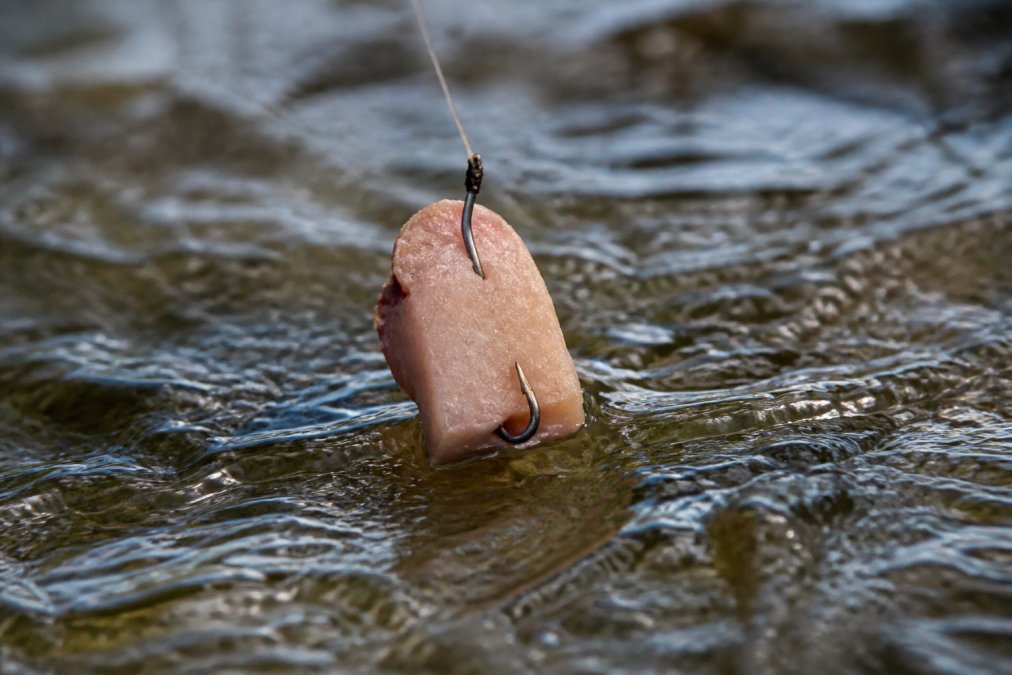
The no-slip sinker rig is standard for current fishing. This rig places a weight above your hook, keeping your bait on the bottom where catfish feed and preventing your entire rig from drifting downstream.
Knot strength becomes critical in high-current situations. Use an improved clinch knot or Palomar knot, both of which maintain 90-95% of your line's breaking strength (fws.gov). Test your knots before fishing, a weak knot will fail under the pressure of strong current.
Sinker Weight and Terminal Tackle Selection
The sinker weight you choose determines whether your rig stays put or drifts with the current. Use the minimum weight necessary to maintain bottom contact. Current speed dictates sinker weight: in 1-2 feet per second current, a 1-2 ounce sinker usually holds; in 2-3 feet per second, move to 2-4 ounces; in faster current (3+ feet per second), you may need 4-8 ounces or more.
Slinky weights, flexible lead-filled tubes, work better than solid sinkers in current. They conform to the bottom and reduce snags. Pyramid sinkers are the standard choice for river fishing in current because they anchor securely.
Terminal tackle quality matters more in strong currents. Use heavy-duty swivels rated for at least 100 pounds to prevent line twist. Quality ball-bearing swivels rotate more freely and reduce tension. Cheap swivels break under the sustained pressure of strong current.
Catfish Bait for Fast Water: Species-Specific Recommendations
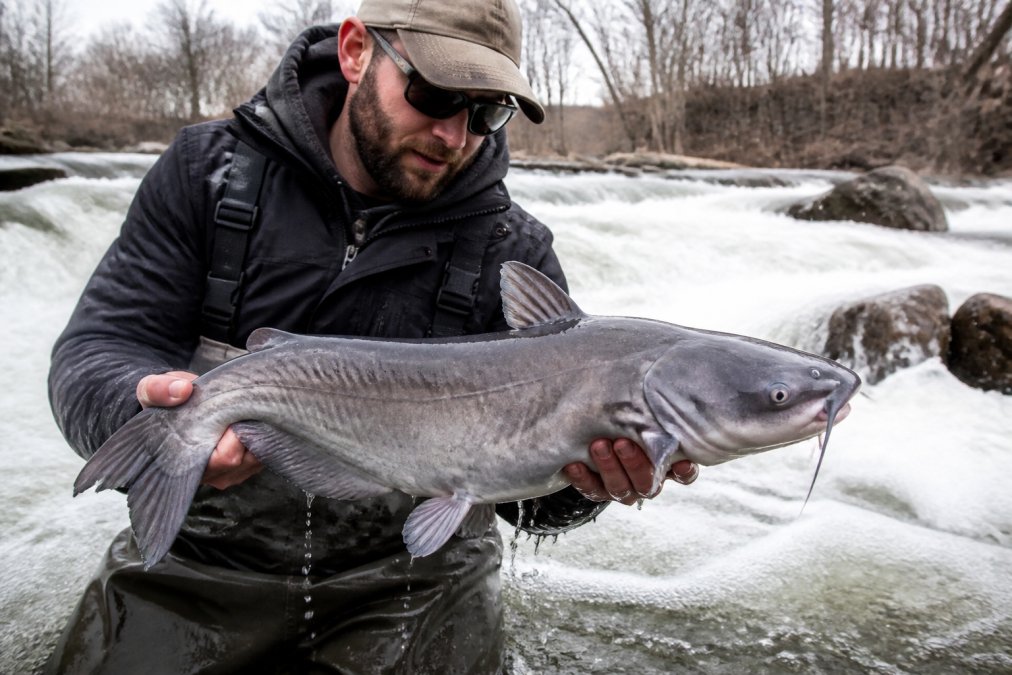
Blue catfish dominate in strong-current environments and respond aggressively to scent. They prefer larger baits and don't hesitate to attack cut fish. Blood-scented cut bait triggers immediate feeding responses. Use the largest bait chunks available, blue cats can consume 3-4 inch pieces without hesitation. Blue River Carp's 10oz chunks in blood scent are specifically formulated for blue catfish in river conditions.
Channel catfish are more cautious than blue cats but still prefer cut bait in current. They respond well to garlic-scented offerings and tend to investigate baits more carefully before committing to a bite. Position your bait in transition zones where slower water meets the main current. Smaller chunks (1.5-2 inches) work better for channel catfish than the massive pieces blue cats prefer.
Flathead catfish are ambush predators that hold in deeper structure in strong currents. They respond to fresh-cut offerings but prefer larger meals. Use substantial bait chunks and fish deeper than you would for blue or channel cats. The current seam behind structure is where flatheads hunt.
Bullhead catfish are smaller but abundant in many river systems. They're less affected by current than larger species and will feed in faster water. Smaller bait chunks work well for bullheads, and they're less selective than larger catfish species.
Drift Fishing vs. Bottom Structure Anchoring
Your fishing method determines how your bait behaves in current. Drift fishing allows your rig to move with the current and covers more water but requires a bait that survives prolonged exposure to moving water. Bottom anchoring holds your rig in one spot and works best when you've located good structure.
Drift fishing in strong current demands a bait that won't disintegrate during a 50-100 yard drift. Cut bait with proper preservation works well for drifting because it stays intact and continues releasing scent as it moves downstream. Cast upstream at an angle and allow the current to carry your rig downstream, maintaining light bottom contact as it drifts.
Bottom anchoring means holding your rig in one spot using a heavy sinker or anchor weight. This method works best when you've identified structure, deeper holes, current breaks, channel ledges, where catfish concentrate. In strong current, bottom anchoring requires more weight and more strong terminal tackle.
Many successful river anglers use both methods during a single trip, drifting to locate fish and then anchoring on productive areas.
Bait Hardening and Preservation for Extended Use
Bait preservation is what separates premium offerings from standard baits. A bait that stays firm and intact for hours outperforms one that begins deteriorating after 20 minutes. Modern preservation techniques use food-grade additives that bond to the bait tissue and resist water penetration without changing the bait's scent profile or attractiveness to catfish.
The shelf life of preserved bait is a practical advantage. A bait that lasts 12+ months without refrigeration means you can stock up before the season and have fresh bait ready whenever you want to fish. Blue River Carp's bait maintains its effectiveness for over a year when stored properly in a cool, dry location away from direct sunlight.
When you open a package of preserved bait, use what you need and reseal the bag immediately. A properly sealed bag will keep bait fresh for months after opening, so you don't waste money on unused portions.
Maximizing Bait Integrity During Your Fishing Trip
Once you're on the water, several factors affect how long your bait remains effective. Keep your bait out of direct sunlight when you're not actively fishing. Store your bait in a tackle box or under a towel. Many anglers keep a small cooler with a damp cloth to maintain humidity without requiring ice.
Replace your bait frequently in strong current. Even durable bait loses effectiveness after 30-45 minutes on the bottom in fast water. Fresh bait releases stronger scent and maintains better structural integrity. Plan to re-cast every 30-45 minutes to maximize your chances of connecting with catfish.
Water temperature affects how quickly your bait loses effectiveness. In warm water (70°F+), adjust your re-casting frequency by changing bait more often. In cooler water (50-60°F), your bait stays effective longer. Current speed also determines bait replacement frequency, in faster current (3+ feet per second), change bait every 20-30 minutes instead of waiting 45 minutes.
Blue River Carp's cut bait is specifically designed to handle these conditions. The preservation process creates a bait that resists breakdown longer than standard offerings. Even in challenging conditions, warm water, fast current, extended fishing sessions, this bait maintains integrity and continues attracting catfish.
Fishing strong currents successfully requires understanding how water moves, how bait behaves under pressure, and how to rig presentations that hold up to sustained current force. The difference between a productive day and a frustrating one often comes down to bait quality. Blue River Carp, Inc. delivers cut bait that's engineered for exactly these conditions, preserved to stay intact for hours, infused with scents that catfish can't resist, and ready to use without refrigeration or preparation. Start with their Fish Attack Strips for versatile presentations or their 10oz Chunks for targeting larger catfish in fast water. Get on the water with bait that actually works in strong currents.

Frequently Asked Questions
How do you keep bait on the hook in fast-moving water?
Use firm, durable bait like cut carp that resists tearing under current tension. Rig with a no-slip sinker to maintain bottom contact and reduce line movement. Secure the bait with a tight loop knot and position the hook through the thickest part of the bait. Preserved, scent-infused cut bait holds together better than frozen or fresh bait, which becomes mushy and slides off under water velocity pressure.
What makes bait durable enough for strong river currents?
Durable bait has tough flesh that resists tearing and maintains structural integrity under high water velocity. Cut carp bait stays firm because it's preserved and pre-cut to optimal size. Scent-infused varieties like those from Blue River Carp attract fish while the preserved formula prevents mushiness. Shelf-stable bait with 12+ month longevity won't degrade during your trip, ensuring consistent bait integrity from your tackle box to the river.
Is scent-infused cut bait effective in high-flow environments?
Yes. In strong currents, scent disperses quickly downstream, so infused bait releases natural scent continuously rather than relying on a single fresh bait's odor. The combination of tough flesh and enticing scent creates better fish strike zones because catfish locate prey by smell first, then visually confirm the bait. Scent-infused cut bait compensates for rapid scent dilution in fast water.
Why does traditional frozen bait fall off in strong currents?
Frozen bait thaws in water and becomes mushy, losing structural integrity. As it softens, drag coefficient increases under current pressure, causing the bait to tear away from the hook. Fresh bait also lacks the preservation that prevents degradation. Preserved cut bait maintains firm texture throughout your fishing trip, resisting both water erosion and the mechanical stress of high-flow environments.
This article was written using GrandRanker