
How to Use Cut Bait for Catfish: A 2026 Guide
Table of Contents
- Why Cut Bait Works: The Science of the Scent Trail
- How to Hook Cut Bait for Catfish: 3 Proven Rigs
- Cut Bait vs Live Bait: Which Catches More Fish?
- Choosing the Best Bait for River Fishing: Size and Species
- Keeping Bait Fresh: Storage and Shelf Life
- Common Mistakes to Avoid with Cut Bait
- Conclusion
- Frequently Asked Questions
Last Updated: September 6, 2026
Cut bait is a piece of fresh or preserved fish flesh used on a hook to attract predators through scent and visual appeal. Most beginners overthink the presentation, but the real secret to catching more and bigger catfish lies in understanding how scent travels in the water and how your bait behaves on the bottom. In this guide from Blue River Carp, Inc., we break down the science of the scent trail, the three rigs that put cut bait where catfish live, and the mistakes that cost you bites.
Why Cut Bait Works: The Science of the Scent Trail
Cut bait works because it releases a steady stream of amino acids and fish oils that predatory fish detect through their olfactory systems from surprising distances (the NIH). Unlike live bait, which moves and can hide, a cut piece of fish creates a continuous scent trail that travels with the current and triggers a feeding response in catfish, especially in murky water where visibility is low.
When you cast a chunk of bait into a river, the current carries the scent particles downstream in a cone shape. Catfish lying in deeper holes or behind structure will pick up that trail, turn into the current, and follow it back to the source. This is why freshness matters more than almost anything else: fresh or properly preserved bait releases scent at a much higher rate than old, mushy bait that has been sitting in a cooler for days.
A common mistake is assuming bigger chunks always mean more scent. A strip bait with a larger exposed surface area releases more scent per ounce than a thick, balled-up chunk (peer-reviewed research). This is why many experienced anglers prefer cutting their bait into long, thin strips rather than cubes, maximizing the surface area that touches the water.

How to Hook Cut Bait for Catfish: 3 Proven Rigs
The best cut bait in the world won't catch fish if it is rigged wrong. The goal of any rig is to present the bait naturally on the bottom while keeping the hook point exposed for a solid hookset. Below are three proven setups, each suited to different conditions.
Rig 1: The Carolina Rig for Bottom Fishing
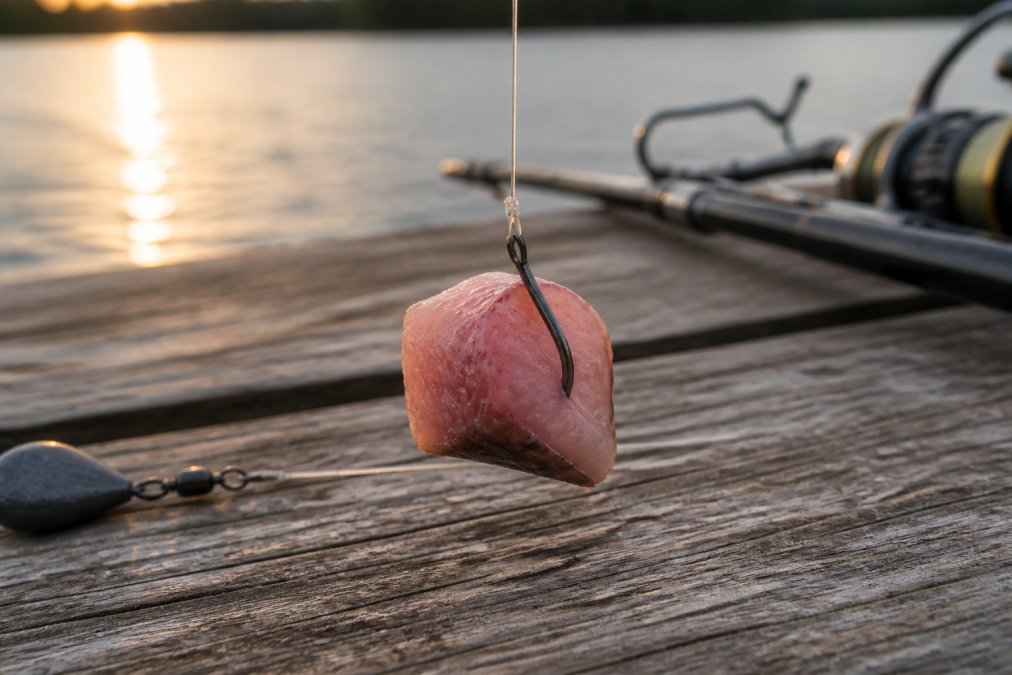
The Carolina rig is the go-to choice for still water or slow-moving rivers when you want the bait to sit perfectly still on the bottom. Start with a sliding sinker above a swivel, then a 12- to 18-inch leader to a circle hook. The key is to hook the cut bait once through the tough skin, leaving the hook gap completely exposed. This allows the circle hook to rotate into the corner of the fish's mouth when it turns to swallow, setting itself without you having to jerk the rod.
Rig 2: The Slip Sinker Rig for Current
For rivers with a noticeable current, a slip sinker rig is more effective because it lets the bait roll naturally along the bottom without dragging. Thread an egg sinker onto your main line, tie on a swivel, and add a 24- to 36-inch leader. The longer leader gives the bait more freedom to move in the current, creating a natural presentation that triggers strikes from active feeding fish. This rig excels in bottom fishing scenarios where catfish are holding in the current breaks.
Rig 3: The Three-Way Swivel for Casting
When you need to cast a long distance or fish a deep hole from the bank, the three-way swivel rig keeps your bait off the bottom and away from snags. Tie your main line to one eye of a three-way swivel, a 6- to 12-inch drop line with a sinker to the second, and a 2- to 3-foot leader with your hook to the third. This rig is ideal for casting into a deep hole and holding the bait suspended just above the bottom, where trophy catfish often hold.
Cut Bait vs Live Bait: Which Catches More Fish?
The debate between cut bait vs live bait is as old as catfishing itself, and the answer depends entirely on the situation. Live bait, like shad or bluegill, is often more effective for targeting wary, pressured fish that have seen every presentation. The movement of a live baitfish triggers a predatory response that a dead piece of fish cannot match.
However, cut bait wins in several key scenarios. It is more durable on the hook, allowing longer casts without the bait flying off. It also works better in current, where a live baitfish struggles to swim naturally and often ends up tangled in your line. Cut bait also allows you to target bigger fish specifically, as a large chunk of baitfish is less appealing to small channel cats and more attractive to trophy blue cats and flatheads.
The practical answer is to carry both. Start with cut bait to cover water and find active fish, then switch to live bait if the bite is slow and you are targeting a specific large fish. For anglers who fish a few times a month, the convenience of shelf-stable cut bait that doesn't require refrigeration makes it the default choice for most trips.
Choosing the Best Bait for River Fishing: Size and Species
Choosing the best bait for river fishing comes down to matching your bait size to the species you are targeting and the size of the fish in that water. A target species like channel catfish in the 2- to 5-pound range will hit a 1-inch nugget, while a trophy blue catfish over 30 pounds wants a whole fillet or a large chunk that mimics a full meal.
Match the Bait Size to the Target Species
For channel and bullhead catfish, use nuggets or strips about 1 to 2 inches long. These smaller pieces are easy for medium-sized fish to inhale and allow you to keep a steady bait supply without wasting larger cuts. For blue catfish and flatheads, step up to chunk bait that is 2 to 3 inches wide and at least 3 inches long. These larger pieces sit on the bottom and put out a much stronger scent trail, which is necessary to attract big fish that are often holding in deeper, faster water.

How to Cut Your Own Bait: Strip vs. Chunk
If you are cutting your own bait from fresh shad or skipjack, the cut matters. Strip bait involves slicing a long, thin piece from the side of the fish, keeping the skin on one side. This creates a bait that flutters in the current, mimicking an injured baitfish. Chunk bait is cut straight through the fish, including the backbone, and is best for still fishing on the bottom where you want a heavy, stationary presentation. A common mistake is making chunks too thick, which prevents the hook point from penetrating on the hookset. Always trim the chunk so the hook can pass through cleanly.
Keeping Bait Fresh: Storage and Shelf Life
The biggest frustration with traditional cut bait is storage. Fresh bait requires ice, and frozen bait must be thawed before use, which often leaves you with a mushy mess that falls off the hook on the first cast. This is where the innovation in bait preservation changes the game for casual and serious anglers alike.
Properly preserved bait that requires no refrigeration solves the two biggest problems: freshness and durability. When bait is processed and sealed in a resealable bag with scent-infused oils, it maintains its potency for over a year without a cooler. This means you can keep a package in your tackle box or truck and be ready to fish at a moment's notice, without planning a trip around thawing bait.
The durability benefit is just as important. Bait that stays firm on the hook allows for longer casts and more aggressive fishing, as it won't tear off during the cast or when a fish picks it up and runs. At Blue River Carp, Inc., we developed our preserved bait with this exact problem in mind, using invasive Asian carp processed into strips, chunks, and nuggets that stay fresh in the bag for 12+ months. This approach supports sustainable fishing by using an invasive species while giving anglers a product that is always ready.

Common Mistakes to Avoid with Cut Bait
Even experienced anglers make errors that cost them fish. The most common issue is over-rigging the bait, threading the hook through the bait multiple times until the point is buried. This prevents a solid hookset, and the fish often feels the resistance and drops the bait. The fix is to hook the bait once or twice through a tough section, leaving the hook point and most of the hook gap exposed.
Another frequent problem is using bait that is too large for the fish in the area. A 3-inch chunk in a river full of 1-pound channel cats will result in constant nibbles and missed hooksets. Downsize your bait until you start hooking fish consistently. Finally, don't ignore the sinker weight. In a strong current, too light a sinker means your bait tumbles downstream and into snags, while too heavy a sinker kills the natural movement of your bait. Use just enough weight to hold bottom, and adjust based on the tide or water flow.
If you are not getting bites, check your bait freshness first. If the bait has been sitting in the sun or has dried out, the scent trail weakens significantly. Re-bait with a fresh piece, and consider adding an attractant like a blood or shad oil to boost the scent plume in the water.
Troubleshooting: Why Your Bait Keeps Falling Off
A bait that flies off on the cast or comes back bare after a nibble is a sign of a hooking problem, not a fish problem. The most common cause is hooking the bait through soft belly flesh rather than the tougher skin or the meat just under the skin. The fix is to hook through the skin only, making one pass and bringing the point out cleanly. If you are using a strip cut, hook it through the skin end, not through the middle of the flesh. For chunk cuts, hook through the skin on one side and out the other, so the hook point is exposed on the opposite side.
Troubleshooting: Small Fish Stealing Your Bait
If you are fishing an area with a heavy population of small channel cats or panfish, they will pick apart a large chunk before a trophy fish ever finds it. The solution is not to use a bigger chunk, it is to use a scent-diffusion strategy. Small fish are attracted to the immediate physical presence of the bait. To avoid them, you can wrap the bait with a piece of spawning sock or a fine mesh bait bag. This allows the scent to escape while preventing the small fish from physically tearing off pieces. The bait stays intact, and the scent trail continues to draw larger fish from downstream.
Troubleshooting: Adjusting for Current Strength
A common frustration is bait that rolls uncontrollably in a strong current, ending up in a snag or spinning around the line. The issue is usually a mismatch between your sinker weight and the current speed. A good rule of thumb is to use a sinker heavy enough that you can feel a slight tap on the bottom every few seconds, but not so heavy that it drags and creates a straight line to the bait. In a river with a strong flow, a 1- to 2-ounce egg sinker is often necessary. If your bait is still rolling, shorten your leader to 12 inches or less. A shorter leader keeps the bait closer to the bottom and reduces the leverage the current has on the bait. Conversely, in slow water, a long leader (24 to 36 inches) gives the bait a more natural drift.
Troubleshooting: When the Bite Shuts Off Completely
If you have fresh bait, the right rig, and the correct sinker weight, but the fish have stopped biting, the problem may be barometric pressure. Many anglers find that a rising barometer (often after a cold front) puts catfish off the feed (noaa.gov). In this situation, switch from a stationary bottom presentation to a slow, dragging retrieve. Move the bait every 30 to 60 seconds, just a few feet at a time. This mimics a live baitfish trying to escape and can trigger a reaction strike from a fish that is holding tight to the bottom. If that does not work, downsize your bait to a nugget and fish it directly under a float to suspend it in the water column, where fish may be more active than on the bottom.
Conclusion
Mastering how to use cut bait is about respecting the fundamentals: fresh bait, a clean scent trail, and a rig that presents it naturally on the bottom. Whether you are fishing a slow-moving river with a Carolina rig or casting into a deep hole with a three-way swivel, the principles of hook placement and bait size remain the same.
The challenge for many anglers is keeping bait fresh and ready. Frozen bait turns mushy, and fresh bait requires a trip to the bait shop. Blue River Carp, Inc. solves this with preserved cut bait made from invasive carp, offering a 12+ month shelf life without refrigeration. Our pre-cut chunks, nuggets, and strips stay firm on the hook, and our scent-infused oils keep the attractant working cast after cast. Get started with Blue River Carp, Inc. and keep your line in the water longer with bait that is always ready to fish.
Frequently Asked Questions
What is the best hook to use for cut bait?
Circle hooks are the top choice for cut bait. Their design allows the hook to slide to the corner of the fish's mouth during the fight, resulting in a secure hookset. Use a size 5/0 to 8/0 circle hook for catfish. A wide gap is crucial to ensure the hook point is exposed past the thick bait, which improves hook-up ratios.
Does cut bait need to be refrigerated?
Traditional cut bait requires refrigeration or freezing to stay fresh. However, preserved cut bait products, like those from Blue River Carp, Inc., are shelf-stable for 12+ months without refrigeration. This makes them convenient for spontaneous trips. If you cut your own baitfish, keep it on ice in a cooler for the best freshness and scent.
Is cut bait the best bait for catfish?
Cut bait is arguably the most effective bait for large catfish because it releases a strong scent trail that attracts fish from a distance. While live bait is excellent for trophy fish, cut bait is easier to manage and works well for both active and inactive fish. It is a versatile choice for catfish anglers of all skill levels.
How do you keep cut bait on the hook?
To keep cut bait secure, hook it through the skin or the thickest part of the flesh, ensuring the hook point is exposed. For softer baits, use a bait needle or rigging needle to thread the hook through. You can also wrap the bait with a few turns of elastic thread to hold it together for longer casts.