
Homemade Dough Bait Recipes for Catfish (2026 Guide)
Table of Contents
- Why Homemade Dough Bait Still Catches Catfish
- Base Ingredients That Make Dough Bait Work
- 3 Homemade Dough Bait Recipes for Catfish
- How to Keep Dough Bait on the Hook
- Scent-Infused Cut Bait vs Dough Bait: Which to Choose
- Catfish Bait Storage Tips for Shelf-Stable Dough
- Conclusion
- Frequently Asked Questions
Last Updated: September 11, 2026
Why Homemade Dough Bait Still Catches Catfish
Channel catfish hunt primarily by smell, and a properly mixed dough bait releases a scent trail that pulls fish in from downstream. That is the whole case for homemade dough bait recipes for catfish: they are cheap, fast to mix, and you control exactly what goes in the bucket.
A common theme among catfish anglers is that store-bought bait is convenient, but mixing your own gives you control over texture, scent strength, and cost. A bag of cornmeal costs a few dollars and makes multiple batches. A common mistake is treating dough bait as a single recipe when it is really a system: a binder holds the ball together, and attractants do the hunting.

Below, we break down how dough bait works, three reliable recipes, and how to keep it on the hook when the current is moving. U.S. Fish & Wildlife Service overview of channel catfish
Base Ingredients That Make Dough Bait Work
Dough bait is a moldable, scent-heavy paste made from a binding base (flour, cornmeal, or oatmeal) mixed with liquid and one or more attractants. The binder gives the ball structure; the attractant gives it pulling power.
Most recipes fail for one of two reasons: too dry (crumbles off the hook) or too wet (slides off on the cast). The fix is almost always in the binder-to-liquid ratio, not the scent.
Common base ingredients:
- Wheat flour - strong gluten structure, best pure binder
- Cornmeal - adds texture and a slow scent release
- Instant oatmeal - absorbs excess liquid, keeps the ball springy
- Soybean meal - high protein, strong binding, popular in pack baits
Binders vs. Attractants: What Each One Does
Binders hold the dough together; attractants trigger the feeding response. A binder without an attractant is just paste. An attractant without enough binder falls off before a catfish ever smells it.

Think of it as a ratio problem. Roughly two parts binder to one part liquid, then add attractants to taste. If the mix feels like stiff cookie dough, it will stay on a hook. If it feels like pancake batter, add more flour or oatmeal.
3 Homemade Dough Bait Recipes for Catfish
These three recipes cover the main scent families catfish respond to: grain, fish, and sweet. Each makes roughly one cup of bait, enough for a full session.
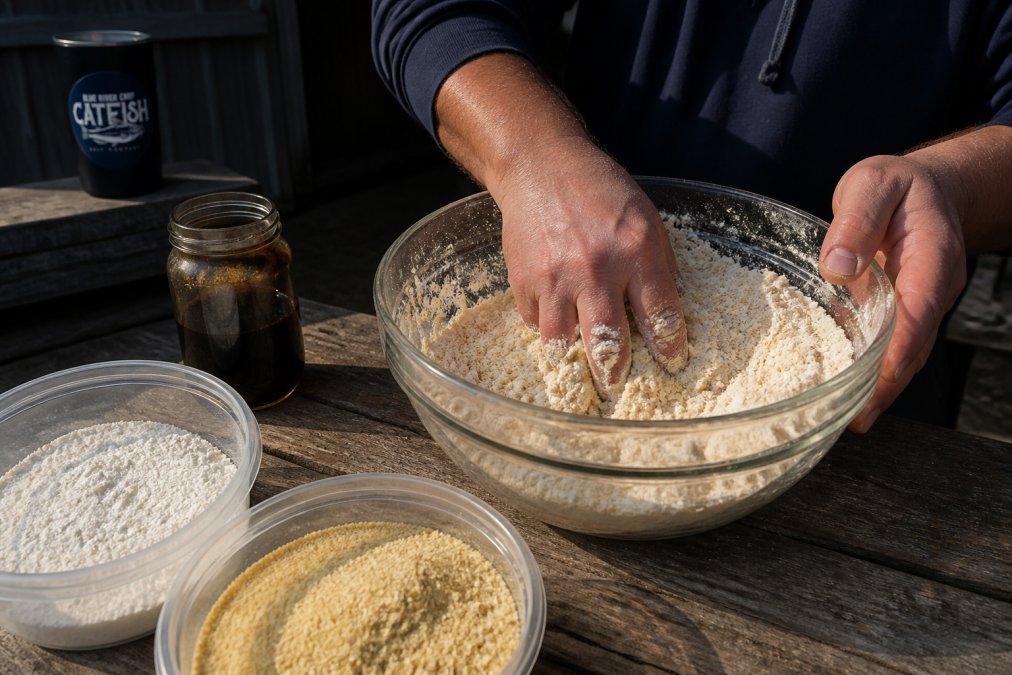
Recipe 1: Classic Wheat Flour and Cornmeal Dough Ball
- Mix 1 cup wheat flour and 1/2 cup cornmeal in a bowl.
- Add 1/2 cup water slowly, stirring until a stiff dough forms.
- Knead for 2-3 minutes until smooth and firm.
- Work in 1 tablespoon garlic powder or anise oil for scent.
- Roll into balls roughly the size of a marble.
Recipe 2: Sardine and Garlic Stink Bait
- Mash one can of sardines in oil into a paste.
- Blend in 1 cup cornmeal and 1/2 cup wheat flour.
- Add 2 tablespoons garlic powder and mix thoroughly.
- Add water a spoonful at a time until the mix holds together.
- Seal in a jar and let it ferment in the sun for a day for extra pungency.
Recipe 3: Molasses and Oatmeal Sweet Dough
- Combine 1 cup instant oatmeal with 1/2 cup wheat flour.
- Stir in 3 tablespoons liquid molasses.
- Add warm water gradually until the dough is moldable.
- Knead until the texture is even and slightly tacky.
- Form into balls and let rest 10 minutes before fishing.
You can buy the base ingredients for all three recipes in one place: cornmeal, liquid molasses, steamed rolled oats, and soybean meal.

How to Keep Dough Bait on the Hook
Keeping dough bait on the hook comes down to four variables: consistency, hook geometry, retention hardware, and cast technique. Most anglers only adjust the first one, which is why they still lose bait on every cast.
Start with texture. A dough ball that holds a fingerprint without sticking to your fingers is right. If it smears, add binder. If it cracks, add water a drop at a time. The target feel is stiff cookie dough, not bread dough, stiff dough survives the acceleration of a cast, soft dough does not.
Hook geometry matters more than most guides admit:
- Hook size, For channel catfish in the 1-5 lb range, a #4 to #1 bait holder or circle hook compresses a marble-sized dough ball against the shank. Oversized hooks (2/0 and up) leave too much exposed shank for the dough to slide down.
- Bait spring or bait holder, A coiled spring or barbed bait holder on the shank grips the dough from the inside. This is the single most effective hardware upgrade for dough bait.
- Treble hook, Three points distribute pressure across the dough ball, but trebles snag more in cover. Use them in open water, not around brush.
- Cheesecloth wrap, A 2-inch square of cheesecloth folded around the ball and hooked through the cloth acts as a physical cage. Scent still disperses through the weave, but the bait survives a hard cast and rough current.
- Egg wash coating, Whisk one egg and roll the formed ball in it, then let it air-dry 10 minutes. The dried protein skin slows water penetration and buys you extra soak time.
Cast technique is the variable nobody writes about. A smooth lob cast loads the rod gradually; a hard snap cast spikes the acceleration and shears soft dough off the hook. If you are fishing dough, lob it. Save the snap cast for cut bait.
For jugline and trotline fishing, where bait sits in moving water for hours, a firmer dough with extra binder lasts noticeably longer than a soft mix. A common pattern among jugline anglers is to mix dough at roughly three parts binder to one part liquid for overnight sets, versus the two-to-one ratio used for rod-and-reel fishing.
If you fish current or cast past 30 yards regularly, dough bait will always be a compromise. That is the honest limit of the format, no recipe fixes physics.
Scent-Infused Cut Bait vs Dough Bait: Which to Choose
Scent-infused cut bait and dough bait solve different problems. Dough bait is cheap, moldable, and easy to make in bulk. Scent-infused cut bait holds up better in current, stays on the hook through repeated casts, and requires no mixing on the bank.
Choose dough bait when you are fishing calm water, casting short distances, and want to experiment with scent combinations. Choose cut bait when you are fishing current, casting long distances, or targeting bigger catfish that respond to a substantial offering.
The honest trade-off: dough bait is cheaper per session, but it is messier and less durable. Cut bait costs more up front but survives conditions that turn dough into mush.
Catfish Bait Storage Tips for Shelf-Stable Dough
Shelf-stable dough bait needs three things: an airtight container, a cool dark spot, and separation between batches. Moisture is the enemy. If condensation forms in the jar, mold follows within days.
Storage basics:
- Seal dough in zip-top bags or screw-top jars with the air pressed out
- Store in a cool, dark cabinet, not a hot garage
- Label each batch with the date and recipe
- Keep stink bait batches separate from sweet dough, or the scents will blend
- For stink baits with fish or cheese, refrigerate after the first day of fermentation to slow spoilage
For anglers who fish once or twice a month, small batches beat one big mix. Make a cup at a time and you will rarely throw out spoiled bait.
What Actually Spoils Dough Bait
Two things drive spoilage: moisture and oxygen. Mold needs both. A vacuum-sealed bag removes oxygen and can extend shelf life from days to several weeks for dry-leaning recipes. Fermented stink baits are the exception, the fermentation itself preserves them, which is why a sealed jar of sardine bait can sit for weeks without refrigeration.
A practical rule: if the dough smells sour rather than pungent, it has turned. Pungent is the goal. Sour is a throw-out.
The Environmental Angle Most Guides Skip
Dough bait is one of the few bait categories where the ingredients are almost entirely biodegradable. Flour, cornmeal, oatmeal, molasses, and garlic break down in water. That matters in waters where synthetic attractants and plastic-based commercial baits leave residue.
If conservation is a priority for you, read the label on any commercial additive before you mix it in. Some liquid attractants use synthetic solvents that do not break down the way grain-based ingredients do. Sticking to food-grade ingredients, the same things you would find in a grocery store, keeps your bait on the right side of that line. U.S. Fish & Wildlife Service guidance on aquatic invasive species and bait use
DIY vs. Store-Bought: The Real Cost Math
A bag of cornmeal and a bag of flour together cost a few dollars and yield multiple cups of finished bait. Commercial stink baits typically run several dollars for a small jar that covers one or two sessions. Per ounce, homemade dough bait is usually the cheaper option, often by a wide margin, but the savings shrink once you count your time, the mess, and the batches you throw out.
The honest trade-off: homemade wins on cost per ounce, store-bought wins on convenience and shelf life. If you fish frequently, DIY pays off. If you fish a few times a season, the math favors buying.
| Bait Type | Prep Time | Shelf Life | Best For |
|---|---|---|---|
| Flour and cornmeal dough | 5 min | Days to weeks | Calm water, short casts |
| Sardine stink bait | 15 min | Weeks if sealed | Murky water, strong scent |
| Molasses oatmeal dough | 5 min | Days | Sweet-scent preference |
| Scent-infused cut bait | None | 12+ months | Current, long casts, juglines |
If you want the convenience of bait that is always ready, Blue River Carp, Inc. makes scent-infused cut bait from invasive carp with a 12+ month shelf life and no refrigeration required. It stays firm on the hook instead of turning mushy, which solves the exact problem dough bait struggles with in heat and current. NOAA guidance on invasive carp in U.S. waterways
Conclusion
The real challenge with dough bait is not the recipe. It is keeping the bait on the hook long enough for a catfish to find the scent trail, especially in current or on long casts.
If mixing and storing dough every trip has gotten old, Blue River Carp, Inc. offers a simpler path. Our scent-infused cut bait is made from invasive carp, veteran-owned and made in Indiana, and it holds a 12+ month shelf life with no refrigeration or freezing. It stays firm on the hook instead of getting mushy, so you spend your time fishing instead of re-baiting.
Get started with Blue River Carp, Inc. and keep your bait ready for every trip.
Frequently Asked Questions
How can I make my own dough bait for catfish?
Start with a base of wheat flour or cornmeal, add a binder like soybean meal, then mix in attractants such as garlic powder, anise oil, or sardines in oil. Add water slowly until the dough forms a firm ball that holds its shape. Knead it for a few minutes, then test a small piece on a hook before fishing. Adjust with more flour if it is too wet or more water if it crumbles.
Does homemade dough bait stay on the hook well?
It depends on consistency and how you hook it. A dough ball that is too soft will slide off during casting or get picked apart by small fish. Mix in extra binder like soybean meal or instant oatmeal to firm it up, and use a treble hook or bait spring to anchor the dough. Press the bait firmly around the hook shank so it holds through the cast and sits tight on the bottom.
How do you store homemade catfish dough bait?
Fresh dough bait made with wet ingredients like sardines or eggs should go in an airtight container in the refrigerator and will keep for about one to two weeks. For longer storage, portion it into small bags and freeze. Dry-style dough made from flour, cornmeal, and powdered attractants can stay shelf-stable in a sealed bag for several months. Label each batch with the date so you use the oldest first.
Is dough bait better than cut bait for catfish?
Neither is universally better. Dough bait creates a strong scent trail that draws channel catfish from a distance and works well in current. Cut bait, especially scent-infused cut bait made from carp, offers more hook retention and appeals to larger blue and flathead catfish. Many anglers carry both and switch based on the species and conditions they are targeting.