

DIY Catfish Bait Recipes for Summer: 5 That Work
Table of Contents
- Why Summer Changes Everything About Catfish Bait
- Base Ingredients Every DIY Catfish Bait Recipe Starts With
- How to Make Catfish Dough Bait That Stays on the Hook
- Using Cut Bait for Catfish When the Water Hits 80 Degrees
- Best Catfish Bait for Summer: Five Recipes Ranked by Mess and Effort
- Scent, Additives, and the Summer Scent Trail
- Frequently Asked Questions
Last Updated: September 18, 2026
Why Summer Changes Everything About Catfish Bait
Catfish bait behaves differently once surface water climbs past 80 degrees Fahrenheit. Warm water accelerates fermentation and breaks down binders, turning a dough ball that held all spring into mush within an hour. That fact reshapes every DIY catfish bait recipes for summer decision you'll make.
Base Ingredients Every DIY Catfish Bait Recipe Starts With
Every dependable dough bait rests on three ingredient classes: a base meal, a binder, and a sweetener or scent agent.
| Ingredient Class | Examples | Job in the Mix |
|---|---|---|
| Base meal | Cornmeal, soybean meal, cottonseed meal | Bulk, scent trail, cloud of particles |
| Binder | Flour, bread, oats | Hook retention, firmness |
| Sweetener | Molasses, sugar, pudding mix | Attraction, binding help |
| Scent agent | Garlic powder, anise oil, strawberry flavoring | Olfactory trigger |
Binders, Meals, and Sweeteners That Hold a Dough Ball Together
Binder choice decides whether your bait survives a cast. Flour makes a firm ball that resists current. Oats add stickiness but soften faster in heat. Bread binds well but tears easily on a hard hookset.

How to Make Catfish Dough Bait That Stays on the Hook
The best catfish bait for summer holds its shape at least 20 minutes in warm water. If your dough ball dissolves faster, add binder.
Step-by-Step Dough Ball Method
- Mix 2 cups base meal with 1 cup binder in a dry bowl
- Add 1/2 cup sweetener and stir until evenly distributed
- Pour water in small splashes, stirring until the mix pulls into a stiff dough
- Knead for 2-3 minutes until the texture feels like firm cookie dough
- Pinch off balls roughly the size of a nickel to a quarter
- Test one ball in a glass of water and time how long it holds
Expected result: A ball that stays intact 20+ minutes and leaves a visible scent cloud.
Fixing Dough That Falls Off or Feels Too Wet
Too wet means more binder, a tablespoon at a time. Too dry means a splash of water or molasses. If it crumbles, you've gone past dry into brittle.

Using Cut Bait for Catfish When the Water Hits 80 Degrees
Using cut bait for catfish in summer is a spoilage-management problem disguised as a presentation problem. Past 80 degrees Fahrenheit, bacterial activity on flesh accelerates while dissolved oxygen drops. Catfish feed aggressively in that warm, low-oxygen band after dark, but the bait you dropped at sunset is already breaking down before the first run. A cold chunk releases scent slowly as it warms; a warm chunk dumps its load in minutes and goes soft.
Choosing Flesh That Survives Warm Water
Firm-fleshed chunks hold better than soft strips. Reliable summer choices:
- Gizzard shad, the standard cut bait across most of the country, but it softens fast above 80 degrees. Cut it into chunks, not strips, and keep it iced.
- Skipjack herring, oilier and slightly firmer than shad; a favorite for blue catfish in river systems.
- Bluegill and other panfish, firm white flesh that threads onto a hook twice without tearing.
- Carp, dense, firm, and widely available; holds up better than shad in heat.
Species-Specific Cut Bait Selection
Most guides treat "catfish" as one fish. It isn't, and summer bait selection differs by species:
- Channel catfish, the most opportunistic of the three. They will take cut bait, dough bait, and even prepared stink baits. In summer, a smaller chunk (nickel- to quarter-sized) fished on the bottom after dark is the workhorse presentation.
- Blue catfish, strongly prefer fresh cut bait, especially oily fish like shad and skipjack. Blues roam open water and channel edges, so a chunk that throws a long scent trail matters more than one that sits still.
- Flathead catfish, prefer live bait, but will take fresh cut bait, particularly large chunks of panfish or carp. Flatheads are ambush predators that hug cover, so bait placement matters more than scent volume.
Managing Spoilage on the Water
A few field rules that hold up in summer:
- Cut fresh, not frozen, when you can. Frozen-then-thawed flesh is softer and slips off the hook faster.
- Keep chunks separated. A bag of chunks pressed together turns into one mushy mass. Layer them with a paper towel or freeze them individually.
- Re-bait on a schedule, not on a hunch. In warm water, a chunk is usually done after 15-20 minutes on the bottom.
- Do not leave cut bait in the sun. A sealed bag on a hot boat deck can spoil in under an hour.
Why This Matters More in Summer Than Any Other Season
In cooler water, a cut chunk can sit 30-40 minutes and still be fishing. In 80-degree water, it may be stripped or dissolved in half that time. Anglers who catch consistently in July and August aren't using a secret bait, they re-bait more often, keep bait colder, and match chunk size to the species they target.
Best Catfish Bait for Summer: Five Recipes Ranked by Mess and Effort
Five dependable recipes, ordered from cleanest to messiest.
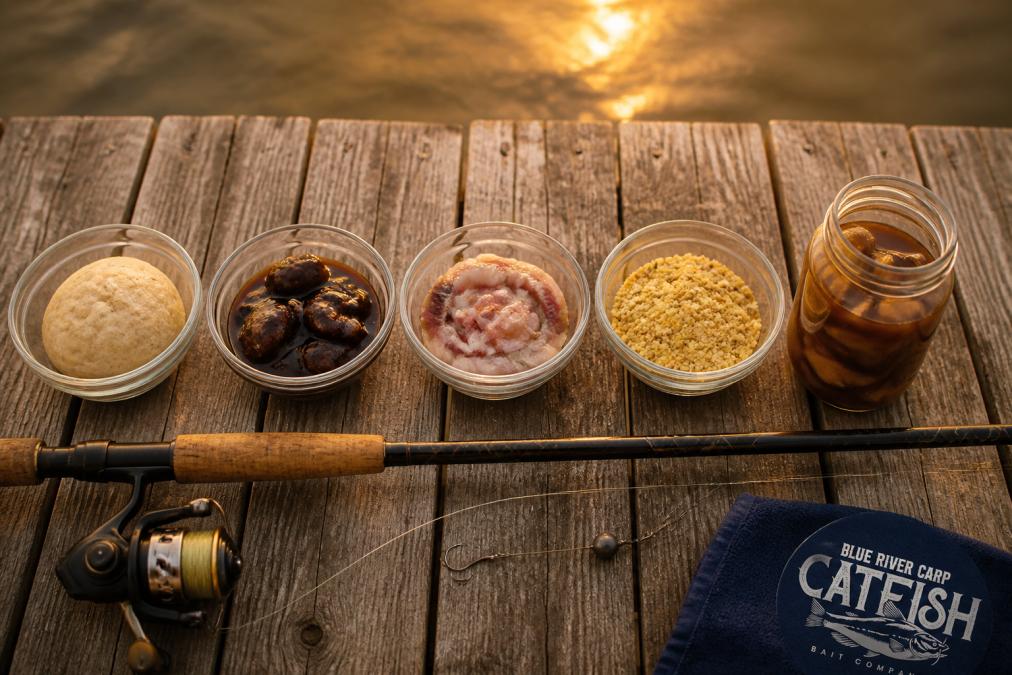
Shelf Life and Summer Storage for Each Recipe
Heat is the enemy of every homemade mix. Dough recipes keep about a week sealed in the fridge, marinated chunks a few days, and blood bait should be used the same day. If you'd rather skip the cooler, Blue River Carp, Inc. makes scent-infused cut bait from invasive carp with a 12+ month shelf life and no refrigeration required, it won't turn mushy on the hook, solving the exact problem summer heat creates.
| Recipe | Mess Level | Refrigerated Shelf Life | Best For |
|---|---|---|---|
| Cornmeal dough | Low | About 1 week | Beginners, quick trips |
| Molasses ball | Medium | About 1 week | Channel catfish |
| Cottonseed dough | Medium | About 1 week | Bottom fishing |
| Marinated chunks | High | 2-3 days | Blue catfish |
| Blood bait | Very high | Same day | Strong scent trails |
Scent, Additives, and the Summer Scent Trail
Scent turns a piece of dough into a fish-finding device. Catfish rely on olfactory senses and chemoreceptors across their skin and barbels, so a dissolving bait creates a scent trail that draws fish from distance. In summer that trail behaves differently than in spring or fall.
How Warm Water Changes Scent Dispersion
Water temperature affects how fast molecules move and how quickly a bait's scent plume spreads. In warm summer water, scent compounds diffuse faster and travel farther, which also means the bait exhausts its scent load faster. A dough ball that threw scent for an hour in April may be scent-dead in 20 minutes in July.
- Firmer binders so the ball dissolves gradually instead of sloughing off.
- Oil-based attractants that cling to the bait and linger in the water column.
- Smaller, more frequent baiting rather than one big ball that dumps its load and quits.
Oil-Soluble vs. Water-Soluble Additives
Anise oil and garlic powder are the two most reliable additives, and both are oil-soluble, they linger in the water column longer than water-based flavors. Strawberry flavoring works in sweet dough mixes but is water-soluble and dissipates faster in warm water. Additives that earn their place in a summer mix:
| Additive | Type | Why It Works in Summer |
|---|---|---|
| Anise oil | Oil-soluble | Long-lasting scent trail; classic catfish attractant |
| Garlic powder | Oil-soluble | Strong, persistent; cheap and widely available |
| Strawberry flavoring | Water-soluble | Good in sweet dough; fades faster in heat |
| Molasses | Sweetener + binder | Adds attraction and helps hold the ball together |
| Vanilla extract | Water-soluble | Mild; best paired with a stronger oil-based scent |
Fermentation: Hours, Not Days
Fermentation adds another layer. A lightly fermented mix produces acids catfish detect at range, but it also accelerates spoilage. In summer, ferment for hours, not days, a mix left on a warm counter overnight can go from "ripe" to "rotten" before you reach the water.
Shelf Life and Preservation: Freezing vs. Refrigerating vs. Fermenting
This is the part most DIY guides skip, and where summer baits fail most often: your preservation method determines how long bait stays usable.
| Method | Typical Shelf Life | Best For | Trade-off |
|---|---|---|---|
| Refrigerated dough | About 1 week | Small batches you will use soon | Takes up fridge space; still spoils |
| Frozen dough | 2-3 months | Bulk batches made ahead | Texture softens after thawing |
| Refrigerated cut chunks | 2-3 days | Short trips | Spoils fast; smell is strong |
| Fermented mix | 1-2 weeks refrigerated | Anglers who want a strong scent trail | Odor; risk of over-fermentation |
| Shelf-stable prepared bait | 12+ months | Spontaneous trips; no cooler needed | Less control over the recipe |
A few preservation rules that hold up in practice:
- Freeze dough in single-use portions. Thawing a whole batch and re-freezing it ruins the texture.
- Label everything with a date. A bait you cannot date is a bait you cannot trust.
- Smell before you fish. If a refrigerated bait smells sharply sour or has visible mold, it is done.
- Keep fermented bait separate. Cross-contamination with other baits in the same cooler is a real problem.
Ingredient Sourcing and Environmental Trade-offs
One more consideration: ingredient sourcing matters. Cornmeal and meal-based mixes can carry environmental trade-offs depending on where they are sourced and how they break down. Choosing bait made from invasive carp, like Blue River Carp, Inc.'s cut bait, turns a nuisance species into a useful product rather than adding pressure elsewhere. Biodegradable ingredients also break down more cleanly than synthetic additives, a small but real consideration for anglers who fish the same waters repeatedly.
Frequently Asked Questions
What is the best homemade bait for catfish in summer?
A simple dough bait built on cornmeal, soybean meal, and liquid molasses works well because it holds together, releases a steady scent trail, and stays on the hook through a cast. In water above 80 degrees, catfish feed more at night and rely on smell, so a bait that keeps releasing scent for 20 to 30 minutes beats one that dissolves in five. Add a splash of anise oil or garlic powder for extra attraction. Keep the mix firm enough to mold around a #4 to #2 hook without falling off on impact.
How do you keep homemade dough bait on the hook?
Start with a firm dough. Too much water makes it slide off; too little makes it crumble. Use cornmeal and flour as binders and add liquid a spoonful at a time until the mix feels like stiff cookie dough. Mold it around the shank and up past the barb, then pinch it tight. Boiling dough balls for two to three minutes and letting them air-dry firms the outside so it survives a cast. A small piece of cottonseed hull or a bread crumb pressed into the center adds grip.
Can I use cut bait for catfish in summer without a cooler?
Fresh cut bait spoils fast in summer heat, so most anglers keep it on ice. If you want to skip the cooler, shelf-stable cut bait made from invasive carp is an option. Blue River Carp, Inc. sells scent-infused cut bait that stays fresh 12 or more months in the bag and does not need refrigeration or freezing. It also holds its texture on the hook instead of turning mushy, which matters when channel catfish are biting light in warm water.
What flavors and additives actually attract catfish?
Catfish hunt by smell, so strong, oil-based scents work best. Anise oil, garlic powder, and liquid molasses are three reliable additives that create a scent trail in warm water. Strawberry gelatin powder mixed into dough bait is another proven option because the sugar and dye release slowly. Marinate cut bait in a sealed bag with garlic or anise for a few hours before fishing. Skip anything that washes off in seconds; the scent needs to linger near your hook, not just on your fingers.