
Bait for River Fishing: Top Picks by Species
Table of Contents
- How to Choose the Right River Fishing Bait
- Live Bait vs Artificial Lures for Rivers
- Best River Fishing Bait by Species
- Best Lures for River Fishing
- River Fishing Rigs for Beginners
- Seasonal Bait Selection for Rivers
- Preserving Bait Without Refrigeration
- Conclusion
Last Updated: August 10, 2026
Choosing the best bait for river fishing comes down to more than grabbing worms from the bait shop. Rivers present constant current, varying depth, shifting bottom structure, and selective fish. This guide from Blue River Carp, Inc. breaks down which baits work, which rigs keep them in the strike zone, and how to match your presentation to actual conditions.
Quick Picks:
- Best for Catfish: Scent-heavy cut bait, especially carp-based options
- Best for Bass: Live crayfish or soft plastic swimbaits on a jig head
- Best for Trout: Nightcrawlers or dough baits in slower current seams
- Best for Walleye/Pike: Live minnows or jerkbaits worked along current breaks
How to Choose the Right River Fishing Bait
The right river fishing bait stays in the strike zone long enough for fish to find it, holds on the hook through current pressure, and produces enough scent or visual appeal to trigger a strike.
Water Clarity and Current Speed
Water clarity is the biggest factor most anglers underestimate. In clear water, fish rely on sight, use soft plastics in natural shad or crayfish colors, inline spinners with silver blades, and jerkbaits with tight wobbles. In stained or muddy water, fish shift to scent and vibration, cut bait, nightcrawlers, and heavily scented soft plastics become your best options. A spinner with a bright chartreuse or orange blade creates enough flash and vibration to pull fish in from several feet away.
Current speed determines your weight and rig setup. Fast current washes light presentations downstream before fish can react. Match your sinker weight to the current so your bait stays within 6 inches of the bottom.
Depth and River Structure
River structure is where fish live: eddies behind boulders, undercut banks, deep holes at river bends, and seams between fast and slow water.
- Shallow riffles (1-3 feet): Lightweight rigs, small hooks, and natural presentations like wax worms or small spinners
- Mid-depth runs (4-8 feet): Slip sinker rigs with nightcrawlers or cut bait, jig heads with soft plastics
- Deep holes (8+ feet): Three-way rigs or heavy Carolina rigs to pin bait near the bottom
U.S. Geological Survey river flow and habitat data
Live Bait vs Artificial Lures for Rivers
Live bait wins on scent and natural movement. Artificial lures win on durability, convenience, and the ability to cover water quickly.
Live bait advantages:
- Natural scent trail in moving water reaches fish downstream
- Real movement triggers instinctive strikes
- Works when fish are inactive or pressured
Artificial lure advantages:
- No storage or refrigeration required
- Covers more water per hour through casting and retrieve
- Inline spinners and crankbaits draw reaction strikes from aggressive fish
Use live bait when targeting a specific hole and waiting fish out. Use artificials when covering a stretch of river and looking for active fish. Many experienced river anglers carry both.
Factor |
Live Bait |
Artificial Lures |
|---|---|---|
Scent attraction |
High |
Low-Medium |
Durability in current |
Low-Medium |
High |
Convenience |
Requires storage |
No prep needed |
Best conditions |
Murky water, slow current |
Clear water, active fish |
Species versatility |
Very high |
High |
Cost per trip |
Recurring |
One-time investment |
Best River Fishing Bait by Species
Different species demand different approaches. Matching your bait to the target fish's feeding behavior improves your catch rate significantly.
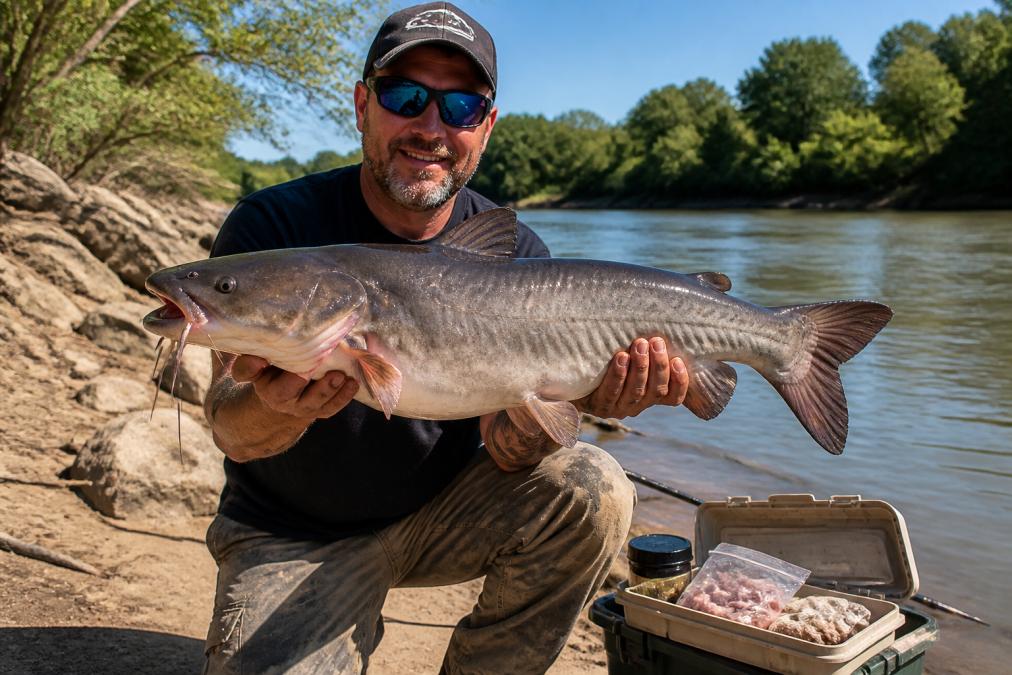
Angler holding a freshly caught catfish over a river bank, with a tackle box and cut bait visible nearby on a sunny day
Catfish: Cut Bait and Scent-Driven Options
Cut bait is the top catfish bait for rivers. Catfish are feeding scavengers that rely on scent to locate food in moving water. A piece of oily, pungent cut fish drifting along the bottom creates a scent trail that catfish follow upstream to your hook.
The best cut bait comes from oily fish: shad, skipjack, and carp. Blue River Carp, Inc. produces preserved cut bait from invasive Asian carp with a 12+ month shelf life and no refrigeration required. The 10oz Package (Chunks) offers 2" x 3" pieces ideal for larger catfish, while the 7oz Nuggets work well for channel cats. Both come in blood, garlic, and shad scents.


Bass: Crayfish, Soft Plastics, and Swimbaits
Smallmouth bass in rivers eat crayfish as a primary food source. Live crayfish hooked through the tail and drifted along rocky bottom in 2-5 feet of water is one of the most effective smallmouth presentations. For artificials, soft plastics that mimic crayfish work well on a jig head.
Largemouth bass in rivers hold in slower water: backwater pockets, submerged timber, and slack areas behind structure. Soft plastics rigged Texas-style or swimbaits on a 1/4 oz jig head cover these zones effectively.
Trout: Nightcrawlers, Wax Worms, and Dough Baits
Trout in rivers sit in current seams, eddies, and pool tail-outs, facing upstream to intercept drifting food. Nightcrawlers are the workhorse trout bait. Thread one on a size 6 or 8 hook, add a small split shot 12-18 inches above the hook, and drift it through the seam between fast and slow water. Wax worms work well in cold water when trout are sluggish. Dough baits like Berkley PowerBait Trout Dough are particularly effective for stocked trout.
Walleye and Pike: Minnows, Jerkbaits, and Spoons
Walleye are structure-oriented predators that hold in deep holes, behind current breaks, and along rocky points. Live minnows rigged on a jig head and bounced slowly along the bottom produce consistent walleye catches.
Pike are ambush predators that hold in slower current near vegetation or undercut banks. Large jerkbaits, spoons, and swimbaits trigger reaction strikes. A 4-5 inch jerkbait worked with sharp twitches and pauses imitates an injured baitfish perfectly.
Best Lures for River Fishing
The best lures for river fishing maintain action in current, stay in the strike zone at the right depth, and match local baitfish profiles. Three categories dominate: inline spinners, crankbaits and jerkbaits, and soft plastics on a jig head.
Inline Spinners
Inline spinners are the most versatile river lures. The spinning blade produces flash and vibration that triggers strikes from trout, bass, and panfish. The Mepps Aglia and Worden's Rooster Tail are standard references for good reason.
How to fish inline spinners in rivers:
- Cast upstream or across the current at a 45-degree angle
- Let the spinner sink 1-2 seconds before beginning your retrieve
- Retrieve at a pace that keeps the blade spinning without lifting the lure out of the strike zone
- Work the seam between fast and slow water
Always use a small barrel swivel 12 inches above the spinner to prevent line twist.
Crankbaits and Jerkbaits
Crankbaits and jerkbaits cover water fast and draw reaction strikes. In rivers, choose crankbaits with a tight wobble rather than a wide roll; tight-wobble designs maintain their action in current. Jerkbaits excel in clear water, with the pause being where most strikes happen.
Soft Plastics on a Jig Head
Soft plastics on a jig head are the workhorse of river fishing for bass and walleye. In rivers, a 1/4 to 1/2 oz jig head is standard, with heavier weights needed in faster current.
River Fishing Rigs for Beginners
Master two setups and you can fish any river effectively: the slip sinker rig for bottom-feeding fish and the three-way rig for strong current.
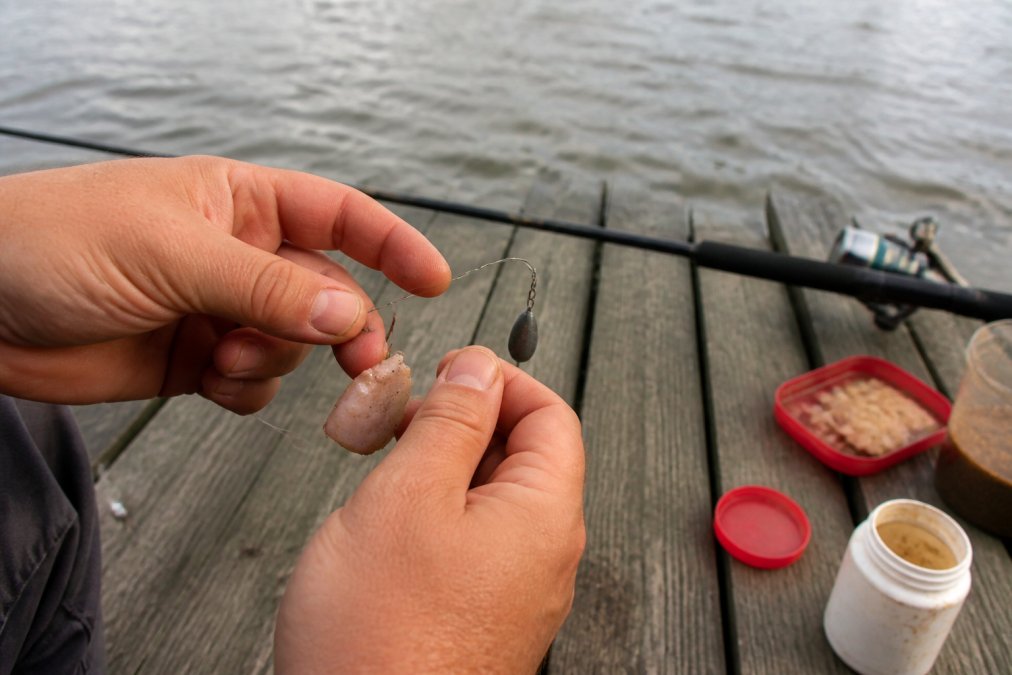
Close-up of hands tying a fishing rig with sinker, hook, and bait on a wooden dock with river water visible in the background
Slip Sinker Rig for Bottom-Feeding Fish
The slip sinker rig is the standard catfish and walleye setup. It allows the sinker to rest on the bottom while the fish picks up the bait without feeling resistance.
How to tie a slip sinker rig:
- Thread an egg sinker (1-3 oz depending on current) onto your main line
- Tie a small barrel swivel to the end of your main line to stop the sinker
- Attach an 18-24 inch fluorocarbon leader to the other end of the swivel
- Tie a circle hook (4/0-7/0 for catfish, 1/0-2/0 for walleye) to the leader
- Bait the hook with cut bait, nightcrawler, or minnow
- Cast to the upstream edge of a deep hole and let the current carry the bait down
Three-Way Rig for Strong Current
The three-way rig solves the problem of fast current lifting your bait off the bottom. A three-way swivel connects your main line, a dropper line with a sinker, and a leader with your hook.
Three-way rig setup:
- Tie your main line to one eye of a three-way swivel
- Attach a 6-12 inch dropper line to the second eye, with a bell sinker at the end
- Attach a 24-36 inch leader to the third eye, ending in your hook and bait
- Cast upstream and let the rig settle; the sinker holds position while the bait drifts naturally
Rig |
Best Current |
Target Species |
Sinker Weight |
|---|---|---|---|
Slip Sinker |
Slow-Moderate |
Catfish, Walleye |
1-3 oz |
Three-Way |
Moderate-Fast |
Catfish, Walleye, Bass |
2-4 oz |
Carolina Rig |
Slow-Moderate |
Bass, Trout |
1/4-1 oz |
Drop Shot |
Slow |
Bass, Walleye |
1/8-1/2 oz |
Seasonal Bait Selection for Rivers
Seasonal patterns in rivers are more pronounced than in lakes because water temperature and flow rates change dramatically.
Spring: Water temperatures rise and fish become more active. Nightcrawlers and minnows are top live baits as fish move into shallower water. Catfish begin feeding aggressively in water above 55°F.
Summer: High water temperatures push fish to deeper, cooler water during midday. Fish early morning and late evening. Cut bait and heavily scented options outperform in warm water where catfish are most active at night.
Fall: One of the best times to be on a river. Fish feed heavily before winter, and baitfish schools concentrate in predictable locations. Swimbaits and jerkbaits shine as bass and pike chase shad and minnows.
Winter: Cold water slows fish metabolism. Smaller baits, slower presentations, and natural scent become critical. Wax worms and small minnows fished slowly near the bottom produce when larger baits get ignored.
Preserving Bait Without Refrigeration
For live nightcrawlers, a foam bait container with damp newspaper keeps them alive for several days without refrigeration if stored in a cool, shaded spot. Wax worms are more temperature-tolerant and stay active in a sealed container for a week or more. Live minnows require an aerated bucket or livewell.
The cleanest solution for cut bait preservation is commercially preserved product that requires no cooler. Blue River Carp, Inc. produces preserved carp-based cut bait with a 12+ month shelf life. The Best 3 - 7oz Nugget Bundle includes blood, garlic, and shad scents for $25.50, covering three different water and weather conditions without any refrigeration.
According to National Oceanic and Atmospheric Administration guidance on invasive species, using invasive species like Asian carp as bait is ecologically responsible and reduces pressure on native baitfish populations.
Blue River Carp, Inc. also offers Fish Attack Strips, which can add real fish scent and flavor to any existing lure or hook setup.

Fish Attack Strips
Bait Type |
Best Species |
Shelf Life Without Refrigeration |
Best Season |
|---|---|---|---|
Preserved cut bait (carp) |
Catfish |
12+ months |
Year-round |
Live nightcrawlers |
Trout, Bass, Catfish |
2-3 days (cool shade) |
Spring, Fall |
Wax worms |
Trout, Panfish |
1-2 weeks |
Winter, Spring |
Live minnows |
Walleye, Pike, Bass |
Hours (needs aerator) |
Year-round |
Dough bait |
Trout |
Months (sealed) |
Spring, Fall |
Inline spinners |
Trout, Bass |
Indefinite |
Spring-Fall |
Choosing the best bait for river fishing gets easier once you stop treating bait selection as guesswork and start matching it to conditions. The current, depth, water clarity, season, and target species all point toward a specific presentation. Blue River Carp, Inc. makes the catfish side of that equation straightforward: preserved, scent-infused cut bait that's ready the moment you arrive at the water, with no cooler required and no bait that falls apart in fast current. Explore the full lineup at Blue River Carp, Inc. and get your tackle box ready before the next trip.
Frequently Asked Questions
What is the best bait for river fishing overall?
Nightcrawlers are the single most versatile river fishing bait because they attract trout, bass, catfish, walleye, and panfish. For catfish specifically, scent-heavy cut bait — like Blue River Carp's preserved carp chunks — outperforms nightcrawlers because the strong odor carries through moving water and reaches bottom-feeding fish holding in deep holes and eddies. Match your bait to the target species and current conditions for the best results.
Do live baits work better than lures in moving water?
Live bait generally outperforms artificial lures in slow to moderate current because natural scent and movement trigger strikes without any angler input. In fast current, lures like inline spinners and crankbaits often win because their action is more visible and they hold their position better. The most effective approach combines both: use live or preserved cut bait for bottom-feeding species like catfish, and reach for lures when targeting actively feeding bass or trout near the surface.
How do you choose bait based on river current speed?
In slow current, light presentations work — small jig heads, unweighted soft plastics, or live minnows under a float. In moderate current, add enough weight to keep bait in the strike zone without dragging. In fast current, switch to heavier sinkers on a three-way rig to pin cut bait or nightcrawlers to the bottom, or cast heavy inline spinners and crankbaits upstream and retrieve with the flow. Matching sinker weight to current speed keeps your presentation in front of fish.
What is the easiest bait to use for beginner river anglers?
Pre-cut, preserved bait is the easiest starting point for beginners. It requires no live bait storage, no cutting, and no refrigeration. Blue River Carp's 7oz nugget packages ($10) come ready to thread on a hook and stay firm in current without falling off. Pair them with a simple slip sinker rig and you have a functional catfish setup in under five minutes. Nightcrawlers on a plain hook are the next easiest option for trout and bass.
How do you keep bait fresh on a river fishing trip without a cooler?
For live bait like nightcrawlers, keep them in a ventilated container out of direct sunlight and change the bedding if trips run long. For cut bait, the practical answer is preserved bait that needs no cooler at all. Blue River Carp's preserved carp bait carries a 12-plus month shelf life in a resealable bag, so it stays fresh in a tackle box through summer heat. This eliminates the mushy bait problem that causes hooks to lose bait mid-cast in strong current.
This article was written using GrandRanker