

Tips for Catching Channel Catfish at Night That Work
Last Updated: November 7, 2026
Quick Summary
Catching channel catfish at night works best by using strong-smelling bait fished near deeper water, because channel catfish hunt by scent after dark. Cut bait such as Catfish Cut Bait Nuggets releases scent well and needs no cooler, and bank anglers should cast toward structure and drop-offs and start fishing around dusk.
- Channel catfish rely on smell and taste more than sight after dark.
- Cut bait releases scent into the water and holds well on the hook.
- The 7oz Catfish Cut Bait Nuggets are pre-cut to about 1 x 2 inches.
- The 10oz Catfish Cut Bait Chunks suit larger fish and heavier rigs.
- Many anglers report the strongest bites in the first few hours after dark.
Table of Contents
- Best Bait for Catfish at Night: Cut Bait vs. Live Bait
- Rigs, Hooks, Weights and Line for Channel Catfish
- Bank Fishing for Catfish at Night: A Step-by-Step Setup
- Where to Cast for Catfish at Night
- What Time Do Catfish Bite at Night? Timing Your Trip
- Night Safety, Handling Fish and Troubleshooting Missed Bites
- Frequently Asked Questions
Channel catfish are most active after the sun drops, and that is why night fishing is one of the most productive ways to catch them in the United States.
Channel catfish rely on their sense of smell and taste more than sight. After dark, they hunt by following scent trails through the water, which makes strong-smelling bait far more effective than a bare hook.
- Catfish use smell and taste to locate food in low light
- Darkness reduces competition from sight-feeding species
- Cooler evening water temperatures often increase feeding activity
Best Bait for Catfish at Night: Cut Bait vs. Live Bait
Cut bait is a practical choice for many night trips. Cut pieces release scent into the water and can hold on the hook well.
Our 7oz Catfish Cut Bait Nuggets are pre-cut to about 1 x 2 inches. For larger fish, the 10oz Catfish Cut Bait Chunks offer bigger pieces for heavier rigs.

Our bait does not need refrigeration or freezing, so you do not need a cooler for it.
Choosing Bait by Season and Water Temperature
Bait choice should shift with the season. Some anglers match scent strength to water temperature: blood and garlic are strong options, while shad is milder. Experiment to see what works on your water.
The article compares the bait options that work for night catfish, and this quick reference lays out the key points.
| Bait | Best for | Key point |
|---|---|---|
| Catfish Cut Bait Nuggets (7oz) | Most night trips | Pre-cut to about 1 x 2 inches |
| Catfish Cut Bait Chunks (10oz) | Larger fish, heavier rigs | Bigger pieces for heavier rigs |
| Cut bait (general) | Convenient night trips | Releases scent and holds on the hook |
| Live bait | Anglers with more gear | Needs more handling, sometimes a cooler or tank |
Rigs, Hooks, Weights and Line for Channel Catfish
Channel catfish do not need a complicated rig. What they need is a rig that keeps fresh-smelling bait pinned near the bottom, lets a hooked fish turn without feeling heavy resistance, and survives the occasional snag. The specifications below are starting points for typical bank-fishing conditions; adjust them to current, cover, and the size of fish you expect.
The Three Rigs That Cover Most Night Trips
- Carolina rig (egg sinker above a swivel). The workhorse for channel catfish. Thread a 1/2 to 1 oz egg sinker on the main line, tie on a barrel swivel, then add a 12 to 18 inch leader to the hook. The sinker slides freely, so a catfish can pick up the bait and move off before it feels weight. Use this on sand, gravel, and gentle current.
- Fish-finder rig with a lighter dropper. Same sliding-sinker idea, but the sinker hangs on a short dropper above the swivel. In snaggy rock or brush, the dropper lets the weight break away instead of costing you the whole rig. Bump the sinker to 3/4 to 1-1/2 oz when current pushes the line.
- Three-way swivel rig. Best when you need the bait to sit just off the bottom in current. Tie a 6 to 10 inch dropper to the sinker and a 12 to 24 inch leader to the hook. This keeps cut bait visible in the flow instead of buried in silt.
Skip the classic tight-line pyramid rig for channel catfish at night unless the bottom is clean and the current is mild. It works, but it gives a hooked fish less room to run and produces more missed hooksets on short bites.
Hook Style and Size
Circle hooks are a common choice for channel catfish, since the hook tends to set in the corner of the mouth as the fish turns away. Match the hook to the bait piece, not to a hoped-for trophy:
- Size 4 to 2 circle hooks for nightcrawlers, small nuggets, and prepared bait.
- Size 1/0 to 2/0 circle hooks for 1 x 2 inch cut bait nuggets and shrimp.
- Size 3/0 to 5/0 circle hooks for larger chunks, whole gizzard shad, and big live bait.
A hook that is too large for the bait leaves the point exposed and buries the scent, while a hook that is too small lets a bigger fish swallow the bait before the circle can rotate. If you are getting short strikes, drop one hook size before you change anything else.
Line, Leader, and Rod
- Main line: 12 to 17 lb monofilament is the practical range for channel catfish in open water. Mono stretches, which absorbs the surge of a fish at the bank and forgives a slightly late hookset. Step up to 20 lb mono or 30 to 50 lb braid around heavy cover, bridge pilings, or riprap.
- Leader: 12 to 20 lb mono or fluorocarbon, 12 to 24 inches long. Fluorocarbon helps in clear water and around pressured banks; plain mono is fine in stained rivers.
- Rod: a 7 to 8 foot medium-heavy spinning or baitcasting rod with a soft enough tip to show a pick-up. Two rods per angler is a common bank setup where regulations allow it; check your state's rules before you set out a second rod.
Watch out: circle hooks only work if you do not set the hook like a bass angler. Reel down until the line comes tight and let the rod load; a hard sweep pulls the hook straight out of the mouth.
Weight Selection by Current
- No current, clean bottom: 1/4 to 1/2 oz egg sinker.
- Mild current or wind chop: 1/2 to 1 oz.
- Strong current or deep water: 1 to 2 oz, or switch to the three-way rig so the bait stays off the bottom.
Carry sinkers in 1/4 oz increments. Being able to add a quarter-ounce when the current picks up is faster in the dark than re-rigging, and it keeps your bait in the scent zone instead of dragging downstream.
Bank Fishing for Catfish at Night: A Step-by-Step Setup
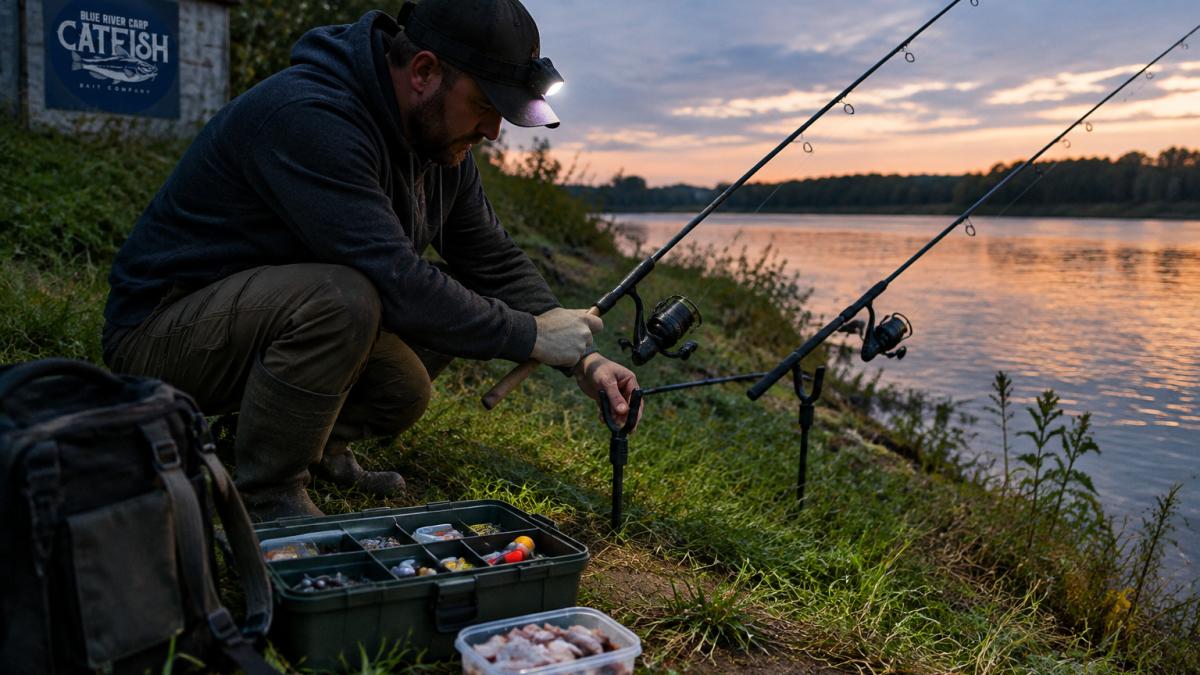
Bank fishing is one of the easiest ways to start night fishing for catfish. Arrive before dark so you can find a safe, legal spot and set up with light to spare.
- Choose a spot with a gradual slope and access to deeper water.
- Place rod holders firmly in the bank.
- Rig your bait and cast out to the spot you chose.
- Set your rod tip so you can see small movements.
- Turn on a headlamp with a red setting to keep your night vision.
!Angler on a grassy riverbank at dusk setting a rod in a rod holder, a headlamp on, tackle box open beside them
Where to Cast for Catfish at Night
Look for structure near deeper water, such as drop-offs, boulder piles, and the edges of current breaks. Channel catfish often hold near these areas and move up to feed after dark. Casting upstream and letting the current carry your scent trail toward likely holding water is a reliable approach.
Check local regulations and fishing rules before you choose a spot, since rules vary by state and water body.
What Time Do Catfish Bite at Night? Timing Your Trip
Many anglers report the strongest bites in the first few hours after dark, though bites can continue through the night. Early evening, around dusk, is a good time to start. Plan to fish through the late night if the bite stays steady.
Watch the water and the weather. Warm, stable nights often produce more action than cold, windy ones.
Night Safety, Handling Fish and Troubleshooting Missed Bites
Most night-fishing articles stop at "bring a headlamp." The details below are the ones that actually keep a bank trip safe and turn a slow night into a productive one, and they are the parts competitors tend to skip.
Setting Up a Safe Night Station
- Light discipline: use a red headlamp for rigging and baiting so your night vision survives, and keep a white light in reserve for the walk in and out. A red setting on a headlamp is enough to tie knots and unhook a fish; a white beam pointed at the water spooks fish holding in the shallows.
- Footing: walk the bank in daylight first if you can. Gravel, riprap, and slick clay banks are the main cause of night falls. Wear boots with grip, and keep your rod bag and tackle box behind you, not in the path between your chair and the water.
- Water hazards: know the depth and current before you cast. Waders are a poor choice on an unfamiliar bank at night; a sudden drop-off or a rising release from an upstream dam can turn a shallow edge into deep water fast. Check release schedules where they apply.
Handling Channel Catfish Safely
Channel catfish have sharp pectoral and dorsal spines, and a poke from one is painful and prone to infection. Wet your hands before touching the fish, support the belly rather than dangling it by the jaw, and use a wet towel or a lip grip designed for catfish. Hold the fish flat and away from your body while you remove the hook with long-nose pliers or forceps.
Troubleshooting Missed Bites and Slow Nights
When the rod taps and nothing hooks up, work through this order before you move:
- Short strikes or stripped bait. Drop one hook size, shorten the bait piece, and make sure the hook point is exposed. A circle hook buried in a big chunk of cut bait will not rotate into the mouth.
- Taps that stop. A channel catfish that picks up and drops bait is often feeling the sinker. Switch from a fixed sinker to a sliding egg sinker, or lighten the weight by a quarter-ounce.
- No bites at all. Change scent before you change spots. Move from a milder bait to a stronger, oilier cut bait, or the reverse if the water is cold. Then reposition: cast closer to structure, or move 20 to 30 yards along the bank to a new drop-off or current seam.
- Snags on every cast. Switch to the fish-finder rig with a breakaway dropper, shorten your leader, and cast upstream so the current carries the bait away from cover instead of into it.
- Current picked up. Add weight in 1/4 oz steps or move to a three-way rig so the bait stays in the scent zone rather than dragging downstream.
- Bite died after the first hour. Channel catfish often feed in waves. Re-bait with fresh cut bait, add a small amount of chum upstream of your casts, and give the spot another 30 to 45 minutes before moving.
Watch out: do not respond to a slow night by soaking the same bait in the same spot for hours.
Setting Up Your Next Night Trip With Blue River Carp Bait
Ready to try these tips on your next trip? Our Catfish Weekend Kit includes four 7oz nuggets in Blood, Garlic, Shad, and Natural scents plus a 4oz Blood Scented Attractant, so you can test what the catfish prefer.

Frequently Asked Questions
What is the best bait for catfish at night?
Cut bait is a common choice for channel catfish after dark because they locate food by smell and taste more than sight. Fresh-smelling, firm pieces hold on the hook and keep releasing scent in the water. Blue River Carp Catfish Cut Bait Nuggets, sold in 7oz packages from $11.00, are preserved, so they stay fresh for 12+ months without a cooler or freezer. Blood and Shad scents are also available if you want to add scent to your bait.
What time do catfish bite at night?
Channel catfish often feed most actively in the first few hours after sunset, when the water is cooling and light has faded. Many anglers see steady action from dusk into the early evening, then a second window in the hours before dawn. Activity drops during the deepest part of the night in cold or high-pressure conditions. Plan to fish the dusk window first, then stay for the late-night bite if the first hour is productive.
Where should you cast for channel catfish at night?
Target spots with current, structure and deeper water near the bank, such as drop-offs, the edges of submerged logs, and the downstream side of rocks or boulder piles. Cast upstream and let the bait drift naturally into these areas, or anchor upstream and let current carry scent across the zone. Start near the bank, then work outward in short casts until you locate the active area.
Do catfish see well at night?
Catfish rely more on smell, taste and their lateral line than on sight, which is why scent-rich bait is a common approach after dark. They can still detect movement and shapes in low light, but they find food primarily by following scent trails. For that reason, choose bait that releases a strong, steady scent and keep it on a rig that presents it near the bottom where channel catfish feed.


