

How to Hook Punch Bait for Catfish: A Practical Guide
Table of Contents
- What Is Punch Bait and Why Catfish Anglers Use It
- Essential Gear for Punch Bait Fishing
- Best Catfish Punch Bait Hooks: Treble vs. Single
- Step-by-Step: How to Hook Punch Bait for Catfish
- How to Rig Punch Bait for Channel Catfish
- How to Store Catfish Punch Bait
- Summer Catfishing Tips with Punch Bait
- Frequently Asked Questions
Last Updated: September 12, 2026
What Is Punch Bait and Why Catfish Anglers Use It
Punch bait is a soft, fiber-based paste loaded onto a treble hook with a stick or applicator. It's a staple for channel catfish because it stays on the hook longer than liver or shrimp. This guide covers how to hook punch bait so it survives the cast, sits on the bottom, and puts scent where fish feed.
The appeal is simple: punch bait is shelf-stable, needs no refrigeration, and doesn't turn to mush like chicken liver. A common mistake is threading it once through the hook like a worm, the fibers need to wrap around the shank and gap to hold together.

Essential Gear for Punch Bait Fishing
The gear list is short, but each piece matters. A bait stick, a jar of punch bait, a quality treble hook, and the right terminal tackle cover 90% of it.
Here's what to carry:
- Bait stick or applicator: A wooden or plastic stick with a notched tip that grabs the bait and pushes it onto the hook.
- Treble hooks: Size 4 to 1/0 covers most channel catfish setups.
- Snap swivels: Let you swap hooks fast and reduce line twist.
- Egg sinkers or split shot: Depending on current and depth.
- Leader material: 20-30 lb monofilament or braided leader works for most bottom fishing.
- Jar bait container: Keeps the bait sealed and workable between casts.
The applicator matters as much as the bait, a blunt tip tears the wad apart before it reaches the shank.
Best Catfish Punch Bait Hooks: Treble vs. Single
A treble hook is the better choice in almost every situation because three points hold the fiber wad from multiple angles. A single hook relies on the bait's viscosity to stay wrapped, which fails more often on hard casts.
Treble hooks also improve penetration: when a catfish mouths the wad, the exposed points are positioned to catch the lip or corner of the mouth.
That said, treble hooks snag submerged structure more easily. If you're fishing heavy cover, a single hook with a wider gap can be the smarter pick.
| Hook Type | Bait Retention | Snag Risk | Best For |
|---|---|---|---|
| Treble (4X strength) | High | Higher | Open water, channel catfish |
| Treble (2X strength) | Moderate | Moderate | Mixed cover |
| Single wide-gap | Lower | Lower | Heavy submerged structure |
Hook Size vs. Bait Volume: Finding the Right Ratio
Match hook size to bait volume. A size 4 treble with a thumb-sized wad buries the points; a 1/0 with a pea-sized wad leaves too much bare metal showing.
A practical rule: the wad should cover the shank and roughly two-thirds of the gap, with barbs and point tips clear. That keeps bait locked on without smothering the hook.
Step-by-Step: How to Hook Punch Bait for Catfish
Hooking punch bait takes about 10 seconds once you've done it a few times. The goal: a compact wad wrapped around the shank, points exposed, fibers locked together.
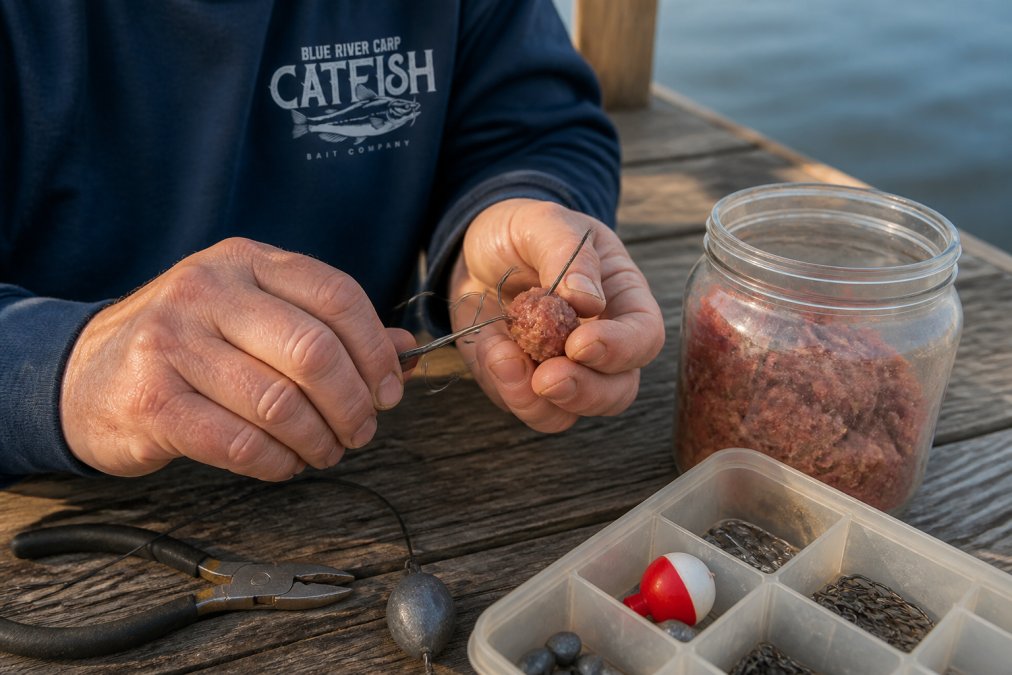
Here's the process:
- Open the jar and stir the bait. Punch bait separates slightly in storage. A quick stir restores consistency.
- Load the bait stick. Push the notched tip into the jar and twist until you have a wad about the size of a marble.
- Position the treble hook. Hold the hook by the eye with the points facing away from you.
- Press the stick onto the hook shank. Center the wad over the shank, between the eye and the start of the bend.
- Twist and pull the stick free. The fibers should wrap around the shank and the base of each point.
- Shape the wad with your fingers. Pinch it tight so it hugs the hook without covering the barbs.
Expected result: A compact, fiber-wrapped wad that stays put when you shake the hook.
Using a Bait Stick or DIY Applicator
A bait stick is standard, but a notched wooden dowel or a plastic syringe with the tip cut off works as a DIY applicator.
The key is a tip that grabs the fiber without crushing it. Too wide and the bait slides off. Too narrow and it punches through the wad.
How to Keep Bait on the Hook Through the Cast
Bait retention comes down to fiber wrap, wad shape, and casting technique.
- Wrap the fibers around the hook shank at least twice.
- Keep the wad compact, not loose or stringy.
- Use a smooth, sidearm cast instead of a hard overhead snap.
- Re-check the bait after every cast and reshape if needed.
A lob cast beats a power cast every time, the extra distance isn't worth losing the bait mid-flight.
How to Rig Punch Bait for Channel Catfish
Rigging punch bait starts with a simple bottom rig: a snap swivel, a sliding egg sinker, and a leader to your treble hook. It lets the bait sit where channel cats feed and controls line twist.
Rig it like this:
- Slide an egg sinker onto your main line.
- Tie on a snap swivel below the sinker.
- Attach a 12-18 inch leader to the swivel.
- Tie your loaded treble hook to the leader.
- Cast, let it settle, and tighten the line just enough to feel the bottom.
For current or deeper water, add a split shot above the swivel to hold position. For shallow, calm water, a lighter sinker keeps the bait from burying in silt.
How to Store Catfish Punch Bait
Storing punch bait correctly keeps it workable trip to trip, and the variable most guides skip is temperature. It's a fiber-and-oil paste whose consistency tracks ambient heat: too warm and the oils separate, too cold and the fibers stiffen into a crumbly brick that won't wrap the shank.
A practical storage target is a stable 60-80°F, which keeps the paste pliable without bleeding oil into the jar threads.
- Close the lid tight after every baiting. Air exposure is what dries the surface into a skin.
- Keep the jar out of direct sunlight and away from truck dashboards. A closed vehicle can push interior temps well past 100°F in summer, which is where separation starts (noaa.gov).
- Store at room temperature, not in a hot garage or a freezing shed. A garage that swings from 40°F nights to 90°F afternoons is worse than a steady closet.
- If the bait dries out, add a few drops of water and stir. Add water a few drops at a time, overshooting turns the paste runny and it won't stay on the hook.
- If the bait gets oily or runny, stir it and let it sit in a cooler spot. Some anglers work in a pinch of the drier crumbles from the bottom of the jar to firm it back up.
Adjusting Bait Viscosity by Temperature
This adjustment is the difference between bait that survives the cast and bait that slings off mid-flight.
- Above roughly 85°F (hot summer boat decks, mid-day sun): the paste softens fast. Load a slightly smaller, firmer wad, press it tighter around the shank, and expect to re-bait more often. Keep the jar shaded and closed between casts.
- 70-85°F (typical summer mornings and evenings): standard consistency. Load a marble-sized wad and go.
- Below roughly 60°F (cool mornings, fall and early spring): the fibers stiffen. Warm the closed jar in your hands or let it sit in the sun for a few minutes before loading, and work the paste with the stick to loosen it. A cold wad crumbles instead of wrapping.
A common summer pattern: carry two jars, one shaded in the boat, one on ice, and rotate to whichever consistency the water and air temps call for.
Cleanup and Disposal After a Punch Bait Session
Punch bait is messy, and its oil-based residue doesn't rinse off gear like liver or shrimp. A few habits keep your tackle box, hands, and the shoreline in better shape.
- Wipe hooks and bait sticks with a rag before they go back in the box. Dried paste on a treble hook dulls points over time.
- Keep a dedicated rag or a roll of paper towels in the boat. Punch bait residue transfers to rod grips, reels, and clothing.
- Wash hands with soap and water, not just a rinse. The oil base resists plain water.
- Dispose of leftover bait and residue in a sealed bag in the trash, not in the water or on the bank. Leaving paste on the shore concentrates scent and oil where it doesn't belong, and many public access areas have rules against leaving bait or fish waste behind.
- Rinse the jar lid and threads before resealing. Residue in the threads lets air in and dries the next batch.
Most jar baits hold up for months when stored this way. Shelf-stable cut bait from Blue River Carp, Inc. stays fresh for 12+ months in the bag with no refrigeration or freezing required, no mushy bait falling off the hook mid-cast.

Summer Catfishing Tips with Punch Bait
Summer is when punch bait earns its reputation, and misbehaves most. Warm water softens the paste and speeds breakdown, so the angler who adjusts consistency and re-baiting cadence out-fishes the one loading the same wad all day.
- Fish early and late. Channel catfish feed more actively in low light during summer (PubMed). The first two hours after sunrise and the last two before dark are the highest-percentage windows.
- Adjust bait consistency to water temperature. As water warms past the mid-70s, bait softens faster. Load a slightly firmer, more compact wad and press it tighter around the shank so it holds through the cast.
- Re-bait on a schedule, not on a hunch. In warm water, a wad that's been soaking for 20-30 minutes has usually released most of its scent and softened to the point where it won't survive a hard cast. Check it after every cast and reshape or reload when it starts to look ragged.
- Target submerged structure. Fallen timber, rock piles, and channel edges concentrate fish and give the bait a scent-holding pocket.
- Use a scent trail, not a scattergun. Punch bait releases scent steadily, so keep it in one spot rather than recasting constantly. A bait that sits still builds a scent column; a bait that's always moving never does.
- Watch the sun on your jar. A jar left open on a hot deck separates and turns oily within an hour. Keep it closed and shaded between baitings.
Matching Bait Firmness to Water Temperature
The most useful summer adjustment is firmness, tied to water temp:
- Water in the low 70s: standard wad, marble-sized, wrapped twice around the shank.
- Water in the mid-to-upper 70s: press the wad firmer and slightly smaller. The extra compression keeps the fibers locked as the paste softens.
- Water above roughly 80°F: go smaller and firmer still, and shorten your soak time between checks. Soft paste plus a long soak is the recipe for a bait that slings off on the next cast.
A common pattern among summer anglers is to keep the jar in a cooler with a little ice on the hottest days, then pull it out a few minutes before baiting so the paste firms up without going stiff.
Night Fishing in Summer Heat
Channel catfish feed heavily after dark in summer, and punch bait works well because scent does the attracting in low visibility. Two adjustments matter:
- Load a firmer wad than you would in daylight. You can't see the bait to check it, so a wad that holds its shape through several casts saves you from fishing bare hooks in the dark.
- Use a headlamp with a red setting when re-baiting. White light spooks fish holding in shallow water, and red light lets you see the hook and wad without blasting the spot.
Blue River Carp, Inc. makes its bait from invasive Asian carp, giving eco-conscious anglers a reason to choose it. The 7oz nugget and 10oz chunk packages are pre-cut and ready to use, and the Best 3 bundles let you test blood, garlic, and shad scents in one order.
For more on handling catfish safely and legally, check your state's wildlife agency rules, such as those published by the U.S. Fish and Wildlife Service, which outline licensing and species regulations that apply to freshwater angling.
Frequently Asked Questions
How do you keep punch bait from falling off the hook?
Push the hook shank deep into the bait wad and pack the bait tightly around it. A treble hook with a wide gap helps the barbs catch and hold the bait. If you're casting far, use a bait stick to mold the bait firmly. Some anglers add a small piece of fiber or thread to the wad for extra grip. The goal is to embed the hook so the bait stays put through the cast and on the bottom.
What is the best hook size for punch bait?
Most catfish anglers use a treble hook in sizes 4 to 1/0 for punch bait. A size 4 to 2 works well for smaller channel cats, while a 1/0 handles bigger fish and larger bait wads. Match the hook gap to the bait volume: the wad should cover the hook but not bury the points. A hook that is too small won't hold enough bait, and one that is too large leaves the bait exposed.
Do you need a special hook to use punch bait?
No, you don't need a specialized hook, but a treble hook with a short shank and wide gap works best. The three points help hold the bait wad together and increase hook penetration when a catfish bites. Some anglers prefer a single hook for easier unhooking, but trebles are the standard for punch bait because they keep the bait from sliding off. Choose a 4X or 2X strength hook if you're targeting big fish.
How should you store punch bait between trips?
Keep punch bait in its original resealable jar or container and store it in a cool, dry place out of direct sunlight. Most punch baits don't need refrigeration, but check the label. If the bait dries out, add a small amount of water or scent oil to restore consistency. Avoid leaving the jar open, as the bait will harden and become difficult to mold onto the hook.
Summer catfishing rewards preparation more than luck. The anglers who land fish consistently are the ones whose bait stays on the hook, in the strike zone, and releasing scent the whole time.
Blue River Carp, Inc. builds bait for exactly that job: veteran-owned, made in Indiana, with a 12+ month shelf life, no refrigeration needed, and a texture that holds together instead of turning mushy. Grab a 7oz nugget pack or a Best 3 bundle and get your hooks loaded with bait that stays put.