
How to Find Catfish in Deep River Holes
Table of Contents
- Reading the River: How to Identify Deep River Holes
- Using Sonar to Find River Structure
- Catfish Fishing Rigs for Deep Water
- Best Catfish Bait for Rivers
- Seasonal Patterns and Water Temperature
- Safety in Turbulent River Water
- Frequently Asked Questions
Last Updated: September 26, 2026
Reading the River: How to Identify Deep River Holes
Learning how to find catfish in deep river holes starts with reading the surface. Catfish hold in the deepest, calmest water they can find, and the river usually tells you where that is if you know the signs. This guide from Blue River Carp, Inc. walks through the bends, structures, and tools that put you on fish instead of guessing.
Deep river holes are sections of a river where the streambed drops well below the surrounding bottom, creating slow water and a resting spot for catfish. These holes collect food, block current, and hold fish year-round.
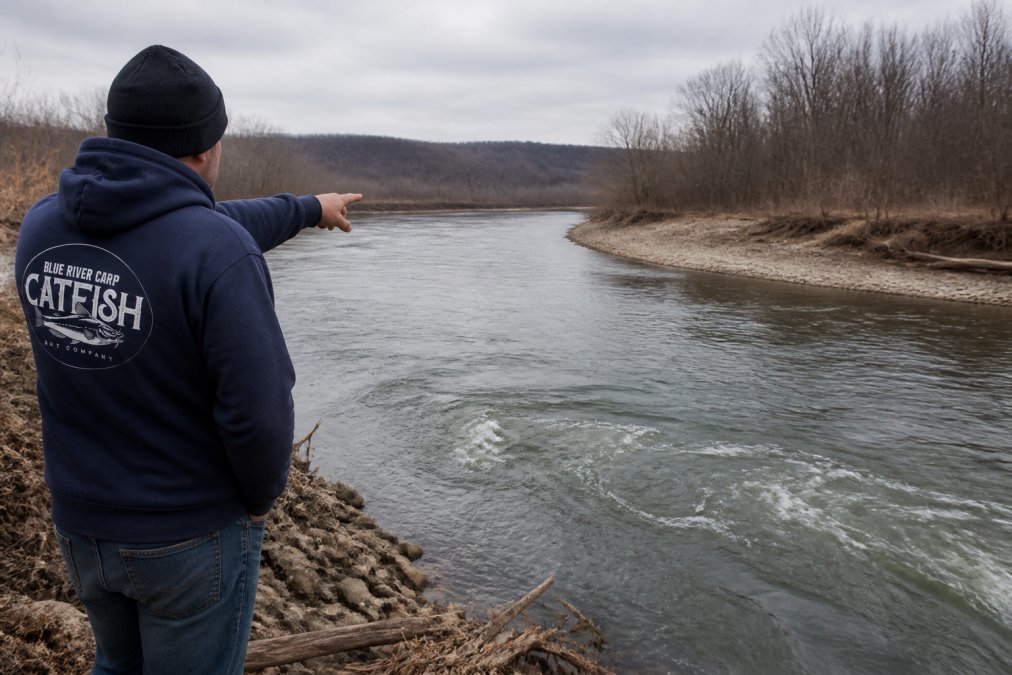
The fastest way to find one is to watch the surface. Smooth, swirling water beside fast riffles almost always means a drop-off underneath.
Outside Bends and Cut Banks
Water speeds up on the outside of a bend and carves the bank away. That scouring action digs a deep river hole over time. Look for steep, bare banks with exposed roots or soil. The hole sits right against that cut bank, often just downstream of the sharpest part of the curve.
Wing Dams, Bridge Pilings, and Tailraces
Man-made structure creates instant deep water. Wing dams push current toward the channel and scour a hole on their downstream side. Bridge pilings do the same thing on a smaller scale. Tailraces below dams hold some of the deepest, most oxygenated water on the river.
Fish all three on the downstream side first. That's where the scour happens.
Using Sonar to Find River Structure
Sonar turns guesswork into a map. A modern fish finder shows depth, bottom hardness, and the shape of the streambed in real time. You're looking for a sudden jump in depth, a hard bottom reading, and marks that suggest baitfish or catfish hugging the bottom.
Set your depth range manually instead of using auto. Auto-range hides the small changes that matter. Watch for the bottom line to drop sharply, then level off. That level stretch is your hole.
Reading the Screen as a Beginner
Start simple. Ignore the clutter and focus on three things:
- The bottom line and where it drops
- Hard returns versus soft, muddy ones
- Clusters of marks near the bottom
Hard bottom shows as a thick, bright return. Soft mud shows as a thin, faint one.
Telling a Catfish Hole From a Snag-Filled Hole
This is the part most guides skip, and it's the difference between a limit and a tackle box full of lost rigs. Both show up as a depth drop. They do not look the same on the screen.
A few practical tells to train your eye on:
- Smooth floor, defined lip, suspended marks, fish it. This is a catfish hole.
- Spiky floor, hard vertical returns, no suspended marks, this is a snag pile. Fish the downstream edge only, or move on.
- Wedge-shaped drop with a soft return, usually a silted-in depression. Low oxygen, few fish. Skip it.
- Double bottom line, a false return from a thermocline or dense bait ball. Drop your transducer gain a notch and re-read.
Marking Holes Before You Fish Them
Don't fish the first drop you see. Idle the hole at 2 to 4 mph, drop a waypoint on the upstream lip, and another on the downstream tail. That gives you a casting lane. Come back and fish the upstream lip first, current pushes bait into the hole from that side, and catfish sit on the lip waiting for it.
US Geological Survey water data and streamflow records
Catfish Fishing Rigs for Deep Water
Deep water and heavy current demand simple, tough rigs. The goal is to keep bait pinned on the bottom without snagging every cast. Most anglers lose tackle in deep holes not because the rig is wrong, but because the sinker can't break free when it wedges. Fix that first, and everything else gets easier.
| Rig | Best For | Sinker Weight | Snag Risk |
|---|---|---|---|
| Carolina rig | General deep water | 1-3 oz | Low |
| Three-way rig | Fast current | 2-4 oz | Medium |
| Slip sinker rig | Finicky fish | 1-2 oz | Low |
| Santee rig | Drifting deep holes | 2-4 oz | Low |
Snag-Resistant Rigging: The Part Most Guides Skip
Losing rigs on every cast is the number one complaint from anglers new to deep river holes, and it's almost always a rigging problem, not a bad-luck problem. Three changes solve most of it.
Leader and Hook Sizing by Target
- Blue catfish in deep holes: 40 to 50 pound mono leader, 6/0 to 8/0 circle hook, cut shad or carp chunks
- Channel catfish: 20 to 30 pound leader, 3/0 to 5/0 circle hook, smaller chunks and prepared baits
- Flathead catfish in cover: 50 to 80 pound leader, 7/0 to 10/0 circle hook, live bait where legal
Heavier leader doesn't spook catfish the way it spooks bass. Catfish hunt by smell and vibration, not by sight, so err on the heavy side in structure.
When to Retie
Check your leader after every snag, every fish, and every 30 minutes of fishing in rock. A nick you can feel with a fingernail is a nick that will fail on the next fish. Cut and retie, it costs 90 seconds and saves a fish of a lifetime.
Best Catfish Bait for Rivers
The best catfish bait for rivers is fresh cut bait that stays on the hook in current. Catfish hunt by smell, so a bait that releases scent and holds together beats one that washes off in seconds.
Match bait to the fish:
- Blue catfish: cut shad or carp chunks
- Channel catfish: smaller chunks and prepared baits
- Flathead catfish: live bait when legal, big cut chunks otherwise
Seasonal Patterns and Water Temperature
Catfish move with the thermometer. In spring, they push shallow to spawn. In summer, they slide into the deepest, coolest holes. In fall, they feed hard before winter. In winter, they bunch up in the deepest water and barely move.
Water temperature drives all of it.
- Below 50°F: fish deep, slow down, target the deepest holes
- 50-65°F: fish move and feed more actively
- 65-80°F: prime feeding, fish shallow and deep
- Above 80°F: fish seek cool, deep, oxygenated water
National Weather Service river forecasts
Safety in Turbulent River Water
Moving water kills, even when it looks calm. A river's current is far stronger than it appears, and a deep hole can hide a powerful undertow.
Follow these rules every trip:
- Always wear a life jacket, no exceptions
- Never wade alone in fast or rising water
- Check the forecast and dam release schedules before you go
- Anchor from the bow, never the stern
- Keep a throw rope and first aid kit on board
- Tell someone where you're fishing and when you'll be back
Frequently Asked Questions
How do you read a river to find deep holes?
Look for outside bends where the current cuts into the bank, creating a scour hole. Watch for surface turbulence, color changes, and slower water on the inside of the bend. Wing dams, bridge pilings, and tailraces below dams also create deep holes. A depth sounder or bathymetry map confirms what your eyes suspect. Start by casting upstream of the hole and letting your bait drift into the deep water where catfish hold.
What is the best bait for catfish in deep river holes?
Cut bait from invasive carp, shad, or skipjack herring works well because the scent trail carries in current. Blue River Carp's 10oz chunks (about 2" x 3") stay on the hook in deep water and resist mushy breakdown. For a scent boost, add L-lysine powder to your bait mix. Match bait size to the fish you want: bigger chunks for flatheads and blues, smaller pieces for channel cats. Fresh bait outperforms old, but shelf-stable options keep you ready.
How does water current affect catfish location in deep holes?
Catfish sit on the downstream side of current breaks, where the water slows and food collects. Deep holes with current breaks behind wing dams, bridge pilings, or rock piles hold more fish than uniform deep water. During high flow, catfish move to the edges of the hole to avoid the strongest current. During low flow, they may spread across the bottom. Anchor upstream and cast into the break, or drift slowly to cover more water.
Do catfish stay in the same deep holes year-round?
No. Catfish move with water temperature and baitfish. In spring, they push shallow to feed; in summer, they use deep holes during the day and move shallow at night. Winter drives them to the deepest, most stable holes. Flatheads often stay near cover in the same general area, while blues roam more. Check your sonar each trip because a hole that held fish last month may be empty now.
Finding catfish in deep river holes takes patience, the right rig, and bait that stays put. Blue River Carp, Inc. makes that last part easy with veteran-owned, Indiana-made cut bait that holds up in current and stays fresh for 12+ months without a cooler. Grab the 10oz chunks or the three-pack bundle with blood, garlic, and shad scents, and be ready for every trip. Get started with Blue River Carp, Inc. and spend less time re-baiting and more time catching.