
6 Best Catfish Baits for Deep Water Fishing in 2026
Table of Contents
- Quick Comparison: 6 Best Catfish Baits for Deep Water Fishing
- 1. Preserved Carp Chunks: The Best Cut Bait for Deep Water
- 2. Bait Nuggets: Pre-Cut Convenience for Deep-Water Rigs
- 3. Fish Attack Strips: Scent-Infused Add-Ons That Stay on the Hook
- 4. Chicken Liver and Natural Baits: Still Effective in Deep Water?
- 5. Dough and Dip Bait Recipes for Deep-Water Catfishing
- 6. Scent Oils and Attractants: Boosting Your Bait's Scent Trail
- Best Catfish Rigs for Deep Water
- Frequently Asked Questions
Last Updated: September 24, 2026
Quick Comparison: 6 Best Catfish Baits for Deep Water Fishing
Fishing deep water changes bait selection. At 30 feet and beyond, scent disperses slowly, current strips soft baits off the hook, and catfish rely more on smell than sight. This guide from Blue River Carp, Inc. breaks down the 6 best catfish baits for deep water fishing.
| Bait | Format | Best For | Key Strength |
|---|---|---|---|
| Preserved Carp Chunks | 2" x 3" cut pieces | Trophy blue and flathead | Stays on hook in current |
| Bait Nuggets | 1" x 2" pre-cut pieces | Everyday channel catfish | Ready to use, no trimming |
| Fish Attack Strips | Scent-infused strips | Adding scent to any rig | Sticks to lures and hooks |
| Chicken Liver and Natural Baits | Fresh organ meat | Shallow-to-mid depth | Strong scent trail |
| Dough and Dip Bait | Molded paste | Bottom fishing | Slow scent release |
| Scent Oils and Attractants | Liquid concentrates | Boosting any bait | Long-range scent dispersion |
1. Preserved Carp Chunks: The Best Cut Bait for Deep Water
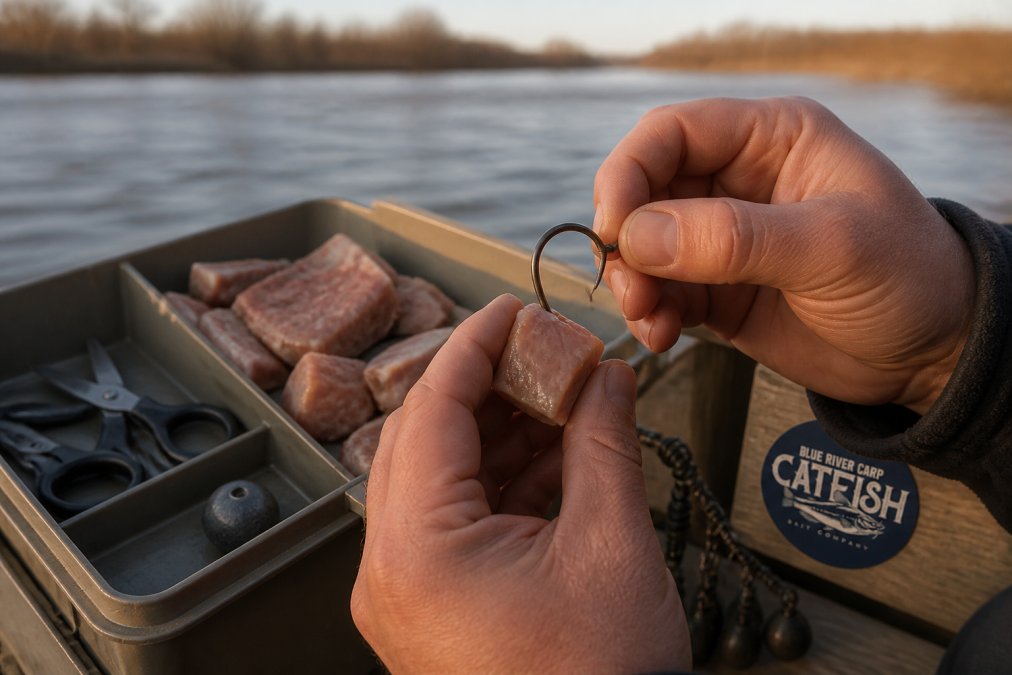
Preserved carp chunks are the top choice for deep water because they hold together under pressure. A 2" x 3" chunk threaded on a circle hook survives current, structure, and the occasional turtle, while frozen cut bait turns to mush.

Why carp chunks hold up in deep water
Carp is an oily bait, and that oil matters at depth. Scent dispersion slows in cold, deep water, so a bait that keeps releasing oil for 20 to 30 minutes gives catfish time to find it. The U.S. Fish and Wildlife Service guide to aquatic invasive species notes that Asian carp populations have expanded across major river systems, which is exactly why carp-based bait is both effective and sustainable.
2. Bait Nuggets: Pre-Cut Convenience for Deep-Water Rigs
Bait nuggets solve the preparation problem. Each nugget is roughly 1" x 2", pre-cut and ready for a hook. No knife, no cutting board, no trimming on a rocking boat.
3. Fish Attack Strips: Scent-Infused Add-Ons That Stay on the Hook
Fish Attack Strips are not a standalone bait. They are a scent delivery system you wrap onto whatever else is on your hook.

4. Chicken Liver and Natural Baits: Still Effective in Deep Water?
Chicken liver still catches catfish, but deep water exposes its weaknesses. Liver is soft, and soft bait plus current equals a bare hook.
When natural bait beats prepared bait
Use natural bait when catfish are actively feeding in shallower structure, and preserved bait for deep holes, current, or overnight soaks. The common mistake is committing to one bait type all season instead of matching bait to depth.
5. Dough and Dip Bait Recipes for Deep-Water Catfishing
Dough bait and dip bait are bottom-fishing staples, and in deep water they solve a problem cut bait cannot: continuous, slow scent release. A chunk of cut bait bleeds oil for 20 to 30 minutes, then goes quiet. A properly bound dough ball keeps leaching attractants for an hour or more, which matters when a catfish 40 feet down needs time to follow a scent gradient to your hook.
How scent actually moves in deep water
Scent dispersion in deep water is driven by current and density. Cold, high-pressure water at 30 feet and below holds dissolved compounds longer than warm surface water but moves them more slowly, so your bait must release scent steadily rather than in one burst. A dough ball that dissolves in five minutes wastes most of its attractant; one that dissolves over 45 to 60 minutes builds a scent column fish can track from downstream.
Simple dough ball recipe with wheat meal and pork meal
- 1 cup wheat meal as the base binder
- 1/2 cup cornmeal or flour to adjust stickiness
- 1/2 cup pork meat and bone meal for scent and protein
- Hot water, molasses, or creamed corn as the binding liquid
Mix the dry ingredients, add liquid slowly until the dough feels like playdough, then mold it around a treble hook or method feeder. For extra pulling power, dissolve 5 to 15 grams of L-Lysine into the liquid before mixing. L-Lysine is an amino acid that is scarce in natural water, so fish actively search for it.

Binding ratios that survive a deep drop
Most practitioners find a 2:1 ratio of wheat meal to cornmeal gives the best balance of moldability and erosion resistance. If the dough crumbles, add liquid one teaspoon at a time; if it slides off the hook in a test drop, add more wheat meal. A dough ball that holds together for 30 seconds in tap water will typically hold 45 to 60 minutes on a deep-water bottom.
10oz Package (Chunks) - Preserved →
6. Scent Oils and Attractants: Boosting Your Bait's Scent Trail
Scent oils extend how far your bait reaches. In deep water, the scent trail is your real bait; the chunk on the hook just closes the deal. But oils behave differently at depth, and the difference between a productive soak and a wasted cast often comes down to viscosity and application method.
Why scent dispersion physics matter in deep water
At 30 feet and beyond, pressure rises and temperature drops, slowing the diffusion of water-soluble compounds. Oil-based attractants behave differently: they do not dissolve but form a slick that rides current and clings to structure. That slick travels farther than a water-soluble plume, but only if the oil stays cohesive in cold water.
Matching oil viscosity to depth and current
- Shallow, slow water (under 15 feet): Thin oils and water-soluble dips work fine. Scent disperses quickly and fish are close.
- Mid-depth, moderate current (15-30 feet): Medium-viscosity oils like shad oil or blood scent hold up well. Apply directly to cut bait or nuggets.
- Deep, high-current water (30+ feet): Thick carp-based fish oil is the best choice. It resists wash-off and keeps releasing scent for 30 to 45 minutes.
A common pattern is two-stage application: a light coat before the cast for an immediate scent trail, then a heavier coat on the bait to sustain release once it reaches bottom.
Application techniques for deep-water rigs
For cut bait, pierce the chunk once with a hook, dip the whole chunk in oil, and let it drain a few seconds before casting; the oil penetrates the cut surface and releases from the inside out. For nuggets, score the surface lightly before dipping so the oil soaks in rather than sitting on top.
Sonar-assisted bait placement: the angle most anglers miss
Scent oils only work if your bait is in the right place. Use sonar to mark the depth where catfish are holding, often tight to a channel edge, submerged ledge, or brush pile, then drop your rig just upstream of that mark and let the current carry your scent trail into the strike zone.
Best Catfish Rigs for Deep Water
The right rig keeps your bait where catfish feed. For deep water, a three-way rig or fish finder rig with a heavy sinker holds bottom and lets your bait move naturally in the current. Circle hooks in the 5/0 to 8/0 range suit most chunk and nugget sizes.
Frequently Asked Questions
What is the best bait for deep water catfishing?
Cut bait made from oily fish like carp or shad is the top choice for deep water. Preserved carp chunks stay on the hook longer than frozen bait and release scent continuously. Prepared baits like dough balls and dip baits also work well when you need a bait that won't wash off in current. Match your bait size to the catfish species you're targeting, with larger chunks for blue and flathead catfish.
Do catfish feed differently in deep water?
Yes. In deep water, catfish rely more on olfactory senses than sight because light penetration drops quickly. They follow scent trails along the bottom and through the thermocline. This means oily, strong-smelling baits outperform visual lures. Channel catfish tend to feed on the bottom, while blue catfish may suspend in deep water structure. Understanding these feeding patterns helps you choose the right bait and presentation.
How do you keep bait on the hook in deep water?
Use baits that are tough and durable. Preserved carp chunks and nuggets stay on the hook far better than chicken liver or fresh cut bait. Fish Attack Strips are designed to stay securely on the hook for extended use. For dough baits, add a binder like wheat meal and wrap the bait in cheesecloth or use a bait holder hook. Larger hook sizes with wider gaps also improve hook retention.
Is cut bait better than live bait for deep water?
Cut bait can be effective in deep water because it releases a stronger scent trail that draws catfish from a distance. Live bait works well for flathead catfish, which are more predatory. But for blue and channel catfish in deep water, oily cut bait like carp chunks or shad is hard to beat. Many anglers use both, fishing cut bait on one rod and live bait on another to see what the fish prefer that day.
How deep should you fish for catfish in the summer?
In summer, catfish move to deeper, cooler water. Look for depths of 15 to 30 feet or more, especially near deep water structure like channels, ledges, and submerged timber. The thermocline, where water temperature drops sharply, often holds catfish. Use sonar to find the thermocline and baitfish schools. Early morning and late evening, catfish may move shallower to feed, so adjust your fishing depth accordingly.