
DIY River Fishing Rigs for Catfish: 4 Proven Setups
Last Updated: October 22, 2026
Quick Summary
The best diy river fishing rigs for catfish are the slip-sinker rig for all-around use, the three-way rig for heavy current and deep holes, and the Kentucky rig for moderate current with snags. Build each with 20-30 lb mainline, a barrel swivel, a 12-24 inch leader, and a 5/0 to 8/0 circle hook matched to your bait.
- Run 20-30 lb braid or 17-25 lb mono on a medium-heavy rod for river catfish.
- Use 5/0 to 6/0 circle hooks for cut bait nuggets and 7/0 to 8/0 for large chunks.
- The slip-sinker rig slides weight on the mainline so catfish feel almost no resistance.
- The three-way rig uses a 6-12 inch dropline and 2-4 oz bell sinker to hold bottom.
- Cast upstream at roughly a 45-degree angle and add 1/2 to 1 oz if line keeps paying out.
Table of Contents
- What You Need Before You Tie a Single Rig
- The Catfish Slip-Sinker Rig: Your All-Around River Setup
- The Three-Way Catfish Rig for Heavy Current and Deep Holes
- The Kentucky Rig for Catfish: Best of Both Worlds
- Picking the Right Catfish Sinker Weight for Current
- Matching Your Rig to River Location and Bait Presentation
- Cutting Snags: Breakaway Design and Bottom-Fishing Fixes
- Frequently Asked Questions
What You Need Before You Tie a Single Rig
A set of DIY river fishing rigs for catfish is only as good as its parts. Cheap swivels lose fish; wrong hook sizes miss bites.
At Blue River Carp, Inc., we build our bait around one idea: fewer variables on the water. Get your line, hooks, and weights right before you leave the truck.
Here's what most guides skip: your rig has to match the current, not just the species, a setup that works in a slow eddy will drag and snag in a fast chute.
Line, Leader, Hook, and Swivel Sizing
Most river anglers run 20-30 lb braid or 17-25 lb mono on a medium-heavy rod. Braid gives better bottom feel and cuts current.
For leaders, drop to 20-30 lb mono, or coated wire if blue cats are around. Running the same line weight top to bottom is a common mistake, fish see heavy line near the bait.
Match hook size to your bait, not the fish:
- 5/0 to 6/0 circle hooks for nugget-sized cut bait
- 7/0 to 8/0 circle hooks for large chunks and whole baitfish
- Offset circle hooks for better hooksets on flatheads
Use barrel swivels rated at or above your mainline strength, a failing swivel is the quiet reason most rigs break off.

Weights and Terminal Tackle
Moving water eats weight. Keep a range on hand:
- 1/2 to 1 oz for slow current and shallow flats
- 1 to 2 oz for moderate flow
- 2 to 4 oz for heavy current and deep holes
Carry beads to protect knots, plus egg sinkers (they slide) and bell sinkers (they anchor).
The Catfish Slip-Sinker Rig: Your All-Around River Setup
The catfish slip-sinker rig is the most versatile setup in river fishing. The weight slides freely on your mainline, so a catfish can pick up bait and move off without feeling resistance. That's why it works on channel cats, blues, and flatheads alike.
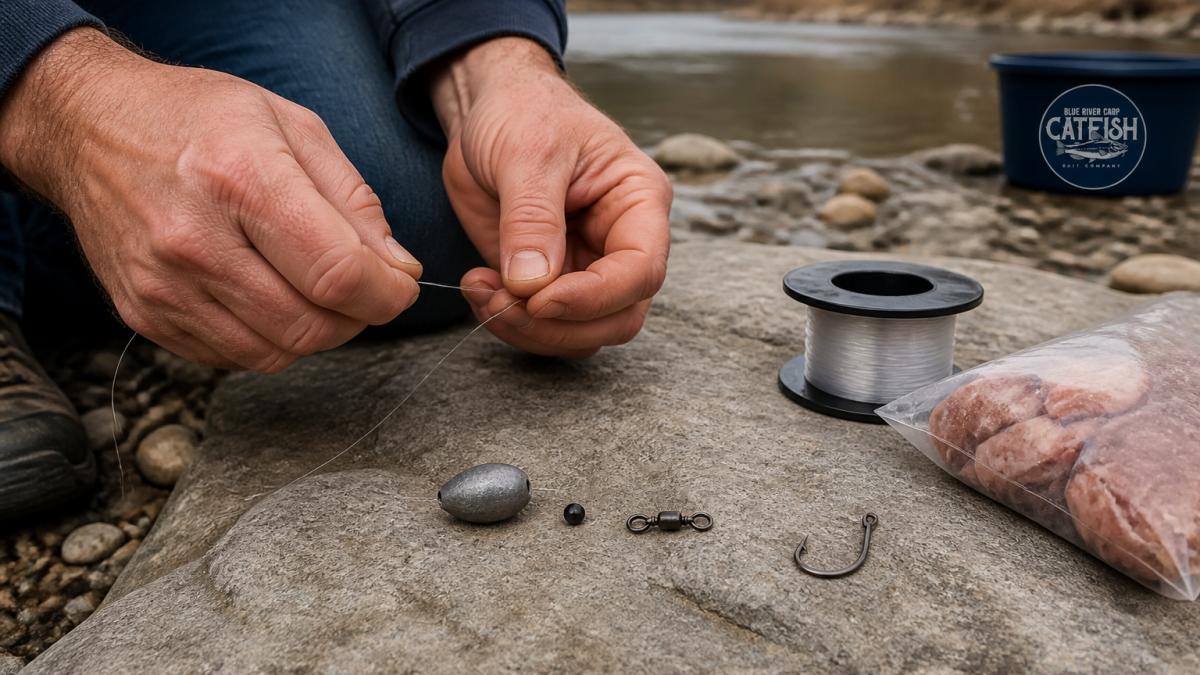
It's also the best beginner option among DIY river fishing rigs for catfish: fewer knots, parts, and tangles.
Step-by-Step Assembly
- Slide a 1/2 to 2 oz egg sinker onto your mainline.
- Add a plastic bead below the sinker.
- Tie your mainline to a barrel swivel.
- Tie an 18-24 inch leader to the other end of the swivel.
- Snell or tie your circle hook to the leader.
- Thread your bait on so the hook point stays exposed.
Expected result: the sinker rests on the bottom while your bait drifts just above it. When a catfish takes the bait, line runs through the sinker with almost no resistance.
Keep leader length short in heavy current and longer in slack water. That single adjustment fixes most slip-sinker problems.
The Three-Way Catfish Rig for Heavy Current and Deep Holes
The three-way catfish rig holds bottom when nothing else will. A three-way swivel splits your line into a dropline to the sinker and a leader to the hook, our pick for deep holes and fast chutes.
It's not a finesse rig; it's a hold-the-bottom rig, and it does that better than any slip setup.
Step-by-Step Assembly
- Tie your mainline to one eye of a three-way swivel.
- Tie a 6-12 inch dropline to the second eye.
- Attach a 2-4 oz bell sinker to the dropline.
- Tie a 12-18 inch leader to the third eye.
- Add your circle hook and bait.
Expected result: the sinker anchors while the hook rides just off the bottom. Current pushes the leader out, which gives your bait natural movement.
Shorten the dropline in snaggy cover. A shorter drop keeps the sinker tight to the swivel and reduces tangle.
The Kentucky Rig for Catfish: Best of Both Worlds
The Kentucky rig for catfish combines a sliding weight with a fixed hook leader, the slip-sinker's feel plus a dropline that keeps bait off the bottom.
Why bother? Submerged timber and grass flats eat bottom baits. The Kentucky rig lifts your bait a foot off the mess while keeping the weight down where it belongs.
10oz Catfish Cut Bait Chunks – Preserved Real Fish, 6 Scents →
It's the rig we'd pick for a river with mixed cover: rock, wood, and soft bottom in the same stretch.
Picking the Right Catfish Sinker Weight for Current
The right catfish sinker weight for current is the lightest weight that still holds bottom, but 'holds bottom' is doing a lot of work there. A 2 oz egg sinker that anchors in a 4-foot gravel run rolls like a marble through a 12-foot scour hole. Weight depends on four variables, and most anglers only think about one.
The Four Variables That Set Your Weight
- Current speed at the bottom. Surface speed is misleading, a lazy-looking chute can rip along the rocks. Drop a heavy bell sinker on a bare hook and watch how far it travels before it stops.
- Depth. Doubling depth roughly doubles drag on your line and sinker, so a weight that holds in 6 feet often drags in 12.
- Bottom composition. Sand and gravel let a sinker dig in with less weight. Flat rock and hardpan give nothing to bite, so you need more weight or a different shape. Soft mud swallows light sinkers and hides bites.
- Line diameter and angle. Braid cuts current better than mono of the same strength, and a tight line loads the sinker more than a bowed one. If you hold bottom with 30 lb braid, a friend on 20 lb mono may need an extra ounce to match.
Starting Points by Current and Depth
Use this as a first cast, then adjust within the first ten minutes:
| Current | Depth | Bottom | Starting Weight | Sinker Style |
|---|---|---|---|---|
| Slow (eddy, slack) | 3-6 ft | Mud or sand | 1/2-3/4 oz | Egg, sliding |
| Slow | 6-10 ft | Gravel | 3/4-1 oz | Egg or bell |
| Moderate | 4-8 ft | Gravel or rock | 1-2 oz | Egg, sliding |
| Moderate | 8-15 ft | Flat rock | 2-3 oz | Bell or no-roll |
| Fast | 4-10 ft | Rock or hardpan | 2-4 oz | Bell or three-way dropline |
| Fast | 10 ft+ | Deep hole | 3-5 oz | Three-way with bell |
| Fast | Any | Snaggy timber | 2-3 oz | Three-way, short dropline |
Those are starting points, not rules. A 3 oz bell that holds in a 10-foot rock run may still drag in a narrow, compressed 6-foot chute.
How to Read the Water and Adjust
Cast upstream at roughly a 45-degree angle and watch the line where it enters the water. Three outcomes:
- Line keeps paying out downstream after the sinker lands. You're underweighted. Add 1/2 to 1 oz and recast.
- Line goes taut and stays put, but you get no bites in 20-30 minutes. You may be overweighted and your bait is pinned flat. Drop a size, or lengthen your leader so the bait can lift and move.
- Line holds, then pops free and resets. Your sinker is tumbling through rock. Switch from an egg to a bell or no-roll shape, or shorten your dropline if you're on a three-way.
On bigger rivers, anglers carry 1/2, 1, 2, 3, and 4 oz in both egg and bell shapes and treat the first ten minutes of every new hole as a weight test, cheaper than losing rigs to drag all afternoon.
Shape Matters as Much as Weight
- Egg sinkers slide on the mainline and roll with current. Best in slow to moderate flow over sand, gravel, and soft bottom.
- Bell sinkers dig in and resist rolling. Best in fast water and hard bottom, and they slip through rock gaps better than a round egg of the same weight.
- No-roll and flat sinkers present a wide face to current and hold in fast chutes where round weights tumble.
If you fish the same stretch often, note what weight held in each hole at each flow level. After a season you'll know the water better than any table can tell you.
Matching Your Rig to River Location and Bait Presentation
Rig choice by river location separates consistent catfishermen from lucky ones. Fish sit in predictable places, and each place calls for a different presentation.
- Outside bends and scour holes: three-way rig, heavy weight, cut bait on the bottom
- Eddies and slack water: slip-sinker rig, light weight, bait drifting naturally
- Submerged timber and snags: Kentucky rig, bait lifted off the wood
Bait presentation matters as much as the rig. Cut bait gives off scent and stays on the hook. Live bait needs movement, so keep your leader short and let the current do the work.
This is where shelf-stable bait earns its place in the boat. Our 7oz Catfish Cut Bait Nuggets are pre-cut at about 1" x 2", so they thread on a circle hook in seconds and stay put cast after cast.
Cutting Snags: Breakaway Design and Bottom-Fishing Fixes
Snags are the tax you pay for bottom fishing. You can't avoid them entirely, but you can rig so you lose a sinker instead of your whole setup, and learn to read a snag so a 30-second setback doesn't become a 10-minute retie in the dark.
How Breakaway Design Actually Works
A breakaway rig puts a deliberately weaker link between your sinker and the rest of the rig. When the sinker wedges, that link fails first, and you keep your swivel, leader, hook, and fish.
The breakaway link must be weaker than your mainline and hook leader, but strong enough to hold bottom under normal current load. Get that window wrong and you either lose rigs to snags or lose sinkers on every cast.
Three Breakaway Options and When to Use Each
- Lighter dropline (the workhorse). On a three-way rig, run 10-15 lb mono or fluoro for the 6-12 inch dropline and 20-30 lb for the hook leader. The dropline fails before the leader or mainline, cheapest and most adjustable, retied in under a minute.
- Sacrificial sinker link. Tie the sinker to the dropline with 8-12 lb line, or use a light snap swivel rated below your mainline. When the sinker hangs, the link or snap opens and the sinker pulls free. Carry spare snaps, cheap and fast to replace.
- Paper-clip or twist-tie release. A bent light wire or plastic twist-tie attaching the sinker straightens and releases under a hard pull. Field-expedient when you're out of light line, but less predictable than a rated dropline.
A common river-regular pattern: 12 lb dropline, 25 lb leader, 30 lb braid mainline. The dropline is the fuse, the leader the armor, the mainline the anchor. Match your numbers so the fuse stays the weakest link.
Reading a Snag Before You Pull
When your rig stops, don't yank. A snag and a bite feel similar on a tight line, and a hard pull on a wedged sinker often drives it deeper.
- Give slack and wait 10-20 seconds. A catfish often moves off and the line comes free. A true snag stays put.
- Try a slow, steady lift, not a jerk. Lightly wedged sinkers roll free; locked ones trigger the breakaway link cleanly at the dropline instead of shock-loading your leader.
- Change the angle. Walk 10-15 feet upstream or downstream and pull from the new angle. Rock snags often release when the pull direction changes.
If none of that works, point the rod at the snag, tighten the drag, and pull straight back until the dropline or sacrificial link fails. You lose a sinker, not a rig.
Habits That Cut Snags Before They Happen
- Shorten your dropline in rock and timber. A 6-inch dropline keeps the sinker tight to the swivel and reduces the pendulum swing that wedges weights into gaps.
- Switch to a bell or bank sinker in heavy cover. A bell slips through rock gaps better than an egg of the same weight; a bank sinker is a good middle ground.
- Cast upstream and let the rig settle naturally. A rig that lands downstream of your target drags into cover on the settle.
When to Move Instead of Fight
Lose two rigs in the same 10-foot circle and the hole is telling you something: the cover is too dense for bottom presentation, or your weight and dropline are wrong. Move 20-30 feet, or switch to a Kentucky rig with bait lifted a foot off the mess. A rig you can fish cleanly beats one you keep donating to the river.
Frequently Asked Questions
What size sinker should you use for catfish in a river?
Match the weight to the current, not to the fish. In slow water along the bank, 1 to 2 oz usually holds bottom. A moderate channel flow calls for 2 to 4 oz, and the heavy push below a dam or in a deep hole needs 4 to 8 oz or more. The test is simple: cast, let the line settle, and watch it. If the line keeps paying out, you are underweighted. If the rod tip never relaxes, you are overweighted and the current is dragging your rig.
How do you tie a slip-sinker rig for river catfish?
Slide an egg sinker onto your mainline, add a small bead, then tie the mainline to one eye of a barrel swivel. Tie a 12 to 18 inch leader of lighter line to the other eye and finish with a circle hook. The sinker slides freely, so a biting catfish feels almost no resistance and the line runs straight through the weight. That free-sliding design is why the catfish slip-sinker rig works so well for bank fishing and drifting alike.
How do you keep a catfish rig from snagging on the bottom?
Use the lightest sinker that holds bottom, shorten your leader over rock and timber, and switch to a breakaway setup. A three-way catfish rig with a lighter dropline to the weight lets you lose the sinker instead of the whole rig when it wedges. In heavy cover, a slip-float or drift rig keeps bait off the bottom entirely. Retrieving with a steady lift instead of a hard yank also frees more rigs than it loses.
What is the best bait for river catfish rigs?
Cut bait stays on the hook through current and casts, which makes it the practical choice for bottom rigs. Firm, preserved cut bait chunks hold up better than soft fresh bait that tears off on the cast or gets picked apart by turtles. Blue River Carp's 10 oz Catfish Cut Bait Chunks are sized for bigger fish and trotlines, while the 7 oz Nuggets suit rod-and-reel setups. Match bait size to hook size so the point stays exposed.


