
Catfish Pro Alternative: Best Bait & Gear for 2026
Table of Contents
- Why Anglers Search for a Catfish Pro Alternative
- Best Bait for Channel Catfish: Shelf-Stable Options That Stay on the Hook
- Durable Catfish Rods Under $100: What to Look For
- Spinning vs Baitcasting for Catfish: Which Reel Type Wins?
- Comparing Top Catfish Pro Alternatives: Features, Pricing, and Performance
- Long-Term Durability and Maintenance: Making Your Gear Last
- Conclusion: Choosing the Right Catfish Pro Alternative for Your Fishing Style
- Frequently Asked Questions
Last Updated: September 10, 2026
Why Anglers Search for a Catfish Pro Alternative
Anglers search for a catfish pro alternative because dough and dip baits often fail to stay on the hook, dry out between trips, or require refrigeration. A shelf-stable cut bait solves those problems. This guide covers what works for channel cats, flatheads, and blues.
The "catfish pro alternative" search isn't about one brand, it's a category shift toward preserved cut bait that doesn't turn to mush after twenty minutes in the water.
Most guides treat bait as a footnote to rod and reel selection. In practice, bait decides whether a channel cat commits or drifts past your hook. Below: the bait, rods, reel choice, and maintenance habits that separate a setup lasting three seasons from one that quits in three trips.
U.S. Fish and Wildlife Service recreational fishing resources
Best Bait for Channel Catfish: Shelf-Stable Options That Stay on the Hook
The best bait for channel catfish is a preserved, pre-cut bait that holds texture in current and releases scent steadily. Channel cats feed by smell, so bait must stay intact long enough to work.
Chicken liver is the classic, but it's messy and flies off on a hard cast. Frozen cut shad thaws into paste in a warm tackle box by mid-afternoon.
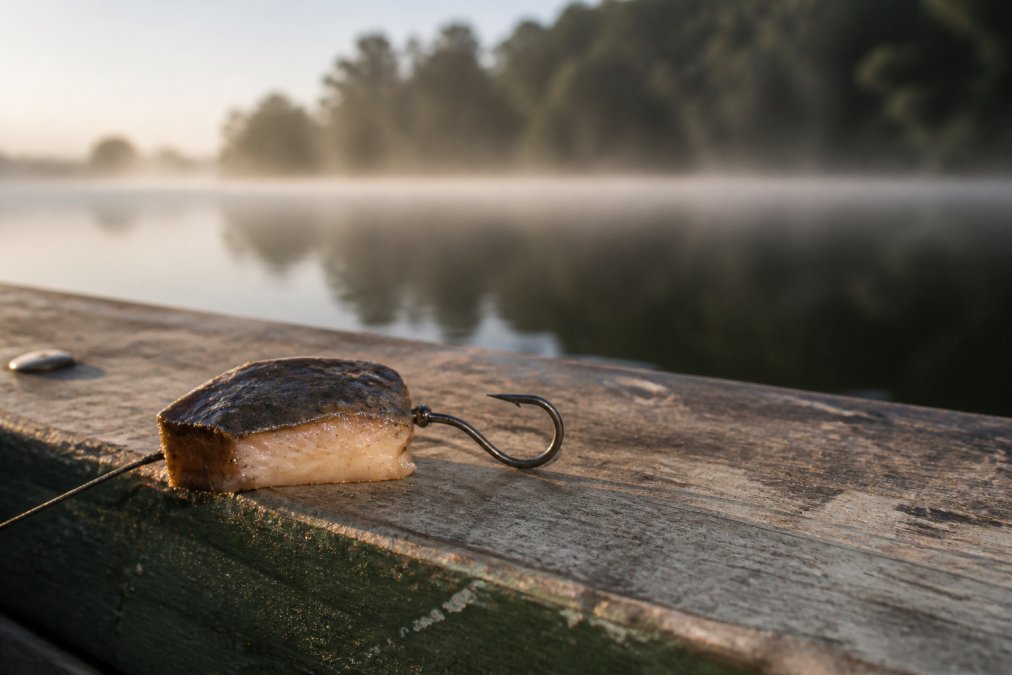
Preserved cut bait made from invasive carp takes a different approach: pre-cut, scent-infused meat sealed in a resealable bag. Blue River Carp, Inc. sells a 10oz package of chunks cut roughly 2" x 3" for bigger fish, and a 7oz package of nuggets at about 1" x 2" for everyday rigs. Both run $10.00 and need no cooler.

Durable Catfish Rods Under $100: What to Look For
A durable catfish rod under $100 needs a strong backbone, a sensitive tip, and corrosion-resistant guides. Skip cosmetics and put your money into the blank, the rod is the cheapest place to lose a hooked fish.
The four specs that actually decide the rod
Power and action. Power is how much force it takes to bend the blank; action is where it bends. For channel cats, medium-heavy power with fast or moderate-fast action is the sweet spot, enough backbone to drive a 4/0 circle hook home, enough tip to show a soft mouth. For flatheads and blues, step up to heavy power with moderate action.
Lure and sinker weight rating. Most budget shoppers ignore this. A rod rated 1-4 oz fishes a 2 oz no-roll sinker in current but feels overloaded throwing a 4 oz bank sinker plus a 2" x 3" chunk. Match the rating to total cast weight, not just the sinker.
Line rating. Rods are rated for a mono range (10-20 lb, 15-30 lb). Braid has no stretch, so a rod rated to 20 lb mono usually handles 30-50 lb braid of equivalent diameter, but guides and drag washers take the extra load. Running 50 lb braid for flatheads? Choose a rod rated at the top of its mono range.
Guide material and frame. Stainless frames with smooth inserts (aluminum oxide at the budget end, silicon carbide higher up) resist grooving from braid. A grooved guide shreds braid and causes wind knots. Run a cotton swab inside each guide before buying, if it snags, walk away.
River current vs. still water: the same rod is not the answer
- River current. You need a stiffer tip to feel a take through moving water and heavier power to hold bottom with 2-4 oz of lead. A 7'6" to 8' medium-heavy rod rated 1-4 oz is the common river setup for channels; longer than 8' becomes a liability in tight timber.
- Still water and lakes. Drop to medium power with a softer tip since you're not fighting current. A 7' to 7'6" medium rod rated 1/2-2 oz casts a 1 oz slip-sinker rig farther and telegraphs a channel cat's tap better than a heavy river stick.
- Bank fishing for flatheads. A 9' heavy rod rated 3-8 oz gives leverage to turn fish away from cover and length to cast a big chunk past the drop-off. The trade-off is weight, most flathead anglers fish it from a holder, not in hand.
Weight-to-power math worth doing before you buy
A rod's usable drag ceiling ties to its line rating; its casting ceiling ties to its lure rating. Running 20 lb drag? You need a rod rated for at least 20 lb line and a power rating that won't bottom out, a medium rod rated 8-17 lb will fold before that drag is tested. Match line rating to reel max drag, then lure rating to sinker plus bait weight.
What to check before buying:
- Backbone: Medium-heavy or heavy power for flatheads and blues; medium for channel cats in still water.
- Action: Fast or moderate-fast for channels; moderate for big fish in cover.
- Guides: Stainless frames, smooth inserts, no grooves.
- Handle: Cork or EVA grips hold up better than foam in wet conditions.
- Length: 7 to 9 feet depending on whether you cast from a bank, a boat, or a tight river bend.
- Line rating: At least equal to the drag you plan to run.
The most common mistake is buying a rod far heavier than your target species, it feels dead on a two-pound channel cat and tires you out. The second is buying one rated lighter than the braid and drag you fish, making the rod the weak link instead of the reel. coffee for fishing trips.
Spinning vs Baitcasting for Catfish: Which Reel Type Wins?
Spinning reels win for most catfish anglers: they cast light baits farther with less backlash risk. Baitcasters win for heavy weights and precise control. The answer depends on three specs, drag, gear ratio, and line capacity, plus how much maintenance you'll do.
Drag: the number that decides whether you land the fish
Drag is the force the reel applies before line peels off. Measured in pounds, it's the most important reel spec for catfish because they pull hard and run long.
- Front drag (spinning). Washers sit at the top of the spool. Smooth, easy to adjust mid-fight, typically rated 10-20 lb on $50-$100 spinning reels. Carbon-fiber washers handle heat better than felt and stay consistent across a long run.
- Star drag (baitcasting). Washers sit under the handle, adjusted with a star wheel, fast but less precise than a front drag. Budget baitcasters top out around 15-20 lb.
- Bait clicker. Not a drag setting, a switch that lets line pay out under light tension while the spool is disengaged. Standard flathead setup: rod in a holder, clicker on, spool loosened, listen for the run. Spinning reels rarely have a true clicker, the biggest reason flathead anglers choose baitcasters.
A practical rule: match the reel's max drag to the rod's line rating and to the leader you tie. If you run 20 lb drag on 15 lb leader, the leader breaks before the drag ever works.
Gear ratio: torque vs. speed
Gear ratio is spool turns per handle turn. A 5.0:1 reel retrieves slowly with more torque; a 7.0:1 retrieves fast but pulls less hard. For catfish, torque beats speed: 5.0:1-6.0:1 baitcaster or 4.7:1-5.2:1 spinning reel is the range for soaking bait on bottom. High-ratio reels are for lures, not winching a 30 lb blue out of a snag.
Line capacity and braid compatibility
Line capacity is listed as mono yardage at a given test (e.g., 150 yards of 12 lb mono). Braid is thinner, so that same reel holds far more 30 lb braid, often 200+ yards. That matters because a big cat can take 50-100 yards on a run.
Two braid-specific cautions:
- Spool fill. Overfilling a spinning spool causes wind knots; underfilling costs casting distance. Fill to about 1/8 inch below the lip.
- Drag strain. Braid has no stretch, so it transfers more shock to the drag washers and guides. Carbon-fiber drag washers and smooth guides matter more with braid than with mono.
Maintenance: the gap most reel guides skip
A budget reel that gets rinsed and re-lubed outlasts an expensive reel that doesn't. The routine is short:
- After every trip. Rinse with fresh water (not a hard spray, you're flushing grit, not pressure-washing bearings). Dry with a cloth. Back off the drag so washers aren't compressed in storage.
- Once a season. Remove the spool, wipe old grease from the main gear, re-apply light reel grease, and add a drop of oil to the handle knob and spool bearings. Don't over-grease, excess traps grit.
- Drag washers. Jerky or sticking drag means glazed or contaminated washers. Carbon-fiber washers can often be wiped clean and reused; felt washers should be replaced.
- Line. Strip and re-spool mono at least once a season, more often in sun. Braid lasts longer but should be inspected for fraying near the knot and the last 10 feet.
Brass gears and quality ball bearings are the internals that decide how a reel feels after three seasons. Budget reels often cut corners here, which is why a mid-priced reel with brass gearing outlasts a cheaper one with plastic internals.
| Reel Type | Best For | Drag System | Typical Drag Range | Gear Ratio Range | Handle Type |
|---|---|---|---|---|---|
| Spinning | Beginners, light baits, still water | Front drag, carbon fiber | 10-20 lb | 4.7:1-5.2:1 | Standard |
| Baitcasting | Heavy loads, flatheads, river current | Star drag, bait clicker | 15-20 lb | 5.0:1-6.0:1 | Power handle |
American Sportfishing Association angler resources
Comparing Top Catfish Pro Alternatives: Features, Pricing, and Performance
For many anglers, preserved cut bait from Blue River Carp, Inc. is a strong alternative: it stays on the hook, needs no refrigeration, and holds a 12+ month shelf life. Here's how the options stack up by use case.
Blue River Carp, Inc. (Top Pick)
Our veteran-owned, Indiana-made bait is cut from invasive Asian carp, turning an ecological problem into a practical advantage. Scent is infused into the meat, so it keeps working after a long soak. No cooler or freezer needed, leave a bag in the truck and fish on impulse. Pieces stay firm on the hook instead of sliding off on the cast.
It's preserved cut bait, not a dough or dip, so paste-style anglers must adjust their rigging. Chunks are sized for bigger fish, so trim them for small hooks.
- 10oz Package (Chunks) - $10.00, cut about 2" x 3", built for trophy-class fish
- 7oz Package (Nuggets) - $10.00, cut about 1" x 2", ready for rod and reel, limb line, or trotline
- Best 3 Bundles - $25.50 for three scent varieties (Blood, Garlic, Shad)
- Fish Attack Strips - $6.00, cut-to-shape strips that add scent to any lure
| Product | Size | Price | Best For |
|---|---|---|---|
| 10oz Chunks | 2" x 3" pieces | $10.00 | Big blue and flathead catfish |
| 7oz Nuggets | 1" x 2" pieces | $10.00 | Everyday channel cat rigs |
| Best 3 Nugget Bundle | 3 x 7oz | $25.50 | Testing scents |
| Best 3 Chunk Bundle | 3 x 10oz | $25.50 | Serious multi-trip anglers |
| Fish Attack Strips | strips | $6.00 | Adding scent to lures |
U.S. Geological Survey invasive carp research

Long-Term Durability and Maintenance: Making Your Gear Last
Gear that lasts is gear that gets rinsed. Salt, grit, and dried bait residue destroy reels faster than any big fish. A two-minute rinse after every trip extends reel life by years.
Plan for braid compatibility. Braid has no stretch, improving hook sets at distance but straining guides and drag washers. Check line capacity before spooling, and don't overfill, a leading cause of wind knots.
Maintenance habits that pay off:
- Rinse reels with fresh water and dry them before storage
- Re-lubricate drag washers and bearings at least once a season
- Inspect guides for nicks that fray braided line
- Store preserved bait sealed and out of direct sun
- Replace monofilament leaders more often than main line
Brass gears and quality ball bearings are the internals that decide how a reel feels after three seasons. Budget reels often cut corners here, which is why a mid-priced reel with brass gearing outlasts a cheaper one with plastic internals.
American Sportfishing Association angler resources
Conclusion: Choosing the Right Catfish Pro Alternative for Your Fishing Style
The right catfish pro alternative depends on how you fish, not what costs the most. Beginners or occasional anglers: a spinning setup with preserved nuggets covers nearly every channel cat situation. Flathead hunters on bottom rigs: a baitcaster with a clicker and larger chunks is the better match.
Blue River Carp, Inc. makes that decision easier with shelf-stable cut bait that needs no cooler, no freezer, and no last-minute tackle shop run. The 12+ month shelf life, resealable packaging, and multiple scent options mean you're ready whenever the water calls. Get started with Blue River Carp, Inc. and keep your bait fresh, firm, and on the hook.
Frequently Asked Questions
Are Catfish Pro rods any good compared to budget alternatives?
Catfish Pro rods are known for their durability and specialized features, but budget alternatives under $100 can perform well for casual anglers. Look for rods with graphite or fiberglass blanks, stainless steel guides, and a power rating suitable for catfish. Many affordable rods offer similar backbone and sensitivity, making them a solid catfish pro alternative if you're not fishing tournaments. Always check user reviews for real-world feedback.
What is the best catfish reel for the money?
For the money, spinning reels are often the best choice for catfish, especially for beginners. They are easy to use, handle heavy lines well, and offer smooth drag systems. Look for a reel with a max drag of at least 15 pounds, corrosion-resistant ball bearings, and a gear ratio around 5.2:1 for power. Baitcasting reels can work but require more skill to avoid backlash. A quality spinning reel under $60 is a reliable catfish pro alternative.
Does Catfish Pro bait work as well as shelf-stable alternatives?
Catfish Pro bait has a loyal following, but shelf-stable alternatives like Blue River Carp's preserved cut bait offer added convenience. They require no refrigeration, last 12+ months, and stay on the hook without getting mushy. Many anglers report success with these baits for channel catfish and blues. The key is matching the bait to your target species and water conditions.
How do budget catfish combos compare to professional gear?
Budget combos under $100 can handle most catfish situations, but professional gear offers better components like brass gears, carbon fiber drags, and higher line capacity. For occasional anglers, a budget combo is a practical catfish pro alternative. If you fish often or target trophy fish, investing in a mid-range rod and reel will pay off in durability and performance. Start with a combo and upgrade as needed.