
Carp Bait vs Shad Bait for Catfish: What Works
Table of Contents
- Carp Bait vs Shad Bait for Catfish: Quick Comparison
- Fresh vs Frozen Bait: What Actually Reaches the Hook
- Gizzard Shad and Skipjack Herring: Availability and Catch Effort
- The Best Bait for River Fishing: Matching Bait to Moving Water
- Scent-Infused Carp Bait Benefits: Scent Profiles, Oils, and Attractants
- How to Hook Cut Bait for Catfish: Rigging by Bait Texture
- Blue Catfish vs Channel Catfish: Does Bait Choice Change?
- Storage, Cost, and Legal Considerations
- Frequently Asked Questions
Last Updated: September 27, 2026
Carp Bait vs Shad Bait for Catfish: Quick Comparison
The short answer: shad wins on fresh-caught scent, carp bait wins on durability and convenience. For most anglers fishing a few hours at a time, carp bait vs shad bait for catfish comes down to one question: do you want to manage spoilage, or do you want bait that's ready when you are?

Shad is the traditional favorite. It's oily, bloody, and catfish find it fast.
| Factor | Carp Bait | Shad Bait |
|---|---|---|
| Scent strength | Moderate to strong (scent-infused) | Very strong when fresh |
| Hook retention | High | Low when thawed |
| Storage | Shelf-stable, 12+ months | Freezer required |
| Availability | Store-bought, consistent | Seasonal, catch or buy |
| Best for | Bank fishing, long soaks | Fresh-water scent trails |
Fresh vs Frozen Bait: What Actually Reaches the Hook
Fresh bait almost always out-fishes frozen, but only for the first 20 minutes. After that, the advantage flips.
Gizzard Shad and Skipjack Herring: Availability and Catch Effort
Availability is the hidden cost of shad fishing. Gizzard shad and skipjack herring are seasonal and location-dependent.
| Bait Source | Effort to Obtain | Seasonal? | Shelf Life |
|---|---|---|---|
| Fresh gizzard shad | High (cast net) | Yes | Hours |
| Frozen shad | Low (buy) | Limited | Months in freezer |
| Skipjack herring | High | Yes | Hours |
| Preserved carp bait | None (buy) | No | 12+ months |
The Best Bait for River Fishing: Matching Bait to Moving Water
The best bait for river fishing is one that survives current. Moving water strips soft bait off a hook fast, so toughness beats tenderness in a river.
Scent-Infused Carp Bait Benefits: Scent Profiles, Oils, and Attractants
Scent-infused carp bait benefits come down to consistency. A preserved, scented bait releases the same scent profile every trip, in every water temperature.
How to Hook Cut Bait for Catfish: Rigging by Bait Texture
Learning how to hook cut bait for catfish starts with texture, not species. A thawed shad chunk and a cured carp chunk can be the same size and still demand opposite hooking approaches, because one is held together by cell structure and the other by a cure. Get the texture-to-rig match wrong and you will either sling bait off on the cast or feed a slow current until your hook is bare.
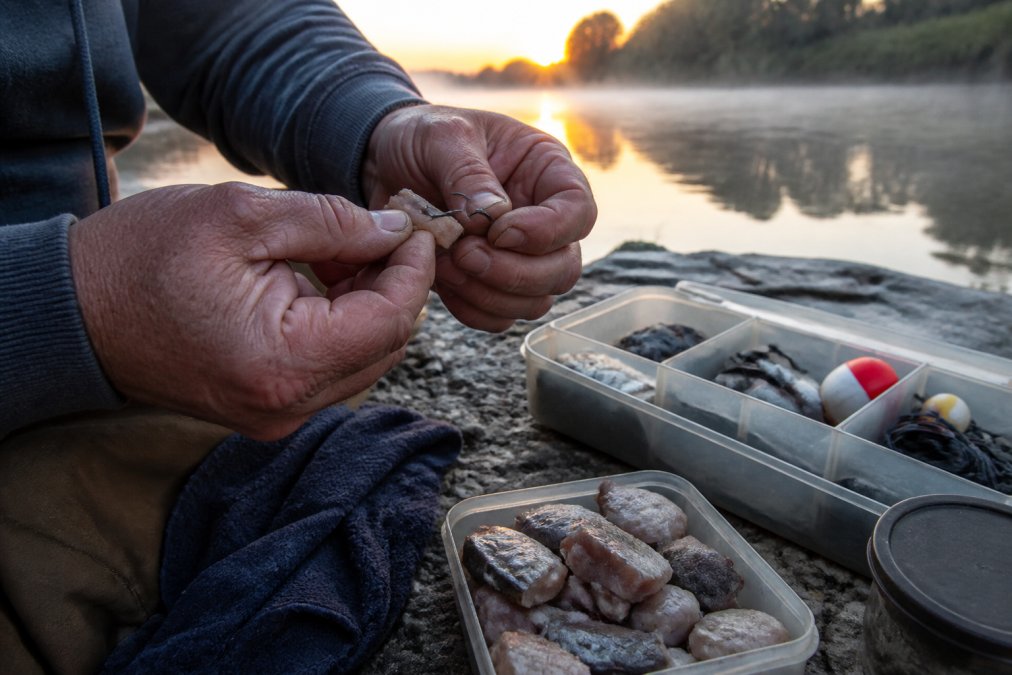
The two failure modes to rig against are:
- Blow-off: the bait leaves the hook during the cast, usually because the hook point tore through soft tissue under centrifugal force.
- Steal-off: the bait stays on the hook but a catfish or a bait-stealing panfish strips it without taking the hook, usually because the hook point was buried inside soft flesh instead of exposed.
- Soft, thawed shad (mushy, tears under light pressure): Use a bait threader or wrap the chunk in elastic bait mesh, then hook through the mesh. The mesh becomes the structural support the thawed flesh lost. Without it, expect a blow-off on any cast past a gentle lob. A 5/0 to 7/0 circle hook works for palm-sized chunks; go larger only if the mesh holds.
- Firm shad (fresh, still rigored): Hook once through the tough dorsal shoulder, not the belly. The dorsal muscle band is the last part of a shad to break down, so it survives both the cast and the soak. Belly meat tears on the cast and is the first thing a catfish strips.
- Preserved chunks (roughly 2" x 3"): Run the hook through the thickest section once, then rotate the hook so the point sits proud of the flesh. The cure keeps the chunk firm enough that a single pass holds, and the exposed point converts a pick-up into a hookset. This is the rigging pattern that makes preserved carp bait castable at distance.
- Preserved nuggets (roughly 1" x 2"): Thread onto a circle hook so the point clears the bait entirely. Nuggets are small enough that a buried point will not rotate into the jaw corner, which is how circle hooks are designed to work. If the point is inside the nugget, you have turned a circle hook into a J-hook with worse geometry.
- Ground or chum mixes: Pack around a hook inside a bait cage, or load into a method feeder. There is no solid piece to hook, so the rig itself has to hold the bait. This is a scent-delivery tactic, not a hook-retention tactic, do not expect it to survive a hard cast.
Blue Catfish vs Channel Catfish: Does Bait Choice Change?
Bait choice shifts between blue catfish and channel catfish, but less than most anglers assume. Both are scent-driven bottom feeders.

Storage, Cost, and Legal Considerations
Storage by bait type
- Fresh shad: Hours of usable life on ice. A cooler with block ice buys you a day; a bag of cube ice buys you an afternoon.
- Frozen shad: Months in a freezer at 0°F or below, but quality degrades each freeze-thaw cycle. Refreezing thawed shad is the fastest way to turn a firm chunk into paste.
- Preserved carp bait: Shelf-stable for 12+ months at room temperature. No cooler, no freezer, no ice runs.
Cost-benefit: DIY vs. store-bought
| Bait Type | Upfront Cost | Time to Obtain | Storage Need | Waste Risk |
|---|---|---|---|---|
| Fresh shad (DIY) | Low cash, high time | 1-3 hours per trip | Cooler/ice | High |
| Frozen shad (retail) | Low | Minutes | Freezer | Medium |
| Preserved carp bait | Higher per bag | Minutes | None | Low |
Legal and environmental considerations
- Live bait transport: Most state wildlife agencies restrict moving live bait, including baitfish, between bodies of water to slow the spread of aquatic invasive species and disease. The general pattern is that bait caught in one waterbody cannot legally be transported to another, and in some states cannot be transported away from the water at all. Rules vary widely by state, so check your state agency's current regulations before you fill a bait bucket.
- Invasive carp as bait: Asian carp (bighead, silver, grass, and black) are classified as injurious or invasive in many states, and several states prohibit possessing them alive or using them as live bait. Using them as cut or preserved bait is a different question and is permitted in many jurisdictions, but the rules are not uniform. Some states require that invasive carp be killed immediately upon capture; others allow use as cut bait in the water where they were caught.
- The upside: Where it is legal, using invasive carp as cut bait is a rare case where a fishing tactic and a conservation goal point the same direction. Removing invasive carp from a river system and turning them into bait is a net positive for native fish.
Preserved carp bait sidesteps most of the legal friction entirely: it is not alive, it is not being transported as a live organism, and it does not carry the same invasive-species transport risk as a bucket of live baitfish. For anglers who fish multiple waters in a season, that alone can be the deciding factor.
Frequently Asked Questions
What is the number one best bait for catfish?
There is no universal number one, but shad and carp both rank at the top for different reasons. Fresh gizzard shad or skipjack herring carry strong natural scent and oils that blue catfish key on, while preserved carp bait holds its shape and scent on the hook far longer. The best choice depends on whether you are fishing moving river water, how often you fish, and whether you can keep bait fresh. Many anglers carry both and switch based on conditions.
Do catfish like carp as bait?
Yes. Catfish feed heavily on carp, especially in river systems where Asian carp are abundant. Carp flesh is oily, tough, and releases a strong scent trail that triggers catfish olfactory senses. Blue catfish, channel catfish, flathead, and bullhead all take carp cut bait. Preserved carp bait keeps that scent profile intact without refrigeration, which makes it practical for anglers who fish on short notice or store bait in a tackle box.
Is shad good bait for catfish?
Shad is one of the best natural baits for catfish when it is fresh. Gizzard shad and skipjack herring are oily, soft, and loaded with scent that disperses quickly in current. The trade-off is freshness: shad breaks down fast, turns mushy, and falls off the hook after a few casts. Frozen shad loses some texture and scent. Shad works best when you catch it yourself and fish it the same day.
Does carp bait stay on the hook better than shad?
Preserved carp bait stays on the hook noticeably longer than shad. Carp flesh is denser and tougher, and preservation firms up the texture so chunks and nuggets hold their shape through casts and current. Shad, especially thawed or aged shad, tears apart easily and needs re-baiting often. For anglers fishing rocky banks, strong current, or long soak times, carp bait means fewer re-baits and more time with bait in the water.
What are the benefits of using scent-infused cut bait?
Scent-infused cut bait combines real fish flesh with added attractants like blood, garlic, or shad oil. Catfish hunt primarily by smell, so a bait that keeps releasing scent in the water draws fish from farther away. Infused bait also masks human scent and stays effective longer than plain flesh. The practical benefit is a steady scent trail that keeps working while the bait sits on the hook, even in slow current or still water.