

How to Use a Cast Net for Shad: Complete Guide
Table of Contents
- Choosing the Best Cast Net Size for Shad
- How to Throw a Cast Net for Beginners
- How to Use a Cast Net for Shad: Locating Schools
- Legal Cast Net Regulations and Bait Limits
- Bank and Boat Strategies for Netting Shad
- Post-Catch Bait Care and Net Maintenance
- Conclusion
- Frequently Asked Questions
Last Updated: September 29, 2026
Choosing the Best Cast Net Size for Shad
The best cast net size for shad balances mesh opening, net radius, and weight. A 3/8-inch mesh suits most threadfin shad, while gizzard shad often need 1/2-inch mesh to prevent gilling. Getting this wrong is the single most common reason anglers catch nothing.
This guide from Blue River Carp, Inc. covers how to use a cast net for shad from the first throw to the last baitfish in the livewell.
Mesh Size: Matching the Net to Your Bait
Mesh size decides which shad you keep and which swim away. It also decides whether your bait survives the trip.
- 1/4-inch mesh: Tiny threadfin shad, but heavy and slow to sink
- 3/8-inch mesh: The all-around pick for mixed shad
- 1/2-inch mesh: Gizzard shad and larger threadfin
- 5/8-inch and up: Too coarse for most shad; bait escapes
Net Radius and Weight for Bank vs. Boat
Radius controls coverage. Weight controls sink speed. Match both to where you fish.
| Setting | Net Radius | Weight | Why |
|---|---|---|---|
| Bank, shallow | 4-6 ft | 1-1.5 lb per ft | Easy to throw, sinks fast in skinny water |
| Boat, open water | 6-8 ft | 1.5 lb per ft | Bigger circle over deeper schools |
| Tight cover | 4-5 ft | 1-1.5 lb per ft | Fewer snags, more control |
How to Throw a Cast Net for Beginners
Learning how to throw a cast net for beginners comes down to three moves: the load, the turn, and the release. Nail those and the net opens into a full circle almost every time.
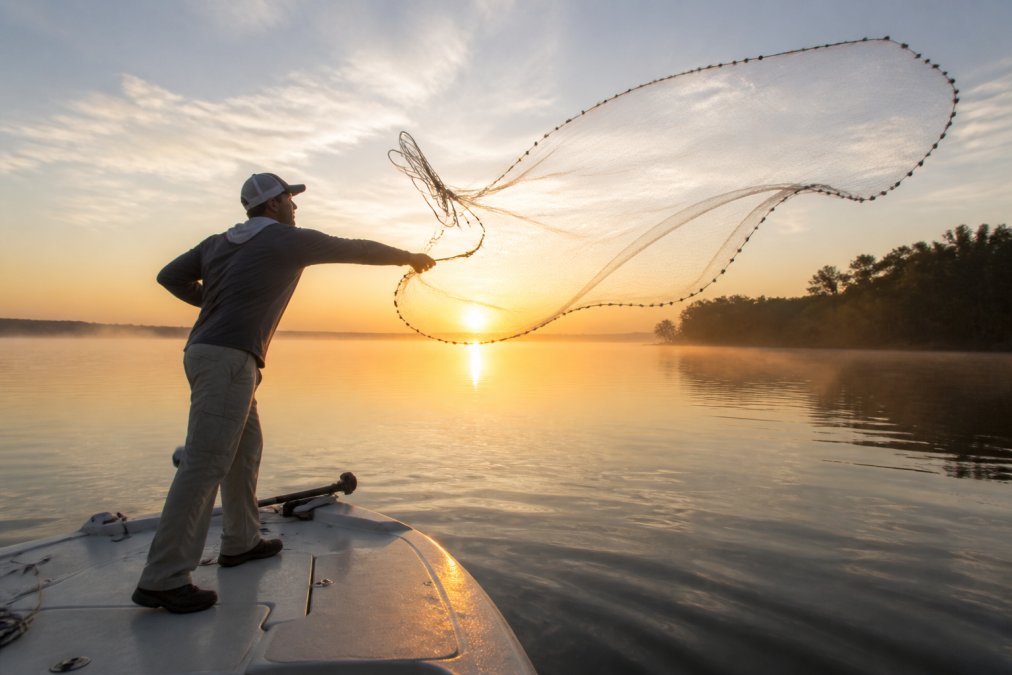
The Load, the Turn, and the Release
The load gathers the net. Coil the brail lines, grab the horn with your non-throwing hand, and let the lead line drape over your wrist strap. Keep the coils even.
Fixing Tangles and Bad Spreads
Tangled nets almost always trace back to sloppy loading. Check these first:
- Coils uneven or crossed over each other
- Lead line snagged on the wrist strap
- Net stored wet and clumped
- Throwing into wind without adjusting your angle
How to Use a Cast Net for Shad: Locating Schools
Finding shad matters more than throwing skill. A perfect throw into empty water catches nothing.
Reading Surface Activity and Water Depth
Surface activity is your fastest clue. Shad ripple the top when predators push them up. Watch for:
- Small dimples that move as a group
- Bait spraying out of the water
- Birds working a tight area
- A darker patch under the surface
Gizzard Shad vs. Threadfin Shad
Gizzard shad grow larger and fight harder. They have a distinct dark spot behind the gill and a longer, deeper body. They tolerate cold water better.
Legal Cast Net Regulations and Bait Limits
Cast net rules vary by state, and bait limits apply to shad in many places. The problem is that most guides stop at "check your local rules" and never explain how. Here's the actual process.
How to Check Your State's Rules in Under 10 Minutes
Every state fish and wildlife agency publishes its fishing regulations online, usually as a downloadable PDF updated annually. The fastest path:
- Search your state agency's name plus "fishing regulations PDF", most publish a single annual digest.
- Jump to the section titled "Bait," "Baitfish," or "Nongame Fish", cast net rules usually live there, not under "Sportfish."
- Look for four specific numbers: maximum cast net radius or diameter, minimum or maximum mesh size, daily baitfish possession limit, and whether a separate bait-collection permit is required.
- Check the "Special Regulations" or "Exceptions" section for your specific waterbody, many reservoirs and tailwaters have tighter rules than the statewide default.
What the Rules Typically Cover
Common restrictions fall into a few buckets:
- Net dimensions: Some states cap cast net radius (commonly 4 to 8 feet) or mesh size. A net legal in one state may be illegal across the line.
- Daily baitfish limits: Possession limits on shad are common and often measured in gallons or by count. Some states limit how many baitfish you can hold at once, not just how many you can take per day.
- Waterbody restrictions: Trout waters, designated trophy waters, and some tailwaters often prohibit cast netting entirely.
- License requirements: A standard fishing license usually covers bait collection, but some states require an add-on or a separate permit.
- Species rules: In a few states, gizzard shad are classified differently from threadfin, and one may be legal bait while the other is not.
Why This Matters More Than You Think
Game wardens enforce bait rules actively, especially on popular catfish and striper waters where shad netting is common. A citation for an oversized net or an over-limit bait bucket is avoidable and expensive. Buying a legal net is cheaper than paying the fine.
Bank and Boat Strategies for Netting Shad
Where you stand changes how you throw. Bank anglers work a fixed spot; boat anglers chase the school.
Throwing From the Bank
Bank fishing limits your angle. You can only cast where the water allows. Focus on:
- Points and drop-offs you can reach
- Creek mouths after rain
- Areas with visible surface activity
- Shallow flats at dawn
Boat Positioning and Sonar
A fish finder changes everything. Idle over the school, stop upwind, and let the boat drift onto it. Then throw.
- Mark the school on sonar first
- Position so the wind pushes you over the bait
- Throw ahead of the drift, not behind it
- Keep the motor off while netting
Post-Catch Bait Care and Net Maintenance
Shad die fast without care, and the reason is physiological. Threadfin and gizzard shad are scale-shedding, stress-sensitive fish with high oxygen demands. Every step from the net to the hook either extends their life or ends it. Maintaining the integrity of these fragile baitfish requires not only careful handling techniques but also the use of high-quality professional fishing tackle that minimizes unnecessary trauma during the transfer process.
Why Shad Die So Fast
Shad lose scales easily when handled, and scale loss opens them to infection and osmotic stress. They also produce heavy ammonia waste relative to their body size, which fouls tank water quickly. Add warm surface temperatures and crowding, and dissolved oxygen crashes within minutes. The fix is not one thing, it's a chain of small decisions.
The Livewell-to-Hook Chain
At the net: Don't dump the whole net into a bucket. Shake shad gently into a soft-mesh dip net or directly into your bait tank. Rough handling is the number-one killer.
Holding Shad Overnight
If you want bait for a morning trip, a round or oval tank beats a square one, shad swim continuously and bash themselves against corners. Insulate the tank, keep it out of the sun, and run the aerator all night. Expect some mortality; plan for 20 to 30 percent loss on overnight holds even with good care.
Net Maintenance
Net care is simple but non-negotiable:
- Rinse with fresh water after every trip to remove salt, slime, and debris
- Dry fully before storing, trapped moisture breaks down monofilament and grows mildew
- Hang, don't fold, to protect the mesh and prevent memory creases
- Inspect the lead line and swivel for wear; a failing swivel causes the net to collapse mid-throw
Monofilament nets dry faster and resist rot. Braided line nets are tougher but hold water longer and need more drying time.
Conclusion
Finding and keeping shad takes the right net, a clean throw, and fast bait care. Get the mesh and radius right, learn the load-turn-release, and your bait bucket fills itself.
Frequently Asked Questions
What is the best size cast net for catching shad?
A 4-foot to 6-foot radius net with 1/4-inch mesh handles most shad. Threadfin shad are smaller and slip through 3/8-inch mesh, so 1/4-inch or 3/16-inch works better for them. Gizzard shad run larger and a 3/8-inch mesh holds them fine. Match the mesh to the shad size in your water, and pick the radius based on whether you throw from the bank or a boat.
Why is cast netting illegal in some areas?
States restrict cast netting to protect game fish and manage bait harvest. Some waters ban nets entirely, others limit mesh size, season, or daily bait limits. Shad are usually legal bait, but you still need a valid fishing license and must follow the specific rules for that lake or river. Check your state wildlife agency's regulations before you throw.
How do you throw a cast net without getting tangled?
Coil the hand line cleanly, grip the net at the brail lines, and load the lead line over your shoulder or arm in even loops. Uneven coils cause tangles. Open the net with a smooth turn and release, not a hard snap. Practice on grass before you try it over water, and inspect the net for snags after every throw.
What time of day do shad bite or school best?
Shad feed most actively at dawn and dusk, when they push toward the surface chasing plankton. Low-light periods make schools easier to spot by surface activity and ripples. Midday they often drop deeper, so you'll need a fish finder to locate them. Early morning is usually the most productive window for cast netting shad.